


Benetton have become the prototypical “tough place to go” in this league.
These aren’t places you dread going to – they’d be a level below that – but they have that aura that says “anything could happen here” because, in years gone by, plenty happened, some of it good, a lot of it bad.
I’ll list them, for completeness’ sake.
The Arms Park.
Ellis Park.
Scotstoun.
Stadio di Monigo.
This game will be no different. Benetton have talent, size and growing control over their brand of counter-transition rugby – heavy counter-transition.
Both sides come into this early season game with wins in the back pocket, albeit with Benetton picking up by far the more dramatic of the two victories. They went to one of the other Tough Places To Go against Cardiff and somehow came away with a last-gasp two-point win after going 16 points down at one stage in the first half.
They didn’t play well in that game – certainly not to the high level they’re capable of – but it didn’t matter. They gutted it out to the death and got the reward. That’s what we’ve come to expect from Benetton in the last few years and it’s what we should expect this Sunday. At the Stadio di Monigo, they are far from unbeatable but they play in large bursts of momentum that, when they really get going, can see you concede two or three scores before you’ve even got into the game.
That’s the challenge for Munster this Sunday; deny them momentum and build some of our own.
Munster Rugby: 15. Shane Daly, 14. Shay McCarthy, 13. Antoine Frisch, 12. Rory Scannell, 11. Calvin Nash, 10. Joey Carbery, 9. Ethan Coughlan; 8. Gavin Coombes, 7. John Hodnett, 6. Jack O’Donoghue, 5. Fineen Wycherley, 4. Edwin Edogbo, 3. Stephen Archer, 2. Diarmuid Barron, 1. Josh Wycherley
Replacements: 16. Scott Buckley, 17. Kieran Ryan, 18. John Ryan, 19. Tom Ahern, 20. Alex Kendellen, 21. Paddy Patterson, 22. Alex Nankivell, 23. Sean O’Brien
Benetton Rugby: 15. Rhyno Smith, 14. Ignacio Mendy, 13. Malakai Fekitoa, 12. Filippo Drago, 11. Edoardo Padovani, 10. Jacob Umaga, 9. Andy Uren; 8. Toa Halafihi, 7. Manuel Zuliani, 6. Alessandro Izekor, 5. Eli Snyman, 4. Edoardo Iachizzi, 3. Giosué Zilocchi, 2. Gianmarco Lucchesi, 1. Mirco Spagnolo
Replacements: 16. Giacomo Nicotera, 17. Federico Zani, 18. Tiziano Pasquali, 19. Gideon Koegelenberg, 20. Henry Time-Stowers, 21. Alessandro Garbisi, 22. Tomas Albornoz, 23. Marco Zanon
I would describe Benetton as a Heavy Counter-Transition team when they play at their best.
What does this mean? From a numbers perspective, they played with a pretty pacey, higher volume kicking game against Cardiff with one kick every five passes. Their work with the ball in hand though had low Pass Per Carry characteristics; they had a ratio of 1.25 passes per carry.
In principle, this means Benetton kicks quite often and in the mid-range distance (mixed up with lots of short, diagonal dinks from Umaga to find Padovani and Mendy) that buffs their kick retention percentage massively. When they settle into phase play, however, they play quite a heavy game off #9 primarily without too much pass action from the forwards. Benetton are always looking for tight compressions off those narrow forward pods to work their midfield in place to arc outside, look for isolations and hit short passes onto their outside backline, with Umaga popping up on multiple loop lines.
When they bait teams into counter-transition sequences, they have the hands, pace and variety to cut you up almost exclusively through their backline.
Here’s a good example of one of their higher-volume kick transition sequences;
They are always looking to unbalance you use their outstanding kick chasers – Mendy and Padovani – to force you into really tough-to-defend sequences. Munster’s kick screening and escorting is going to be vitally important, as well as our composure on bouncing balls in over the top.
Cardiff’s escorting and work under the high ball cost them the game.
Benetton used to be quite a high-volume off-loading team but they really stripped that back out of their game last season. I’d expect them to play with more offloads both this season in general and specifically in this game. You don’t sign Malakai Fekitoa and start him at outside centre if you don’t want to use that Umaga > Fekitoa > offload action on their post-transition phase play.
Part of the reason why I think that is when you watch some of their post-transition sequences, they can devolve into slow ruck, low pass per carry sequences that often lead to a turnover, or expose Umaga to outside edge line speed. Have a look at this sequence here – it starts with that counter-transition starter play.
Watch for how tight they play on post-transition and look for the times when a slashing impact runner like Fekitoa might have got a pass off Umaga to attack an edge blitz.
It’s a long sequence, in part to illustrate the type of kicking volume Benetton typically wants to play with. Fekitoa isn’t a playmaker – we saw that last season – but you could see how he might be used as an outside centre in this system. I felt they were a little limited on these sequences from a variety point of view and Fekitoa allows them to play as directly as they like to but with the opportunity to force compressions on the edge – and play out of Munster’s line speed.
This kind of spot for Fekitoa is dangerous, we know that pretty well.
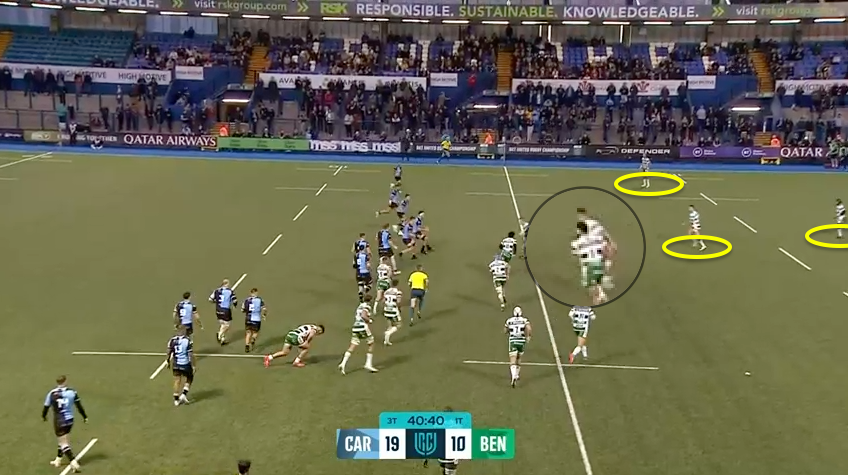
How do we stop it?
We play our natural game. When Benetton kick to us off Uren and Umaga, we have to run the majority of those kicks back into contact and engage them in long on-ball possession sequences. In the same way that we wouldn’t just kick blindly back to Leinster, we have to treat Benetton the same. When they kick at us, we have to stress them before giving it back on our terms exclusively. The way they play the game means drop-offs in their front five – they play heavier in the pack than a traditional counter-transition side – and we can exploit that ourselves.
Guard the offload on the edge, screen and escort our back three under the high ball, hit our markers at the offensive breakdown and retain the ball – we’ll win.
