


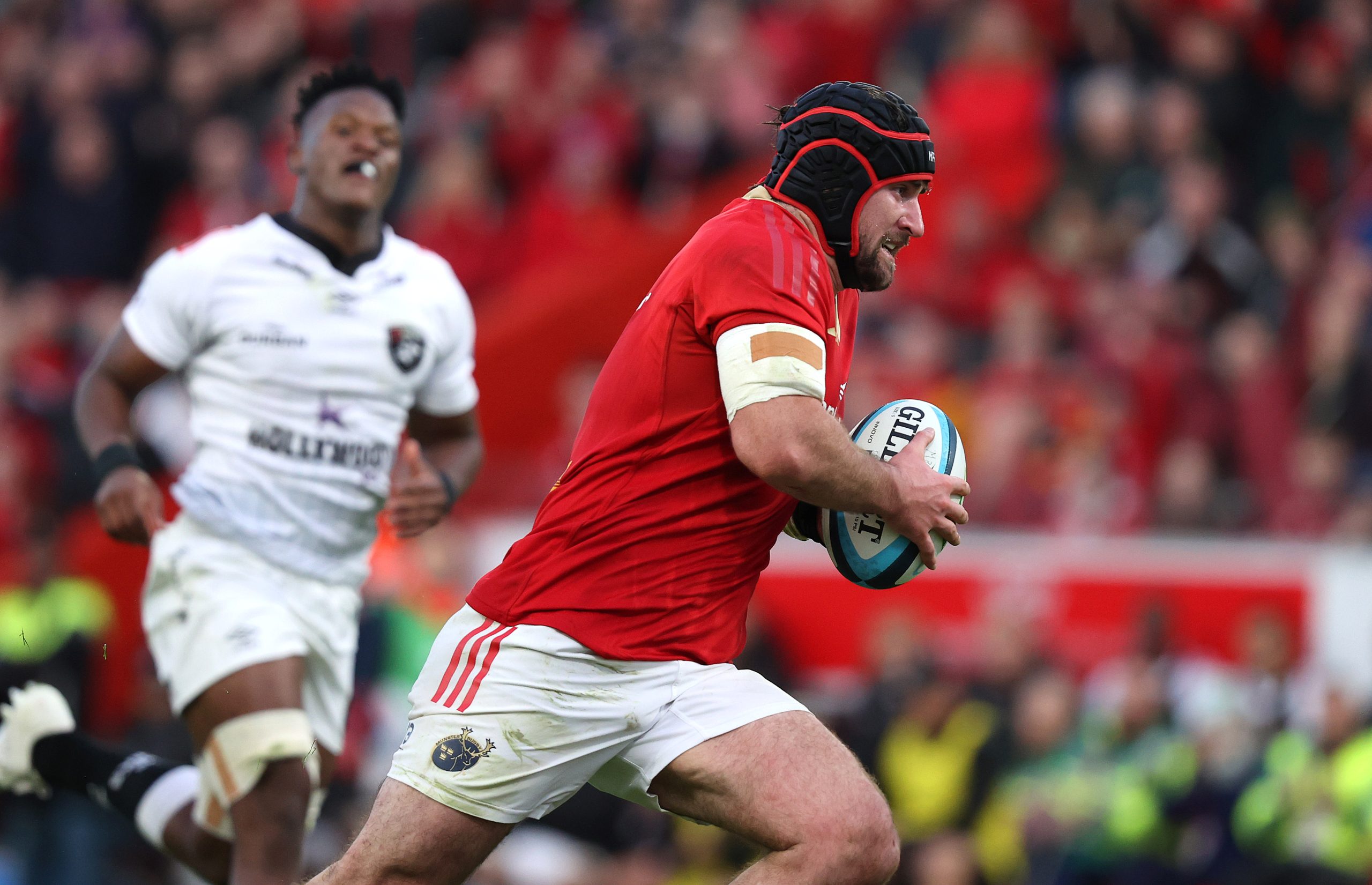
A good start is half the battle.
We know that’s true around these parts because we saw how difficult the last half of the battle is when you get a bad start. Starting the URC on the back foot means a super sweaty run from March to April with all the pressure and momentum killers that come with that.
Starting out with a bonus point win against one of the most difficult teams in the league, even accounting for the World Cup depleting both sides, is the beginning of a good start and not a good start on its own. Let’s put it this way though; it beats losing away to Cardiff last season.
When we compare that game to this, it’s like night and day, chalk and cheese and whatever you’re having yourself that’s opposed to something else.
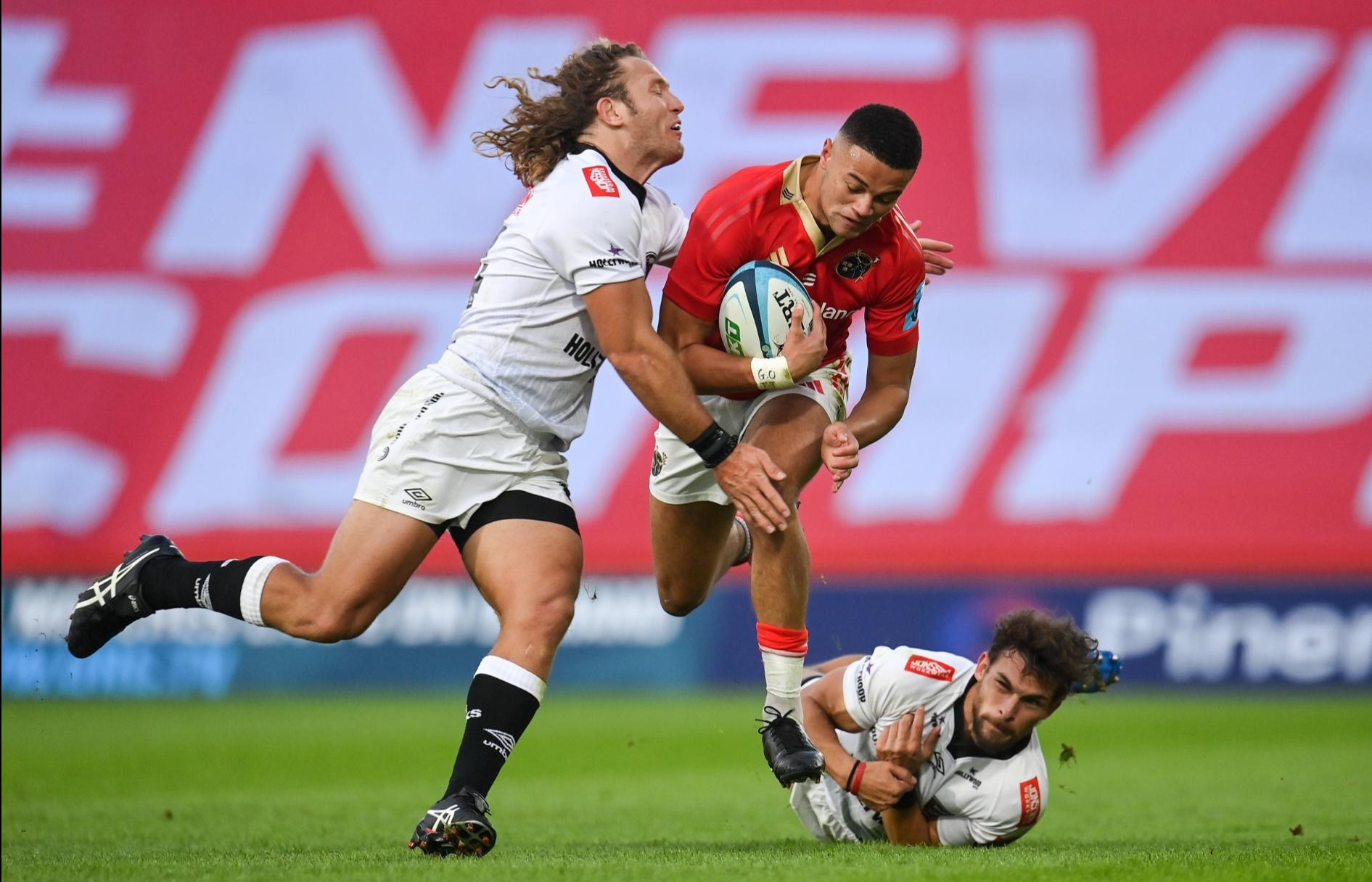
In Cardiff 2022, there was confusion, blown running lines, isolated runners on solo runs and a gallon of unforced errors. This game wasn’t error-free by any means but in place of all those bad things was one really good thing; clarity. Clarity comes from certainty, certainty comes from stability plus confidence multiplied by time. Munster teams have had stability before, and time, but not confidence so clarity was hard to come by. In winning the URC last season, Munster ended up earning the kind of confidence that you can’t fake (but that we were trying to fake for a decade) so now the hard work and determination that was always there had a focus.
We saw glimpses of that focus on Saturday evening.
***
One of the best parts of Munster’s run to the URC title last season was how comfortable we were in utilising what would typically be described as “inefficient” high-possession rugby, and turning it into effective on-ball pressure.
In practice, this meant that Munster became very comfortable in hanging onto the ball for multiple phases from our 10m line onwards after a launch point of either a set piece or a kick transition. This is notable because, typically, Munster would have been known for having a crack off 2/3 phases of possession in and around the halfway line before resetting for a kick of some description to pressure the opposition in and around their 22.
This was the “radical” change that Rowntree and Prendergast brought last year to Munster and it saw its final form on the title-winning charge at the end of the season.
From a definition perspective, I look at the teams in the following way;
The various styles of Off Ball Rugby fall in the range of one kick for every 2.9 passes and below, the different styles of Counter-Transition range from between one kick for every 3 passes to one kick every 5.9 passes and the various on-ball variants are one kick for every six passes or above.
As an example, England played a solidly off-ball game in this World Cup with an average kick-per-pass ratio of one kick every 1.8 passes – about as clear as it gets. But this isn’t a value judgement on style. It served England well because they were conditioned perfectly to play that game and arguably should be planning for a World Cup final right now if not for some last-minute heroics by the Springboks.
Find a style that works for your team, select the right players to run it and then condition your players appropriately but, remember, there are different types of conditioning and no one gold standard for “fitness” when it comes to this game.
Ireland, for example, is a counter-transition team and usually plays in the upper reaches of that counter-transition range (1 kick every 3 to 5.9 passes) so they are conditioned to play that game to the nth degree. This means that Ireland mostly plays a lot of the game on the run, so they are usually “lighter” than the opposition for this very reason. If you’re kicking the ball in this range, it usually means you’re doing it to attack on transition, so you’re going to prioritise players of a certain profile who can take advantage of the spaces that show up on post-transition phases. Counter-transition teams want to run you up and down the pitch, pull you into mismatches on post-transition and then blow you away with a high Pass Per Carry game so it looks like they’re almost running through you when it works at its best.
That game is predicated on kicking at a relatively high volume and the players are conditioned to thrive in that environment. When that environment changes – for whatever reason – into a game where they play an Off Ball or On Ball style game, performances can fluctuate wildly. When Ireland played New Zealand in the World Cup quarter-final, a team that is normally conditioned to play a game inside that Counter-Transition range ended up playing a heavy on-ball game (one kick every 16.3 passes) and looked like they had absolutely nothing for the All Blacks in the carry in the end. All the All Blacks had to do was set a passive defensive line to mop up the carries, and Ireland couldn’t progress any further than the outer edges of the 22 when it mattered.
Why? Because without the option to kick, Ireland were carrying into a settled defence and looked too small as a result. When you play On Ball rugby, you need size and weight in your back five and you don’t have it, you need a mistake or overly complex passing structures (and a mistake) to puncture a hole that scores you a try.
If you are not conditioned for this game, it is highly unlikely that you will succeed in playing it. Conditioning is hugely important, as is creating play structures that allow you to play your game to the level required.
During the run in last season, Munster were playing solidly in the On Ball Rugby range.
- Stormers Final: 1 kick every 6.4 passes
- Leinster Semi-Final: 1 kick every 9.7 passes
- Glasgow Quarter-Final: 1 kick every 10.7 passes
- Sharks URC R18: 1 kick every 6.1 passes
- Stormers URC R17: 1 kick every 4.6 passes
That is an average of one kick ever 7.5 passes on average across those games. In this game against the Sharks, we played a ratio of 1:7.2 on a Pass Per Carry average of 1.44. What does this numberwang mean? That we were continuing the exact game that brought us to a title last season with a tiny drop off, from a raw numbers perspective.
In the URC last season, no team scored more tries after 10+ phases than Munster.
Munster’s opening try against the Sharks was a 14-phase special launched from a lineout exactly on the halfway line. At numerous times throughout that sequence, Munster could have kicked down the line at an angle to get a set piece from the resulting pressured exit or put the Sharks under territorial pressure but we didn’t.
How many times did you spot a window to stab the ball down the line or over the top into the backfield? I saw two or three. Maybe more. But that’s not what we’re doing. We want to keep the ball in hand. We want to pressure teams with the ball in hand and we’re selecting the size to do just that, as well as playing really aggressively at the breakdown to retain the ball on those long phase sequences.
Not only that, we’re backing up our on-ball sequences with really incisive, instinctive transition phases.
This is really good stuff. It’s the product of the clarity I spoke about earlier. None of these scores happens with the belief that those phases are going somewhere. All it takes is one player to bail out of the sequence with a needless kick to release the pressure. Don’t get me wrong though, we do kick the ball, but we’re primarily looking to stress the opposition with our phase play. We’re conditioned to play that game and, even better, we now seem to be comfortable with it.
Going away to Benetton will be a stiff test again but if we bring the clarity we had here, we’ll be tough to stop.
| N | Rating |
|---|---|
| Josh Wycherley | ★★★★ |
| Diarmuid Barron | ★★★★ |
| Stephen Archer | ★★★ |
| Edwin Edogbo | ★★★★★ |
| Fineen Wycherley | ★★★★ |
| Jack O'Donoghue | ★★★★ |
| Alex Kendellen | ★★★★ |
| Gavin Coombes | ★★★★ |
| Ethan Coughlan | ★★★★ |
| Joey Carbery | ★★★★ |
| Shay McCarthy | ★★★★ |
| Rory Scannell | ★★ |
| Antoine Frisch | ★★★★★ |
| Andrew Conway | ★★★★ |
| Shane Daly | ★★★★ |
| Scott Buckley | ★★★ |
| Kieran Ryan | N/A |
| John Ryan | ★★★ |
| Tom Ahern | ★★★ |
| Brian Gleeson | ★★★ |
| Neil Cronin | N/A |
| Alex Nankivell | ★★★★ |
| Fionn Gibbons | N/A |
