


It’s the end of an era in more ways than one. It’s actually closer to the end of several eras all rolled into one crash-bang letdown that will take a lot of water under the bridge to properly get over, for fans, coaches and especially the players who went out on their shields in an epic World Cup Quarter-final at the Stade de France.
There is no questioning the effort of this group, their desire, or indeed, the fine margins that went into this loss. There were two margins, in particular, at the pointy end of things.
- The few centimetres between Ronan Kelleher being the hero for Ireland and Jordi Barrett being the hero for New Zealand.
- The critical penalty miss by Johnny Sexton leaked roughly a metre wide of the left upright in the 58th minute.
Both of those fine margins changed the context of how New Zealand could approach the end game of this quarter-final and changed how Ireland had to approach it. But none of this happens accidentally or in isolation. Ireland didn’t lose this game because of any one individual, they lost it, in my view, because of the pressure of the moment and key early moments going against them which in turn forced them away from the game we’ve played all year and right into the hands of the All Blacks.
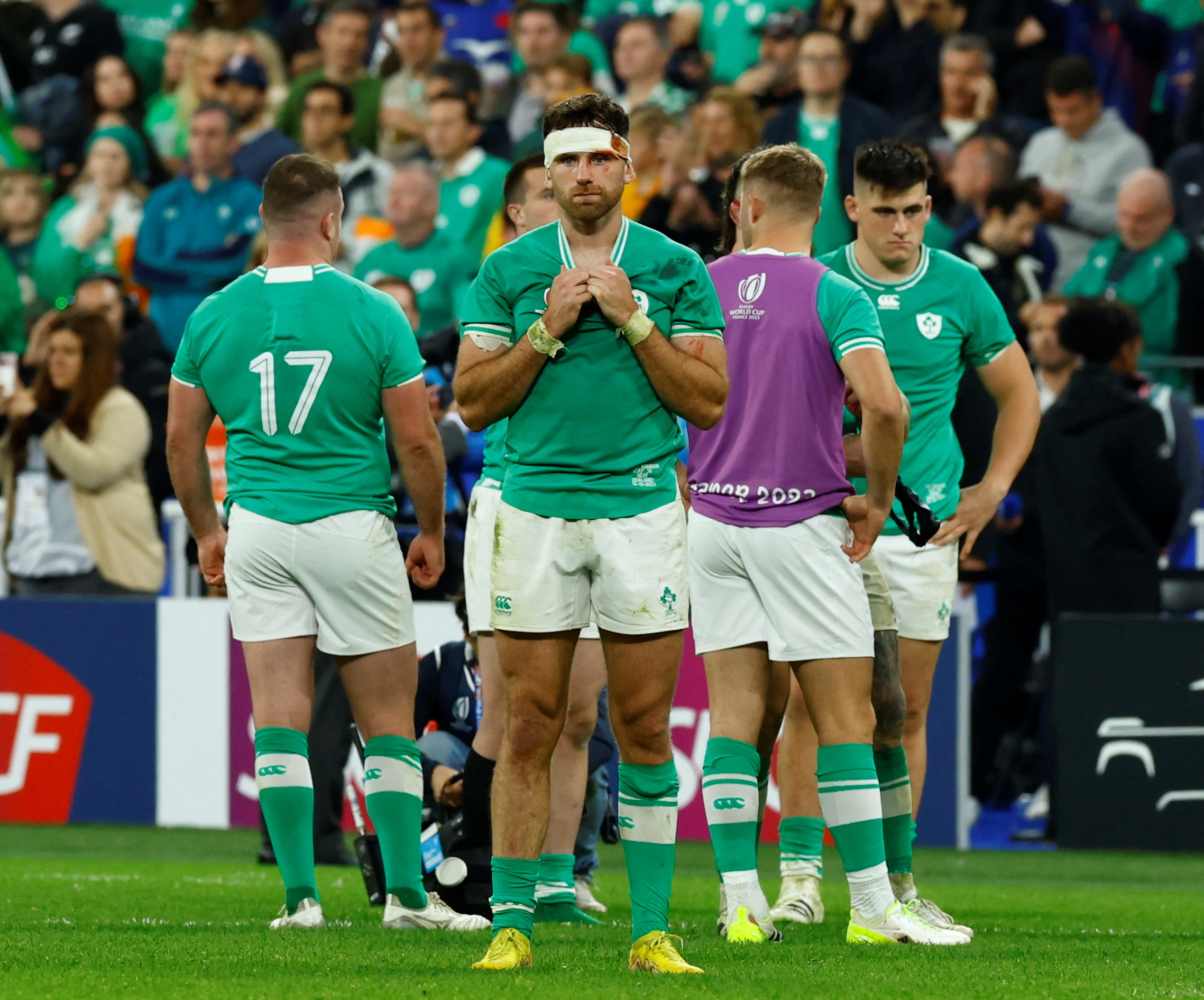
An extremely uncharitable view of this defeat would be that Ireland choked this game – bottled it, blew it, cracked under the pressure, whatever you want to call it. It has an element of truth to it, as hard as that might be to stomach.
Ireland’s opening quarter cost us this game through a combination of the worst breakdown performance I’ve seen from this group in years and our halfbacks having career-worst games as a partnership.
To properly get a look at the first quarter, we need to first look at the performance at the breakdown, which means assessing the Offensive Ruck Work score for the entire game. See what sticks out to you from the whole game first.
IRELAND’S OFFENSIVE RUCK WORK SCORE VS NEW ZEALAND
- A Dominant Clean is an action that decisively secures possession when the ball carrier takes contact. A Dominant Clean does not have to be the first arrival at the breakdown but it is rewarded in the context of effectiveness. We will assign this action 3 points.
- A Guard Action is where a player plays a role in helping to retain possession after we have “re-won” the ball on the floor. Sometimes this can happen on a carry/ruck point where there is no active contention by the opposition. Let’s assign this action 2 points.
- An Attendance can be anything from standing as a “kick shield” on a ruck to adding a bit of bulk to ward against a counter-ruck. I’m marking this down as being worth 1 point.
- An Ineffective Action is a blown cleanout, a lean, a breakdown penalty or an action that I couldn’t see any direct benefit for. This will be worth -2 points.
| Dominant Clean | Guard Action | Attendance | Ineffective | Ruck Work Score | |
|---|---|---|---|---|---|
| Porter | 1 | 17 | 2 | 3 | 33 |
| Sheehan | 12 | 4 | 2 | 24 | |
| Furlong | 1 | 12 | 1 | 3 | 22 |
| Beirne | 6 | 17 | 1 | 53 | |
| Henderson | 2 | 11 | 2 | 30 | |
| O'Mahony | 8 | 19 | 1 | 63 | |
| Van Der Flier | 12 | 2 | 3 | 20 | |
| Doris | 24 | 2 | 5 | 40 | |
| Gibson-Park | 0 | ||||
| Sexton | 5 | 1 | 8 | ||
| Lowe | 5 | 1 | 8 | ||
| Aki | 2 | 15 | 2 | 32 | |
| Ringrose | 1 | 20 | 1 | 2 | 40 |
| Hansen | 5 | 10 | |||
| Keenan | 10 | 7 | 1 | 2 | 41 |
| Kelleher | 5 | 10 | |||
| Kilcoyne | 5 | 10 | |||
| Bealham | 12 | 3 | 27 | ||
| McCarthy | 4 | 8 | 1 | 26 | |
| Conan | 7 | 14 | |||
| Murray | 1 | 2 | |||
| Crowley | 0 | ||||
| O'Brien | 2 | 2 | 10 |
First things first – absolute heroics there from Peter O’Mahony, Tadhg Beirne, Hugo Keenan and Garry Ringrose. O’Mahony’s performance at the lineout and the breakdown is one of the best you’ll ever see and if this was his last World Cup appearance, he went out in the most Peter O’Mahony way possible – swinging and fighting like a dog.
Tadhg Beirne’s performance for the full 80 minutes is something else too. He started slowly but grew into the game despite visibly tiring as the minutes ticked by. His lineout work was superb and he was unlucky at the defensive breakdown a few times. Hugo Keenan’s performance is genuinely one of the most inspiring I’ve ever seen and it’d make you emotional watching it back – he scrapped so fucking hard for this team and hit the kind of breakdown output you’d normally see out of a flanker on top of his usual excellence everywhere else. He’s a real scrapper and Garry Ringrose put in a captain’s performance in midfield.
Doris’ scoring was actually really low around 50/60 minutes but his numbers were buffed considerably when he stepped into Van Der Flier’s small forward role. Josh looked tired and out of it in this game, to the point he was visibly struggling just a few minutes before slipping off Richie Mo’unga for what would be the killer score.
Three ineffective entries are something you just wouldn’t see from Josh Van Der Flier across three games, never mind one and, a bit like Doris in the same period, I felt the pressure of the moment got to both players.
Doris seemed to relish a less prominent carrying role as he switched roles and he really maxed out his guard actions on three massive on-ball sequences in the late third quarter and late fourth quarter.
We can see where the game fell down, however, by tracking our Collective Offensive Ruck Work across the quarters.
Look at the first quarter.
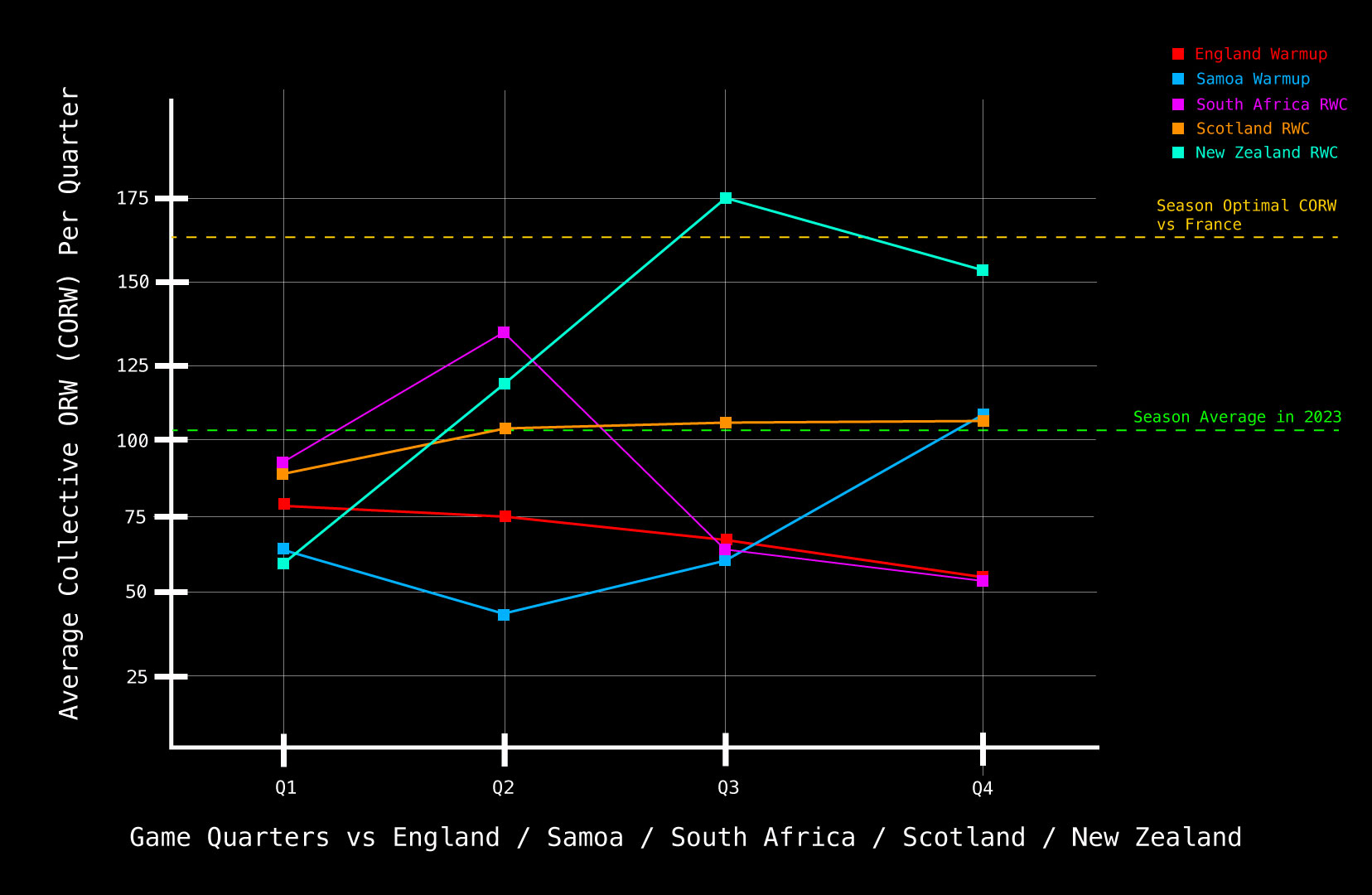
Three of our best quarters for offensive breakdown output mixed with the worst quarter we’ve produced in two years. The 13 points we conceded in that quarter – from a position where we had enough opportunity to pin the All Blacks in and begin dictating the game to them – was the actual turning of the game.
Some of that comes down to individual errors, like Porter’s indisciplined rip on the floor inside the first two minutes to give the All Blacks the impetus but it mostly comes down to panic, especially when we were down on the scoreboard so early. Our decision to kick down the line when we won a kickable penalty after conceding on the first possession was exactly what Scotland did last week – with the same result. Zero points and minutes burned.
I’m not saying it wasn’t a close run thing in this particular case – a pass being a few centimetres too high and a heartbeat too soon – but the outcome is the same.
This is knockout rugby. At times I think we played this game lurching from one emotion to the next. At times, we played this like it was a league game with another opportunity waiting around the corner for us and then, a few moments later, we played like we’d never have another sniff of the ball again.
If we dig a little deeper into the CORW numbers what do we find? Well, the 41 minutes of ball-in-play time was one of the longest games we’d played this year but the interesting thing was the numbers involved; if we total all the ruck involvements, we get 523 ORW points, which is the second highest on record in the last two years for this Ireland team (the France game this past Six Nations was the highest) but it’s right in the usual range for Munster’s games in the run-in to the URC. Munster and Ireland play a very different style – it informs many of the recent selection decisions in the last year – but in the second half, Ireland were engaged in huge on-ball sequences that lasted 10+ phases multiple times. Ireland aren’t built for that type of rugby under this much pressure.
Ireland’s team is selected to play Counter-Transition, hit-and-run rugby but, because the All Blacks took us off that game, we had to engage in the kind of rugby we’re deliberately not built to play. How many times did it feel like we got smashed up in the middle of the field? Because we didn’t have the heavy hitters to truck the ball for us, especially in an environment where Sexton and Gibson-Park were playing like strangers to each other.
Long on-ball sequences with no heavy-hitting runners put more pressure on your halfbacks – and your #10 in particular – to move the outside defence around.
They were unable to do so.
Sexton is so static here – far more static than normal – and it seems like he looked his age for the first time all season on the field. New Zealand just didn’t buy him as a threat in an already packed centrefield and neither Gibson-Park or himself could work their way outside.
Even then, obvious compressions that Sexton would normally pull the trigger on passed him by.
Sexton would normally hit Furlong here and release a 4-2 overlap with some of our best forward handlers but instead, he pulls it back inside. If that isn’t Sexton playing within himself, I don’t know what is. If this is Scotland, Sexton throws that pass – I’m convinced of it. I think the pressure of the moment got to him and core members of the spine of this Irish team. That, when mixed with early setbacks on the scoreboard, took us away from our natural game.
We are a Counter-Transition team for every other game of the year but in this one, we kicked once every 16 passes. This is off scheme for this Irish team. What does that stat mean? We kick to unsettle and disrupt the opposition defence and their forward line in particular. So far in this World Cup, we’ve kicked once every six passes. Even with the long on-ball sequences, to throw an extra ten passes per kick is a massive change. It essentially means we were running at a settled defence with a team built for post-transition phases.
Look at this sequence and see how often an Irish player is run onto a pile of black jerseys.
Watch Sexton’s action as the link between pods; it’s the step-and-sling game he never plays. It ends with a chip over the top that really is “out of ideas” rugby.
In this environment, we were essentially playing against a Black Mirror of ourselves. New Zealand kicked once every four passes which meant we were constantly on the back foot. We punched ourselves out and, despite the genuinely inspirational work rate we saw from the guys on that chart above, we just fell short – exhausted, broken and out of the World Cup far too soon.
New Zealand were good – very good – but a competent first quarter would have, in my opinion, seen us outlast them. That’s what will rankle this team once it’s all said and done. Yes, fine margins, but we had more than enough opportunity to make those margins work in our favour instead of theirs.
For me, this team was more than good enough to win a World Cup – this World Cup – so leaving the tournament this week is not only a letdown, it’s a failure of this team’s potential. Losing a game as good as this is no shame but let’s not pretend that it just happened either.
Key fundamentals of our game – playstyle and core players – didn’t stand up to the heat of knock-out rugby. Hurt will be the primary emotion this week, and rightly so, but once the hurt subsides I think we’ll see the opportunity that passed us by for what it was.
It’ll be for a new team to try again in four years but one thing is for sure – changes are not only necessary due to retirements, they’re needed in everything from playstyle to overall concepts to the personnel to make it happen.
There’s no shame in losing a game like this, but we need to take the real learnings from the game, not just double down on what hasn’t worked in the white heat of a knockout game.
| Names | Rating |
|---|---|
| Andrew Porter | ★★★ |
| Dan Sheehan | ★★ |
| Tadhg Furlong | ★★ |
| Tadhg Beirne | ★★★ |
| Iain Henderson | ★★★ |
| Peter O'Mahony | ★★★★ |
| Josh Van Der Flier | ★★ |
| Caelan Doris | ★★ |
| Jamison Gibson Park | ★★ |
| Johnny Sexton | ★★ |
| James Lowe | ★★★ |
| Bundee Aki | ★★★★ |
| Garry Ringrose | ★★★★ |
| Mack Hansen | ★★ |
| Hugo Keenan | ★★★★★ |
| Ronan Kelleher | ★★★ |
| Dave Kilcoyne | ★★★ |
| Finlay Bealham | ★★★ |
| Joe McCarthy | ★★★ |
| Jack Conan | ★★★ |
| Conor Murray | ★★★★ |
| Jack Crowley | N/A |
| Jimmy O'Brien | ★★★★ |
