


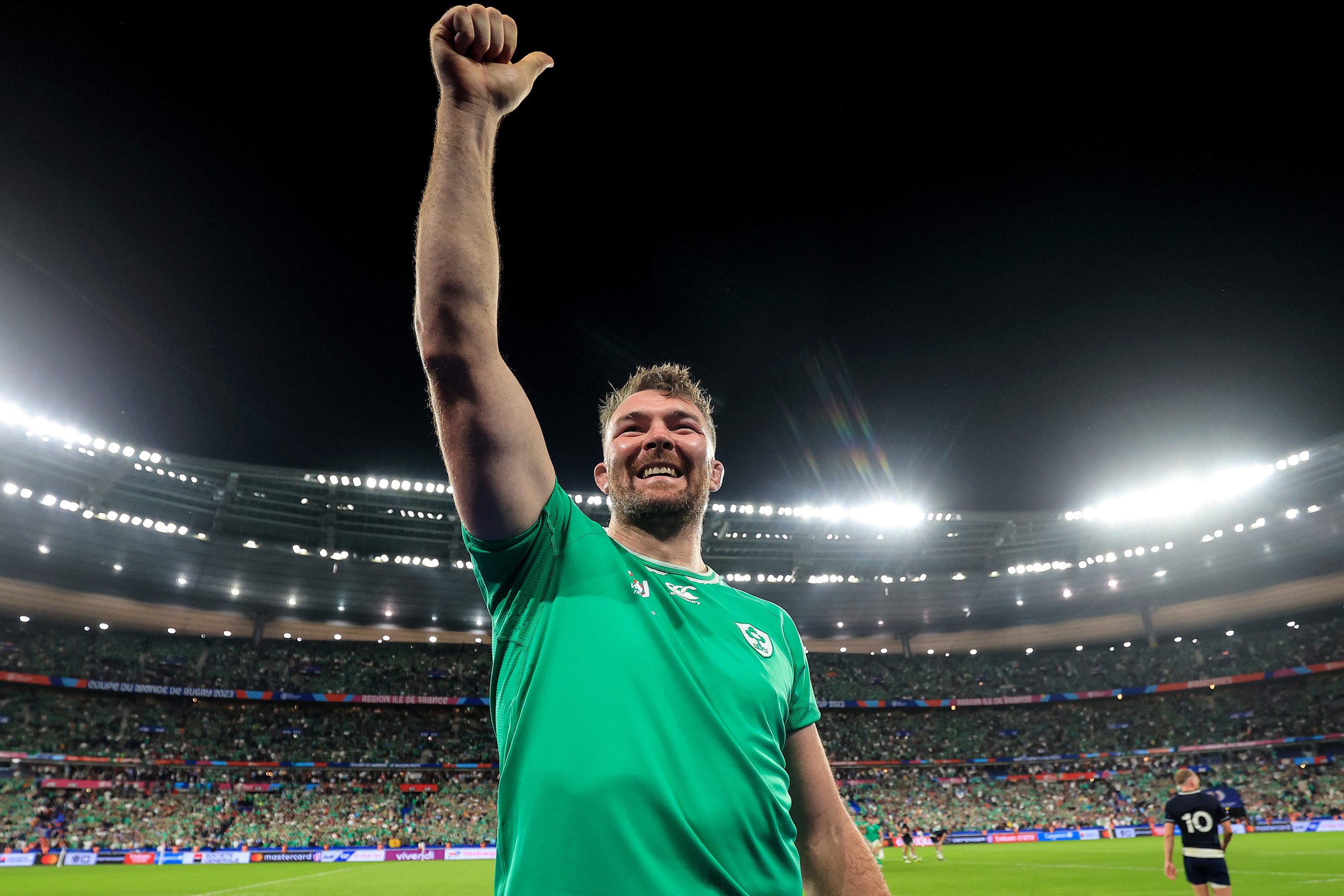
And send him homeward, to think again.
And again. And again.
And again.
No, not Edward II, Gregor Townsend.
Will he learn this time? Probably not.
Ireland’s ruthless beatdown of Scotland in what was ostensibly a Pool B decider owes as much to Gregor Townsend as it does to Andy Farrell’s outstanding Irish side that were as impressive as any side has been in this tournament when it comes to taking their chances and converting opportunities.
Fundamentally, Gregor Townsend misunderstands how teams beat Ireland (and Leinster) but, even if he did understand, his commitment to Scotland’s playstyle and his own principles prevents him from exploiting it. To me, this game proved that Townsend’s Scotland is incapable of beating Ireland as we are currently constructed. I think he took the wrong lessons from Ireland vs Scotland in the Six Nations AND from La Rochelle’s wins over Leinster in the Heineken Cup.
One stat stands out to me. Scotland kicked the ball once every 13.8 passes. Ireland kicked the ball once every 5.3 passes. So – you might think – Scotland tried to “on-ball” Ireland with a high-volume possession game like La Rochelle did. What does this mean? It means that Scotland made a deliberate choice to retain the ball over multiple phases of possession instead of kicking it to surrender possession to Ireland in a place where Scotland might pressure us into giving them possession they can actually use. What this did was increase the pressure on their ball-carrying game where they don’t have the firepower that La Rochelle does in the pack or in midfield. So what does that mean?
It means wave after wave of Scottish attack smashing into the woodchipper that is the Irish defensive structure. They went nowhere, flattened themselves with on-ball rugby and would have shipped 50 if Ireland needed that score.
The thing is, they didn’t play like this against South Africa. In that game, they kicked the ball once every five passes and lost because they (a) couldn’t live with the Springbok’s power when it counted and (b) they didn’t take the chances that their kicking produced for them.
Scotland wildly changed tack for this game against Ireland and met their doom on the road they took to avoid it.
A few key moments stood out to me early on that showed me Scotland weren’t going to be able to touch us.
An early Irish try on counter-transition – I’ll get to that later – put Scotland behind inside two minutes and it seemed to fry their tactical thinking. A really kickable early penalty that would have made it 5-3 inside the first five minutes was cashed in for one long 22-entry that they scored nothing on.
Watch Ireland pump this 5m maul four on seven initially and then five on eight for a first stop and use it.
Scotland hit the middle uncontested but get stuffed on the drop by Henderson and Porter on the edges with O’Mahony and Beirne driving power through the Scottish “drive shaft”.
Furlong waits until the hooker joins and then adds his weight in behind Beirne and O’Mahony.
O’Mahony and Henderson have almost popped Fagerson, the infield lifter, like a loosehead popping a tighthead in the scrum.
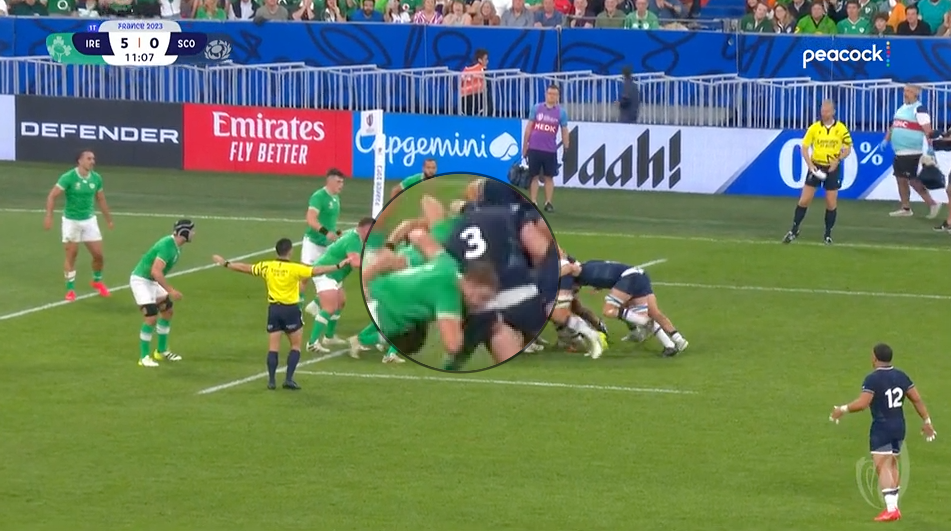
Fagerson has absolutely no power to transfer here. Ireland are lower and have dominantly stuffed the initial forward momentum that Scotland were looking for. Even with their long train, they have nowhere to go because Ireland have Sheehan, Doris and Van Der Flier covering the breaks.
Scotland would get turned over a few phases after this and Ireland would advance up the field.
It seemed like Ireland’s early score panicked Scotland into forcing close-range engagements when Ireland were still fresh. So how did we manage that score?
They Never Learn
You’ve seen Ireland’s first try so many times, I’m shocked that Scotland gave up the position that always seems to result in it being scored.
Ireland went long off the kickoff and hemmed Scotland into their 22 with a good stop on Jamie Ritchie. Now, would Scotland go to touch or look to keep this infield and play a fairly typical backfoot counter-transition play to bring their back row into the game over the ball at the breakdown?
You know the answer to this. Scotland didn’t want to give Ireland the lineout so, when Sexton found Richie in the back pin, Scotland looked to give Price a platform to kick contestably from.
Schoeman, Gilchrist and Darge went into the secure the ruck in the face of a lot of Irish counter-rucking, which later drew Richie Gray in to make Price’s life easier.
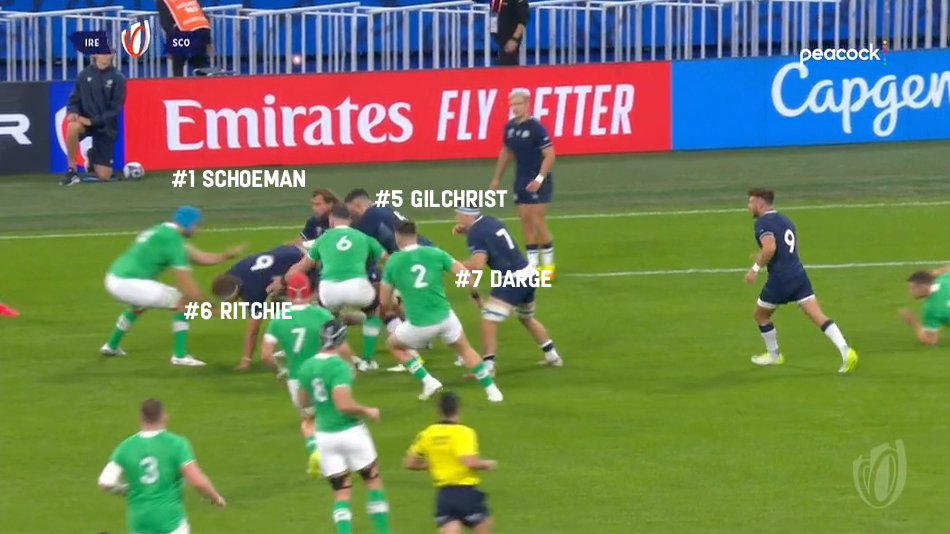
When Price kicks this well beyond his 10m line right into the 5m tram Scotland’s job is simple – pressure Keenan on the ball and fill the field before Ireland can get into structure. Keenan was too agile for the chasing Darcy Graham and managed to set up the first transition ruck.
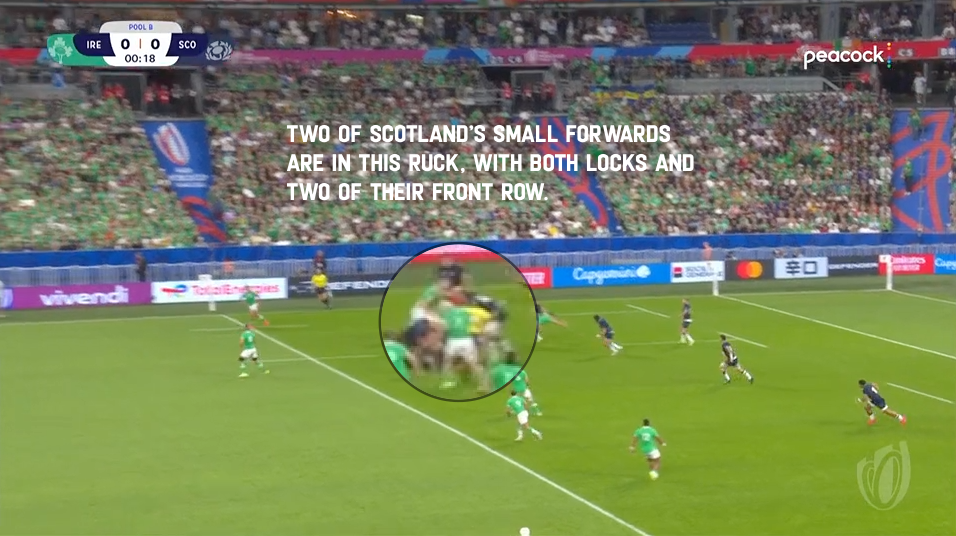
When I spoke about box-kicking counter-transition plays in the last few years, I told you about the dangers of the caterpillar ruck you use to launch the kick becoming like a scrum, where all your heaviest forwards are compressed into one place with no scope for them to adjust once the kick is made.
As a result, Ireland’s first transition ruck has four of the Scottish tight five trapped on the edge of the defensive line.
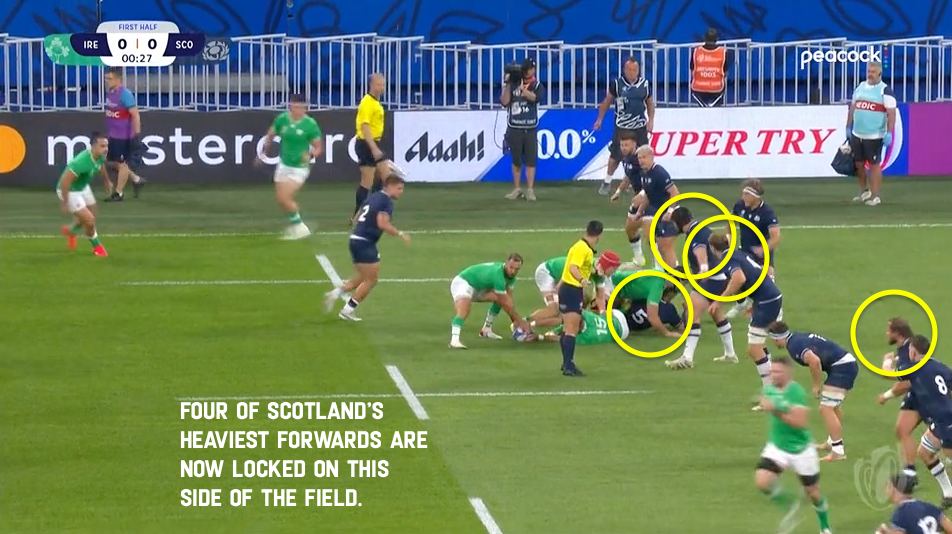
Why is this a problem? Because if Ireland start to move away from this initial ruck on post-transition phase play, there’s no opportunity for those heavier, slower players to stay in the radius of the ensuing rucks. They’ll be guarding edge space.
Two phases on, the Scottish hooker and Grant Gilchrist have been locked on the edge of the play as the small forward build Scottish back row tracks Ireland’s rucks across the pitch looking for turnovers.
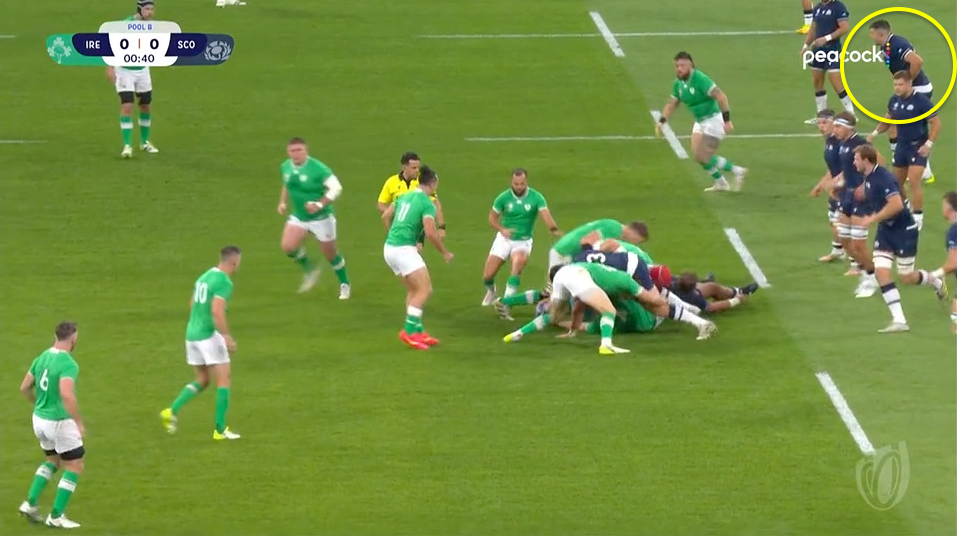
They almost got a few, too, but Ireland’s last-ditch ruck work was exactly what it needed to be at key points.
Remember how I spoke about how Ireland are better when they hit Peter O’Mahony’s edge zone where he can secure crucial wide rucks?
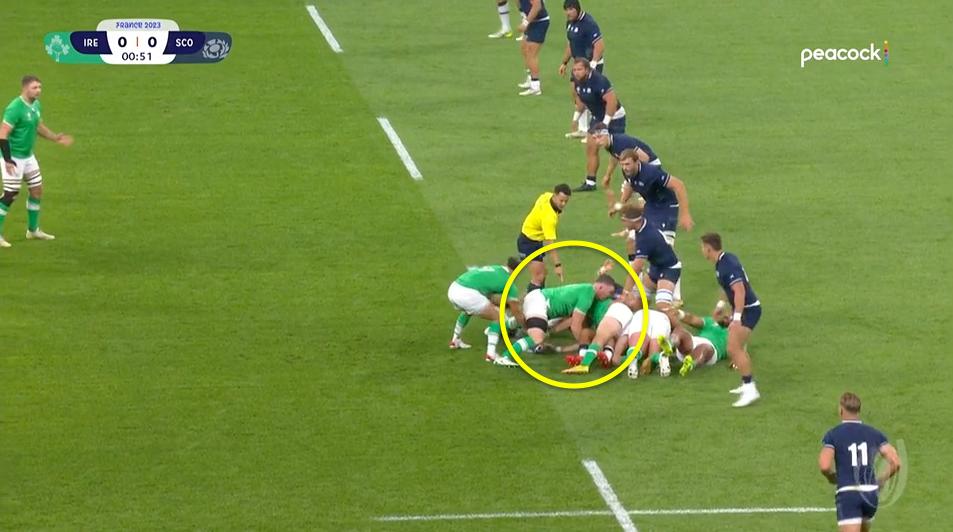
This one wasn’t his cleanest by any means but securing this ruck meant we could attack that heavy Scottish edge which Sexton knew was still in place. Ireland’s deep loop running plays from the wingers kicked into gear and we went hunting for the strike.
Beirne ran a perfect scrag line on Ashman, which opened up Grant Gilchrist on the edge of the play;
Ireland’s system did the rest with Hansen’s deep loop line overloading Ali Price as the covering back and isolating a lane for Garry Ringrose to attack inside Gilchrist. He couldn’t recover in time and Ireland threw all of Scotland’s early game plans into disarray.
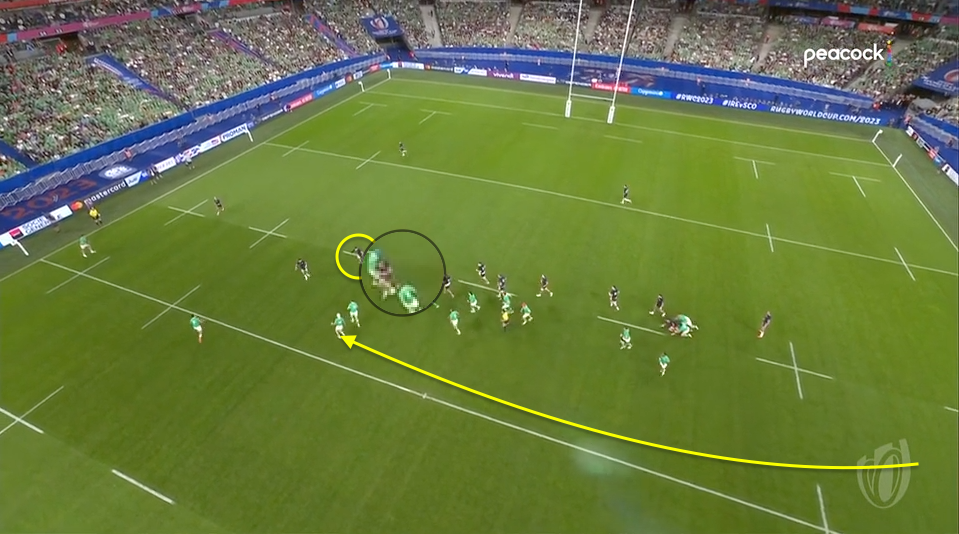
Watch the entire thing through and look at how quickly and how smoothly Ireland’s forwards work themselves back into position for the post-transition phases.
Scotland gave up that opportunity almost unknowingly and they were severely punished, like a lost tourist blundering into a lions’ den. They had no way to hurt Ireland in the scrum, at the lineout (75% completion) or in phase play. This game is actually a great example of why quick ruck ball isn’t the be-all and end-all of attacking rugby. 70% of Scotland’s rucks were completed in under 3 seconds but without defenders pinned to the ruck, it just meant they had less time to wait between tackles.
Ireland stuffed them in contact, stayed out of the breakdown unless a clear window to poach presented itself, and just waited for a turnover to come – and it almost always did.
It isn’t that Scotland didn’t fire any shots, they forgot to bring their bullets. Ireland took all of their shots and then some in as clinical a display of offensive rugby as you’ll see. Counter-transition opened up the first try but clean lineout possession, clever blocking schemes and lighting quick ruck ball where it counts (78% of Ireland’s rucks in the opposition 22 are under 3 seconds) meant Scotland had nowhere to turn.
Watch Doris open up a gap for Beirne to slide through on the killer linebreak that led to Ireland’s fifth try.
This lineout strike attacks – once again – the pace of Scotland’s front five as they transit across from the lineout. It’s surgical.
Josh Van Der Flier runs an angled line to draw the defender away from the space that Doris will be blocking off, and Beirne runs an aggressive line right from the lineout and Bundee advances a beat behind Beirne.
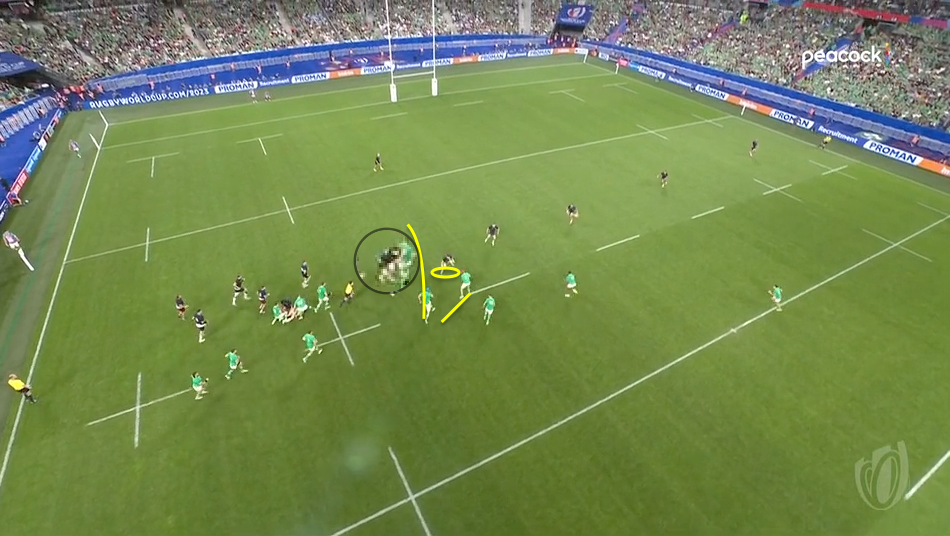
Scotland were sliced up and they had very little answer for it.
Two late tries added some gloss to the scoreline but everyone watching the game knew the story – Ireland could have won this game any way they wanted. Sure, Scotland might have been able to tilt some of the pressure back on Ireland by taking three points, as the All Blacks certainly will, but that wouldn’t have mattered either.
Scotland are just not on Ireland’s level right now and that’s the brutal truth of it.
And with that, we move on to the biggest game in the history of Irish rugby.
| Names | Rating |
|---|---|
| Andrew Porter | ★★★★★ |
| Dan Sheehan | ★★★★ |
| Tadhg Furlong | ★★★★ |
| Tadhg Beirne | ★★★★ |
| Iain Henderson | ★★★★ |
| Peter O'Mahony | ★★★★★ |
| Josh Van Der Flier | ★★★★★ |
| Caelan Doris | ★★★★★ |
| Jamison Gibson Park | ★★★ |
| Johnny Sexton | ★★★★ |
| James Lowe | ★★★ |
| Bundee Aki | ★★★★★ |
| Garry Ringrose | ★★★★ |
| Mack Hansen | ★★★★ |
| Hugo Keenan | ★★★★★ |
| Ronan Kelleher | ★★★ |
| Dave Kilcoyne | ★★★ |
| Finlay Bealham | ★★★ |
| James Ryan | N/A |
| Jack Conan | ★★★ |
| Conor Murray | ★★★ |
| Jack Crowley | ★★★ |
| Stuart McCloskey | ★★★★ |
