


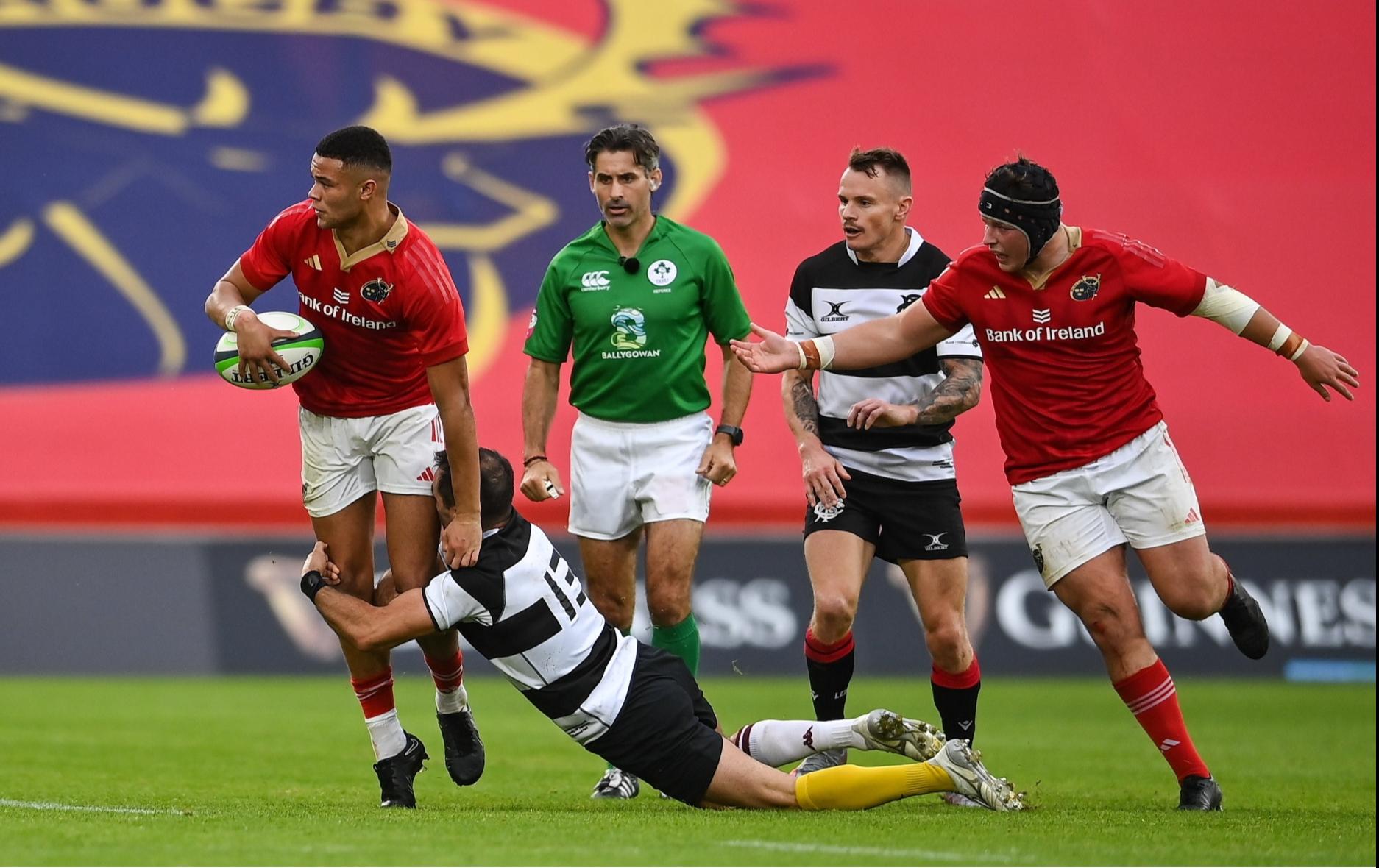
Coming into a new season as defending league champions brings with it a tonne of good and, potentially, bad things, but that’s the gift and the curse of lifting a trophy. In European Rugby last season, 37 teams finished the campaign without lifting their domestic league trophy so, when you are one of the very few teams to actually win something in any given season, you go into the next season with a massive target on your back. That is particularly true for Munster this year given we were quite beatable for most of the regular URC season last time out. If teams can manage a win over Munster this season, they’ll be beating the reigning, defending Champions. That isn’t to say that every game is going to be like a cup final but beating the defending Champions means something a little bit more than just beating Munster, if you can beat Munster, that is. That will increase the difficulty of certain away games this year and increase the chances of teams cycling up higher tier selections when they travel to Cork or Limerick.
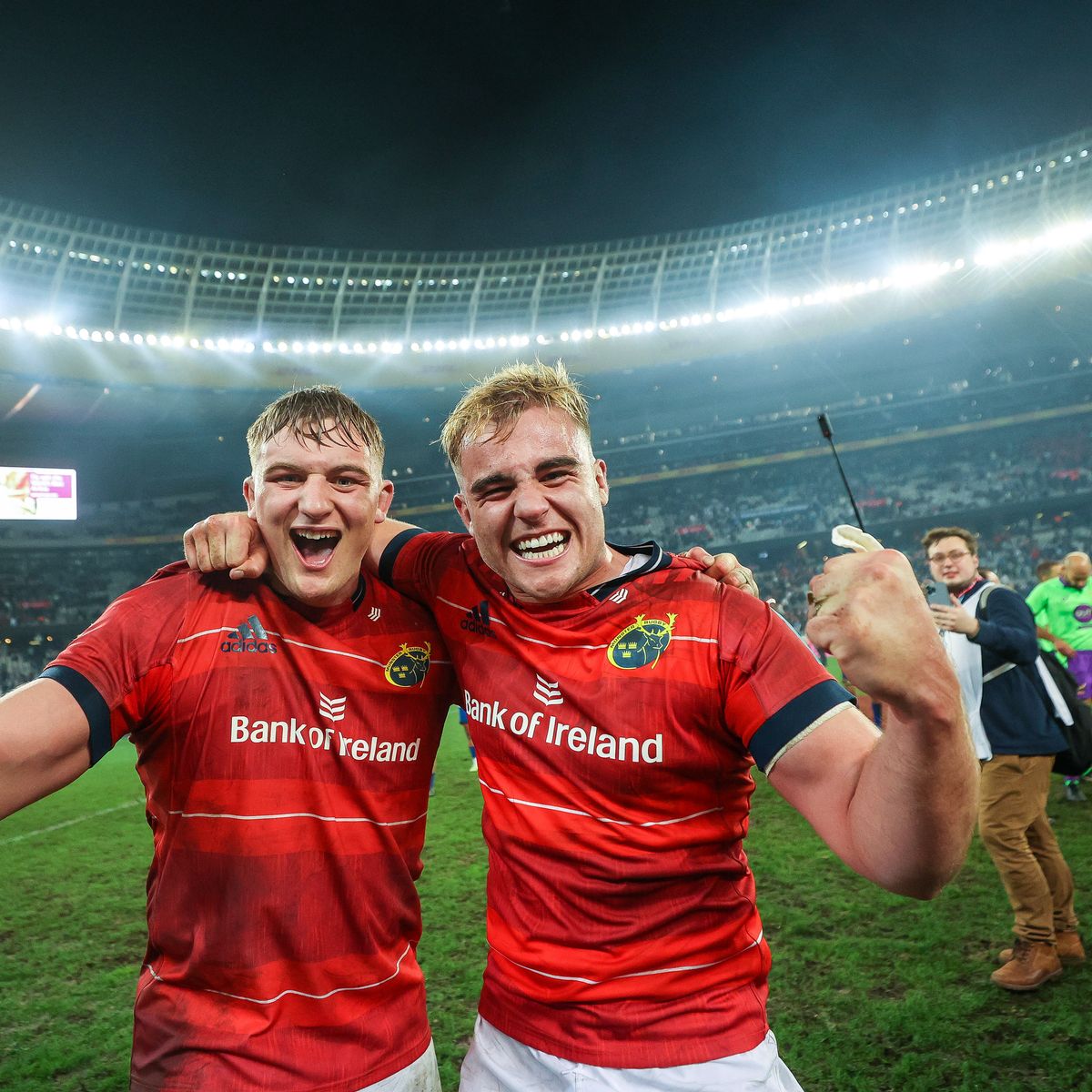
At the same time, knowing that you managed to win something where 93% of all the elite sides in Europe failed gives you the kind of confidence that’s impossible to fake. It’s the tiger blood of this game – the knowledge that when you click, you can beat anyone, anywhere. Munster have the most potent tiger blood you can have in that our trophy was won with the hardest end-of-season schedule anyone in the club game has seen in decades; away to the Stormers, Sharks, Glasgow, Leinster and then the Stormers again without losing? It’s never been done before and it’ll be years until it’ll be done again, if ever.
This Munster group know that, when the pressure comes on, what we do week-to-week in training and game-to-game works. That is invaluable.
After all the work it took to bed in this system last season – literally while the season was ongoing, like fixing a plane’s engine in mid-air – Munster have had the biggest luxury of all this offseason.
Time.
Creating Layers and Building Depth
How Munster have used that time will obviously become clear this season but from what I know so far they’ve done the exact thing you’d expect; building on what works in the only clear run of time you have to actually implement new ideas consistently.
Preseason is about building fitness and collision readiness, sure, but it’s also the only block of time you have to consistently add new concepts to the group in the set piece and on both sides of the ball at the set piece.
The grind of week-to-week rugby – especially the insane block of games coming after the World Cup – leaves very little time for new information. You’ve got recovery from the previous game to consider, analysis of the opposition to onboard, you’ve got your S&C to keep the bodies topped up, and then you have your mid-week recovery days after your big training day – usually Tuesday for Munster – before you’re in for the game the next week. Last season, Munster were still implanting ideas and schemes to the group while the season was ongoing and results, as you might expect, cratered.

There are only so many hours in any game week and you absolutely do not want to be using those hours to throw in a tonne of new information.
So, ideally, you layer on these ideas during the preseason. Again, ideally, you aren’t going to be ripping up the playbook completely; you’ll be adding extra options to plays you already run, you’ll be focusing on areas that you had to cut short the previous season for expediency’s sake and start working on finding other playing options for your system.
Your system maps out a framework for your game on both sides of the ball – offensive and defensive – and your framework, once it’s settled, gives you a specific type of player that you can identify and stack.
So, for example, in Munster’s system last season we can begin to identify positions where a certain role type is required. A role type is separate from a player’s number. As an example, the way Munster uses the #6 and #7 jersey in our pack build is quite a bit different from Leinster, Connacht and Ulster.
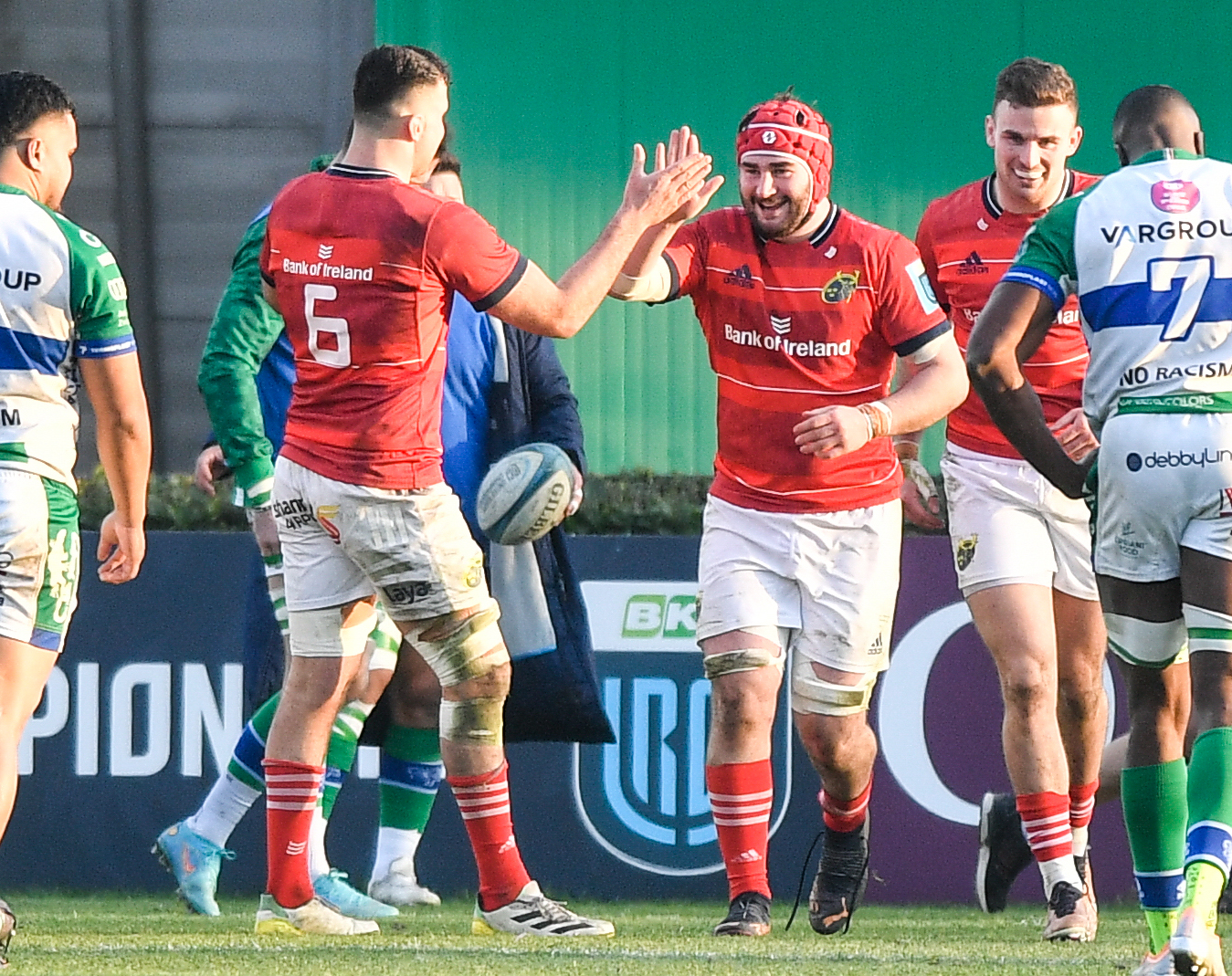
On phase play, our flankers pin the edges of our 1-3-3-1 forward shape in settled phase play. One of those flankers has to be a lineout option – ideally primary or secondary at worst – but both players have to be comfortable playing in those wide spaces. In practice, this means being pretty quick, and agile, with decent hands while being capable of winning wide collisions against wingers or midfielders tackling them at an angle. Peter O’Mahony and John Hodnett are really good examples of this build, with Tadhg Beirne also being versatile enough to cover this role in heavier-pack builds. Hodnett doesn’t have a lineout option but he doesn’t need to if the other flanker does. Hodnett’s pace and explosivity in the wide channels – see the URC final – make him a perfect option for that job, along with his ever-improving passing as a +1 and maul jockey. Alex Kendellen seems to be used in our #8 role a bit more in line with the extra size he’s put on but he can cover both edge roles too.
Down the chart, you’ve got Jack O’Donoghue there as an experienced guy with captain experience, a top tier lineout on both sides of the ball and real pace and power in the wider channels. Jack O’Sullivan, when fit, has added the lineout chops to his game that he needed to make the role work for him. He’s got the pace and hands to be a proper option with a run of availability.
You can even see Munster using that pair mid-way through last season in this picture.
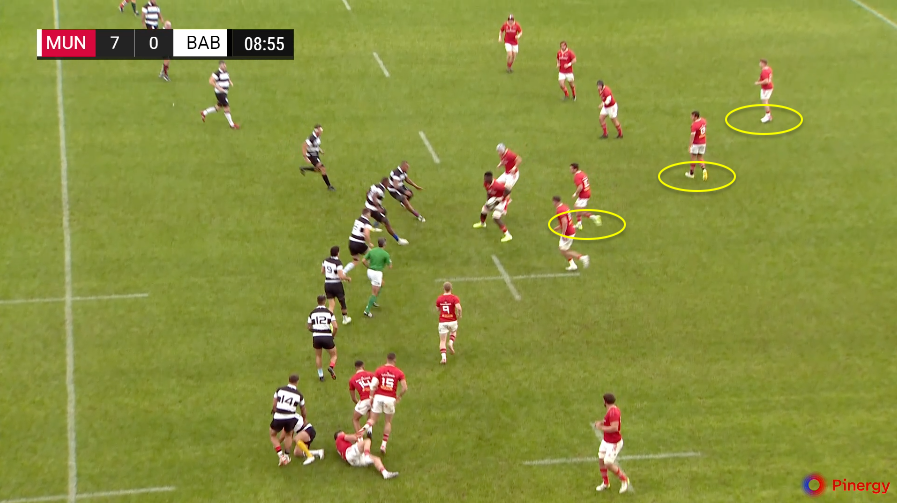
Against the Barbarians, Jack Daly also impressed in that edge role – what he lacks in explosive acceleration, he makes up for in good strong contact, accurate, physical ruck work and a passable lineout game – but I would suggest there’s room for a super quick, super springy Strike Combo Flanker to get into the academy. That’s a role type where you see a very explosive lineout jumper on both sides of the ball with super athletic edge carrying, but I think we’ll be looking in the academy for that roleset, as opposed to going to the market.
You can get a really good look at the structure here – 1-3-3-1 – with Daly and O’Donoghue pinning the edge spaces and the other six forwards making up two pods of three with Carbery/Frisch/Scannell stacked and the back three looping to force number overloads.
The pass straight to Carbery at the end looks off-scheme – and I think it probably is – even with the bonk off his nose but you can see the familiar structure from last season. Arrowhead off 9, flat pod off #10 with Frisch as a strike playmaker off Carbery.
When you look at Scannell’s positioning, you get a good feel for what Munster want in that #12 jersey – essentially a Power Winger.
The interplay between the two midfielders suggests that, eventually, Sean O’Brien and Alex Nankivell will be the ones expected to play off Frisch as the outside runner on a lot of our back schemes.
This was true with Fekitoa – essentially defending as a traditional inside centre but attacking like a traditional outside centre – all while wearing our #12 jersey and Nankivell and O’Brien are perfectly suited to that role.
We also ran a few tweaks on our strike plays, like this three-phase strike off a centrefield scrum.
That deep pass back behind the screening runner by Carbery is a feature of what Munster have been doing this preseason and in this instance, it opens up a double-loop option – Coughlan and Daly. This overloads the edge defender in that he’s got two possible pull back options to defend.
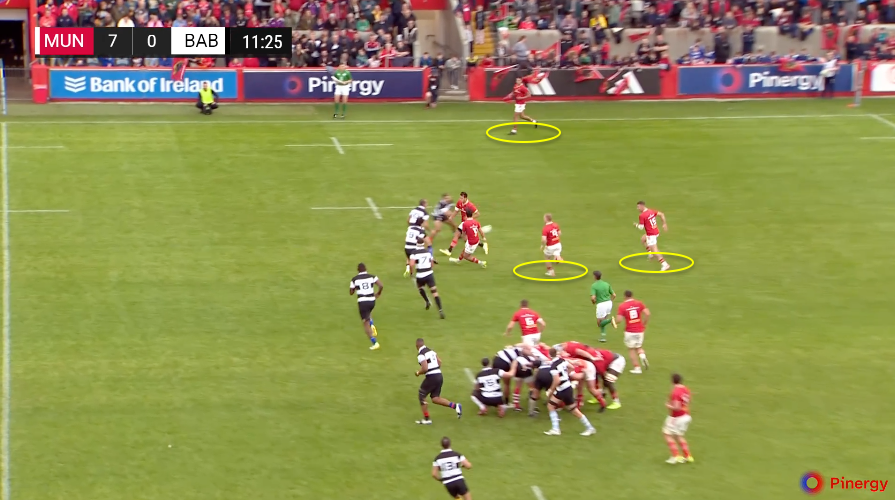
Coughlan does really well to get his pass away under pressure but he’s doing well even to be there on this play – it seems designed for the pace and raw scuttling energy of Craig Casey. The pass from Coughlan on the next ruck should probably have gone a little cleaner through the screen but you can see the intent from Carbery and Scannell to bounce back against the grain on the next phase. They’re checking to see if the structure is in place.
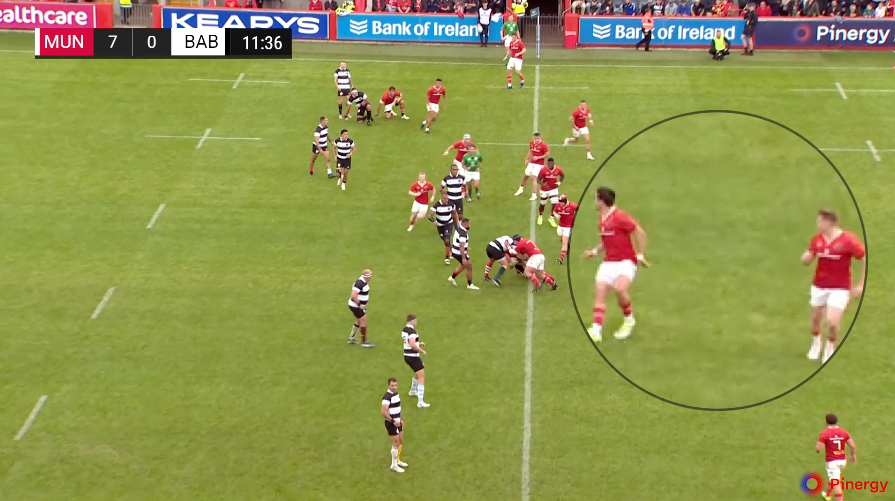
When it is, they hit the strike with Scannell running a tight pocket route on Carbery i.e. basically following him at a 45° angle like he was following his ass pocket on a pair of jeans.
The strike involves another deep pass from the forward to Carbery and it almost opens up a clean linebreak for Frisch or O’Donoghue.
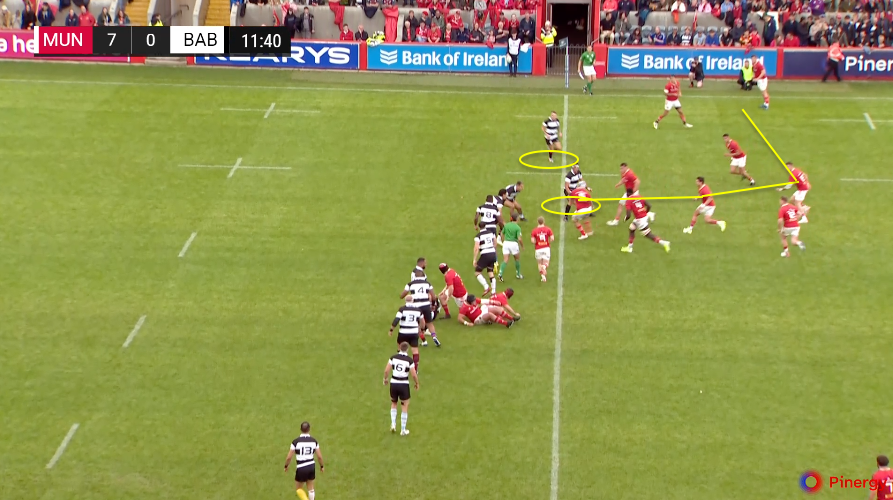
The pass from Fineen Wycherley wasn’t accurate enough, which slowed Carbery’s transfer and left Scannell with too small a window to work with.
This deeper screen pass acts as a blitz killer because there are too many options just a little too far out of reach, especially if you can maintain a central position on the first two phases.
That deeper pass action was also visible in our post-transition phases, as well as a structure change.
For almost all of last season, Munster used a 3-2-X shape on the first few phases of a kick transition. Mike Haley would take the ball off the kick, hunt for the centre of the field or the edge, and then Munster would look to flow through that 3-2-X shape to add depth to the transition. Why do you want depth on a transition? Because the opposition is naturally out of position and is more prone to making long blitzes upfield, and if you have a more recessed shape like 3-2-X, you can pass around that blitz action.
The problem is that post-transition 3-2-X also leaves a clear lane for aggressive blitzing teams like, let’s say a Jacques Neinaber-coached edge blitz defence, to shoot directly into that natural pocket of space that exists on the outside of the two pod.
Against the Barbarians, Munster consistently used a 3-3-1 shape with Brian Gleeson and Thomas Ahern used as the last forward in the 3-3 block.
That allowed Munster to hold that edge defender, and block him with pass options; especially when we changed the usual “flat” three pod off #10 into an arrowhead to make for easier and more defensively concerning tip-on options (but a more difficult screen pass).
Frisch’s deep loop line behind the action opened up the Barbarian’s edge and we were unlucky that we didn’t score directly. Even in this part, you can see what we’re looking for from certain roles.
Our “big six” across the middle have to be competent line runners and passers at a bare minimum. Forwards who end up primarily in the first pod have to be capable of advancing through the gainline to give the outside pods space to work with. Archer and Ryan have done well in this role but I feel we’ll go looking for some heavy tight power in the market ahead of 23/24. These players also have to be capable of tipping the ball on a little more than, let’s say, a similar player in a similar role might be asked to do at Leinster or Ulster.
The forwards who make up the outer three pod have to have the pace to work in the wide spaces and, ideally, one of our game-breaking power runners – Coombes, Snyman, Ahern, Edogbo, Kendellen – will be lurking here for a tip on, a direct run into space or a screen pass to the ever moving backline.
