


For me, the Offensive Ruck Work score tells you a lot about who did what, where they did it, and how they did it relative to the overall game plan and the behaviour of the opposition.
When you use this metric with a knowledge of how your team is playing, you can build a picture of what the ORW scoring is like when your team – Ireland in this case – play well and win big games and, sometimes even more importantly, what it looks like when they play poorly. Rucks aren’t just rucks, they show you the map of the game.
In the 2023 Six Nations, Ireland averaged a Combined Offensive Ruck Work score of 456 per eligible game. When we break that down into twenty-minute blocks, we get an average output of 114 CORW per game quarter. Using this rolling average, we can see where Ireland’s performance levels are relative to the best performances we’ve seen from them.
For example, when we go back to Ireland walloping Wales in the 2022 Six Nations, we see a CORW score of 459, which breaks down to 115 CORW per quarter which is right where we’d expect Ireland to be when they’re playing well. When we break it down, Ireland’s Counter-Transition style produces top performances when we’re producing CORW scores of between 400 and 650. What does this show us? It means that we are creating the ruck points we need on post-transition phases and, more importantly, working our way into the opposition 22 where we can build ruck pressure which leads to scores.
Ireland’s CORW score of 638 against France produced 13 entries into the French 22 for an average point return of 2.4 points per entry. The higher our ruck work score against elite opposition, the more opportunities we get to score points. In 2023, we’ve averaged around 2.7 points per 22 entry.
Against England two weeks ago, our CORW score was 261, which is well below our average in the Six Nations but that was still enough to produce ten 22 entries for a return of 2.9 points per entry. What does this tell us? Are we getting more and more efficient or are England a defensive basket case? I would lean towards the latter based on what happened against Fiji last weekend and against Wales in the games earlier last month.
The proof of our current performance levels would be against Samoa when it comes to establishing a trend. What do we see? Let’s have a look.
IRELAND’S OFFENSIVE RUCK WORK SCORE vs SAMOA
- A Dominant Clean is an action that decisively secures possession when the ball carrier takes contact. A Dominant Clean does not have to be the first arrival at the breakdown but it is rewarded in the context of effectiveness. We will assign this action 3 points.
- A Guard Action is where a player plays a role in helping to retain possession after we have “re-won” the ball on the floor. Sometimes this can happen on a carry/ruck point where there is no active contention by the opposition. Let’s assign this action 2 points.
- An Attendance can be anything from standing as a “kick shield” on a ruck to adding a bit of bulk to ward against a counter-ruck. I’m marking this down as being worth 1 point.
- An Ineffective Action is a blown cleanout, a lean, a breakdown penalty or an action that I couldn’t see any direct benefit for. This will be worth -2 points.
| Player Name | Dominant Clean | Guard Action | Attendance | Ineffective | Ruck Work Score |
|---|---|---|---|---|---|
| Healy | 3 | 6 | |||
| Steward | 7 | 1 | 1 | 13 | |
| Bealham | 6 | 3 | 1 | 13 | |
| Beirne | 2 | 16 | 1 | 3 | 33 |
| Henderson | 6 | 2 | 1 | 12 | |
| Baird | 4 | 5 | 1 | 11 | |
| Van Der Flier | 4 | 13 | 3 | 5 | 31 |
| Doris | 4 | 10 | 4 | 24 | |
| Murray | 1 | 2 | |||
| Crowley | 1 | 3 | 9 | ||
| Stockdale | 2 | 5 | 1 | 1 | 15 |
| McCloskey | 2 | 7 | 1 | 21 | |
| Henshaw | 3 | 2 | 1 | 11 | |
| Hansen | 5 | 1 | 8 | ||
| O'Brien | 1 | 2 | |||
| Herring | 1 | 11 | 1 | 26 | |
| Loughman | 1 | 8 | 1 | 17 | |
| O'Toole | 5 | 1 | 8 | ||
| Ryan | 1 | 6 | 3 | 9 | |
| O'Mahony | 1 | 4 | 11 | ||
| Casey | 1 | 2 | |||
| Byrne | 1 | 1 | 3 | ||
| Ringrose | 1 | 2 | 7 |
Top Five ORW Scorers
- Tadhg Beirne – 33 points
- Josh Van Der Flier – 31 points
- Rob Herring – 26 points
- Caelan Doris – 24 points
- Stuart McCloskey – 21 points
Individually, there are a few concerning markers;
Iain Henderson’s output at the breakdown was really poor by the usual standards we expect from our locks. We expect more carrying from our locks than some other nations but Henderson’s numbers in this regard were as poor as his breakdown numbers. It’s not a shock that Beirne did the full 80 given he was the most efficient back-five scorer we had.
My initial watchbacks of the game were far kinder to James Ryan than the numbers would go on to illustrate. The inefficiency that hurt him in the Six Nations was present here again and some of his entries were out of control – he is an active card risk against South Africa on this form, but he brings real energy and direction to this pack so his value remains high.
I think Andrew Porter’s value to Ireland is also illustrated here with only Rob Herring coming close to the usual numbers we expect from the Irish front row. Jeremy Loughman started really slowly off the bench but grew into the game as he progressed.
Josh Van Der Flier was unusually inefficient in his work in this game. He left 10 extra points after him with some unusually poorly timed and weak entries over the 80 minutes.
Ryan Baird’s low numbers illustrate that we had issues progressing the ball to his wing consistently. He started quite strongly but fell back in the second half – we weren’t progressing the ball to the edges for the majority of the second half so our primary edge forward struggled to impact the game during phase play.
***
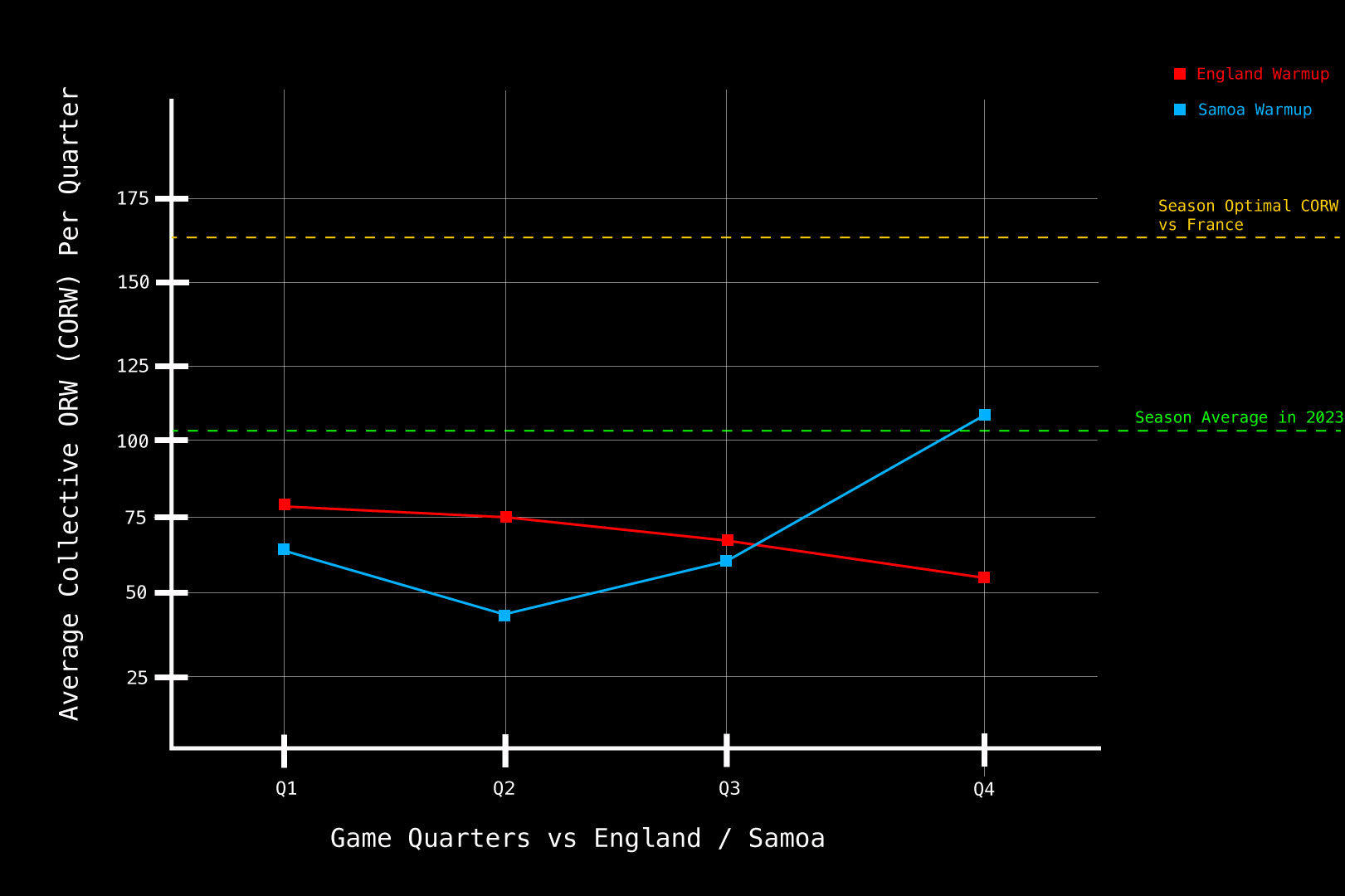
Despite almost losing this game, we had a CORW score of 294, which is improved on the England game. We also earned fourteen 22 Entries off the back of this limited possession but, and this is crucial, we only scored 1.2 points per entry which is well below our yearly average. Of that score of 294, a bulk of it was scored in the last quarter during a period where Ireland were camped on the Samoan tryline multiple times but couldn’t convert that pressure into points with James Ryan ultimately being held up over the line.
It was Ireland’s maul in the third quarter that put us in position to score what would be the winning try on 63 minutes, right when the CORW started to trend upwards.
Ireland drastically underscored our CORW score in the last quarter, which distorted our usual efficiency and put Samoa in a place where they might have won the game.
One thing is certain – if we produce these entries against South Africa, we will lose. In 2023, the Springboks concede an average of 6.2 entries to their 22 per game. Unless we’re producing a CORW output of 450+ during phase play, we’ll be relying on a slew of penalties and lineout/maul dominance to produce our scores – both of which seems a difficult ask against the Springboks. Ireland have lost the highest percentage of mauls in Tier One rugby this year (in part because we maul so much) so we can’t afford to rely on the maul to bail us out as it did against Samoa and Italy.
There is lots to work on and much to think about for Ireland as the Pool of Death awaits.
