


The 23rd of September won’t be long coming.
Pool B isn’t just about Ireland vs South Africa – Tonga and Scotland will be spicy meatballs for sure – but you’d be silly to think that match in the Stade de France won’t decide who wins the pool and avoids playing, most likely, France in their home stadium on the 15th of October.
That game isn’t unwinnable by any means and, sure, the All Blacks could beat France on the opening night of the tournament to upend the whole thing but let’s put it this way – I want Ireland to win this World Cup and, to do that, we need to avoid France until the final.
To get there we need to win on the 23rd of September 2023.
So to prepare you for that game, I thought diving deep into the Springboks over the summer months to see what they’re doing in the Rugby Championship and their warmup games would be a good starting point.
This kind of coverage can get a little wonky so I wanted to break it down into simple, easy-to-digest chunks of information as if I was presenting this to players before a game.
Here’s what stood out to me from the Springbok’s dominant win over the Wallabies at the weekend.
Role Depth & Ambition
One of the biggest bugbears I have in the modern game is the scourge of Jersey Numberwang. I can’t think of anything more vague and useless than the “oh, he’s not a 7/4/blindside/8” discourse that springs up whenever there’s a selection to be made. You need to stop thinking that way. When you see coaches talking about a “4 lock” or a player “playing 8 for us” they are speaking about the specific role that corresponds to that number in their system. Every system is different too, so what Toulouse, for example, needs from the players who wear #6 and #7 in their system is different from what Leinster require from their #6 and #7. Each jersey has a specific job that is different for every team who plays this game at the elite level and if you understand that, you’ll see beyond the number and look at the job description.
For the Springboks, the job description of their #5 lock seems to be changing and, with it – potentially – the makeup of their squad for the World Cup. Before we get to that, we need to acknowledge that the Wallabies weren’t very good and ended up shipping a fairly big defeat. The Springboks weren’t to know the level of the Wallabies until halftime, however, so their approach from the start of the game was tailored to an opponent they rated in an important game, so we can assume it was a legit approach when the game was there to be won.
For the upcoming All Blacks game this weekend, I’m expecting a selection of #5 De Jager and #4 Etzebeth to start with #19 Snyman on the bench, injury permitting for all, along with Mostert playing in the half-lock role the Springboks have for the #7 jersey.
In the Autumn Nations Series, the Springboks played with an incredibly low PPC rating across their forwards. They just did not pass the ball with any real volume and it made the Springboks quite predictable against France and Ireland. They were still incredibly difficult to stop – they are still the biggest, most physical pack out there, in my opinion – but their attack lacked complexity because their forwards, on the whole, didn’t pass the ball with any real volume.
In their three big games last Autumn, their highest passing forwards were Eben Etzebeth, Pieter Steph Du Toit, Kwagga Smith and Siya Kolisi but this would be broken down game by game in pairs. So you would have Etzebeth & Du Toit, Etzebeth & Smith and Etzebeth & Kolisi all acting as passers, such as they were, in the Springbok system at the time.
However, this past weekend showed something notably different and it was the way they used their #5 lock Marvin Orie as a primary forward passer, especially in the first half. The Springboks still only had a 1.1 PPC rate overall but their work in the first half was notably different from what we’ve seen before, especially in their Q2 zone.
Let’s have a look at all their passes and I’m talking about where they passed from each ruck, to whom and then what happened after the pass.
A quick key;
- P: A pass from a pod to a screened runner
- M: A pass from a maul
- S: A pass from a scrum
- L: A pass from a lineout
- K: The player kicked the ball on this possession
- E: The player made a handling error.
- T: A try was scored on this player’s possession
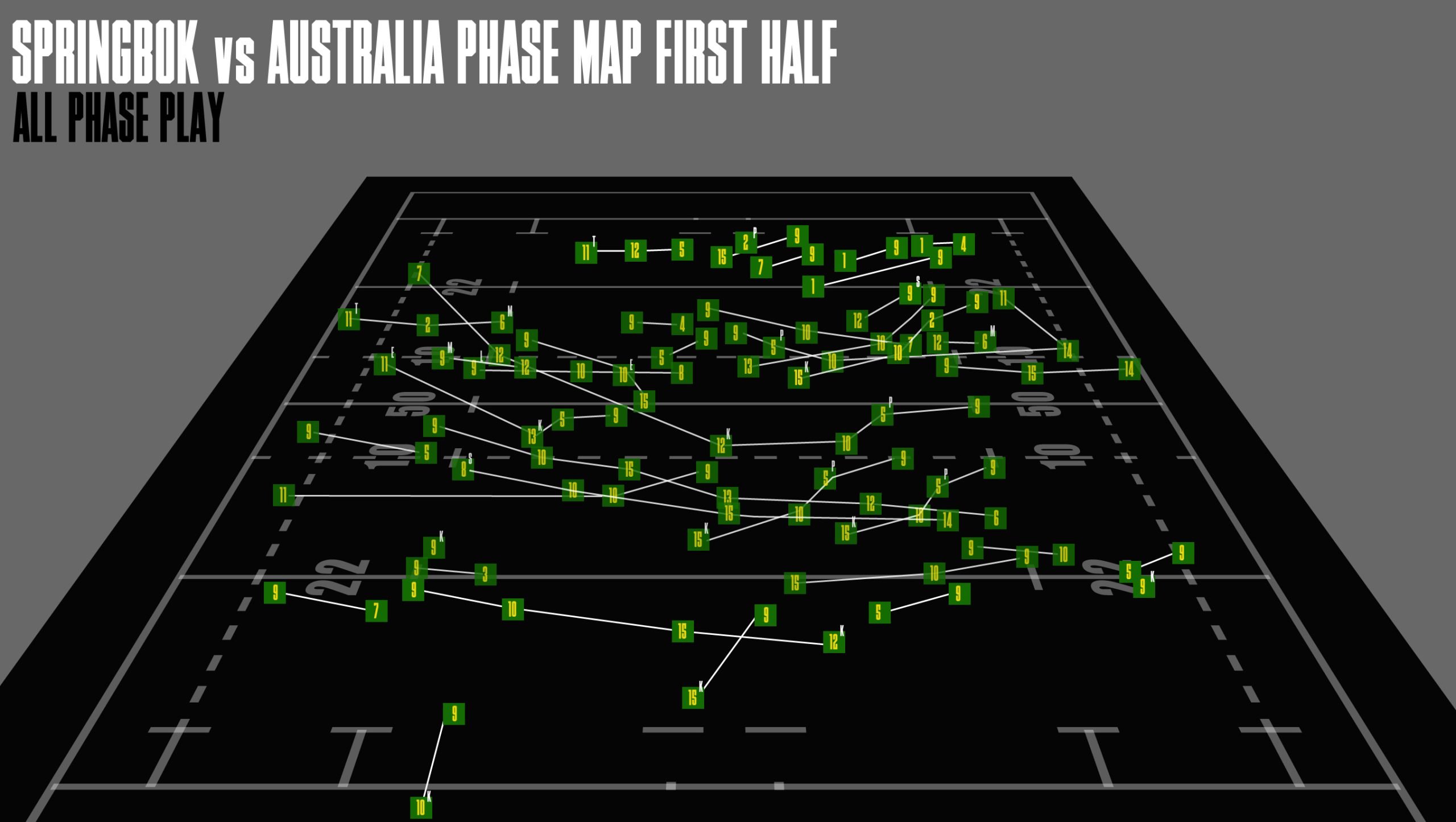
This was a high PPC half from the Springboks relative to what we know about them from last season.
The Boks were quite direct in the opposition 22 and in their own 22, for the most part, but that Q2 action is pretty notable.
The volume of passing and structure that’s going on in Q2 is heavily increased from what we know about this South African side. The Springboks received a lot of kickbacks from the Wallabies in this area of the field and, instead of box kicking back, they played heavily off the screen and #10.
But let’s strip that back to show the passing sequences that went through a pod to #10 anywhere on the field to get some clarity.
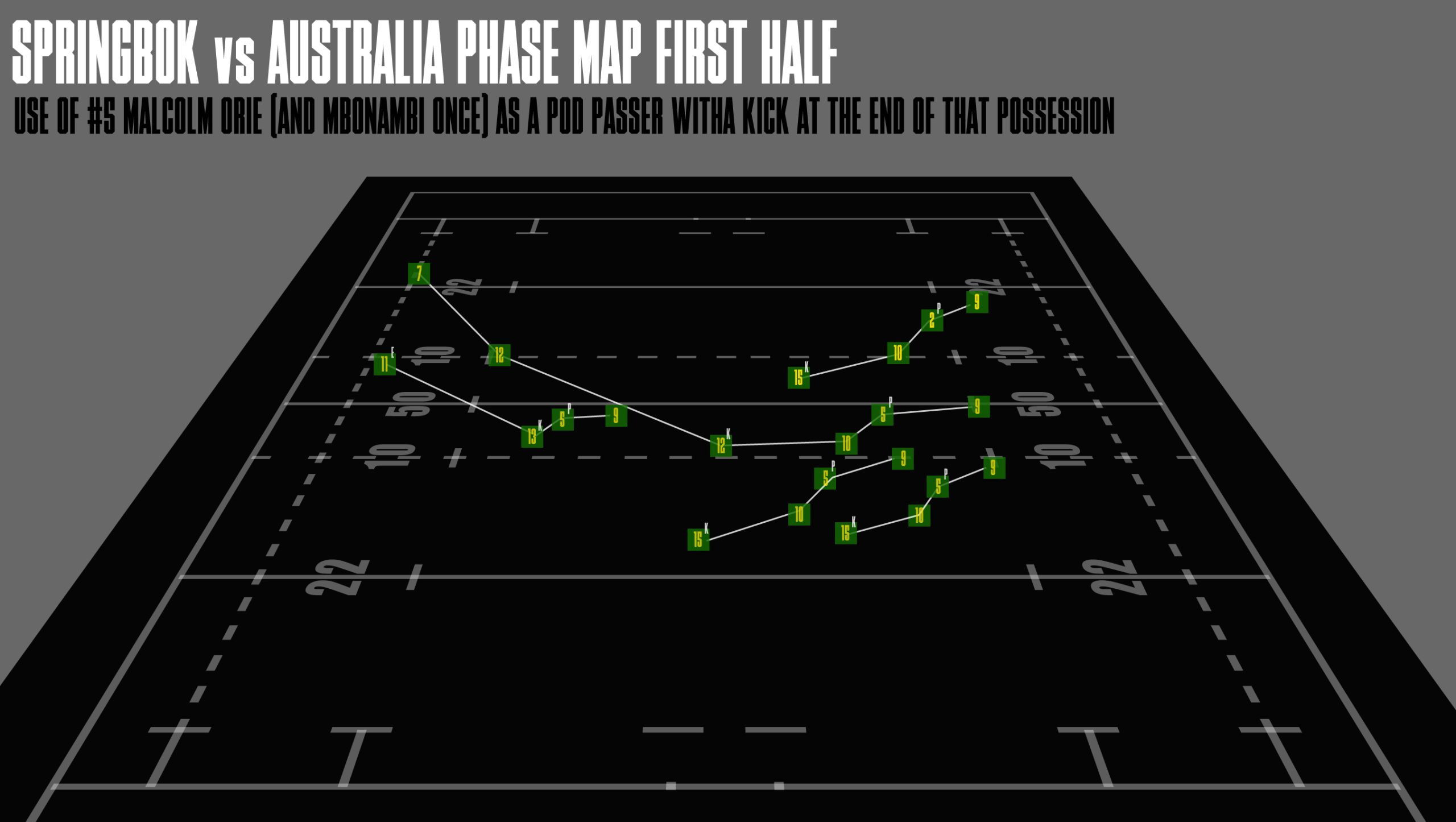
They primarily used Marvin Orie in this role with Mbonambi showing up for a pod pass but the biggest standout is that every one of those pod passes ended with a kick on the play off the third pass.
It’s also notable that the Boks used this strategy in the first half against a team with a recently hired Rugby League defence coach that was kicking above the mid-range – just like Ireland.
That structure – unusual for the Boks on the whole – opened up the ball in a central space well above the range of the blitz, which gave Le Roux, Esterhuizen and Am opportunities to make a play with the boot with clear ground in front of them.


This seems, to me, to be a way to target heavy blitz teams that also kick at counter-transition length, especially when the kicks were all targeted to land on Kurt Lee Arende’s wing, in behind the edge defending wing whose natural tendency in a league style defence is to push up from the secondary cover position in the backfield.
Saturday’s game against the All Blacks might not require as much forward handling in the same way as the All Blacks don’t defend at that height so we might see much less forward passing in favour of rolling across their defence. If we do see more passing, however, it might hint at a role change in the Springbok second row that puts a clear delineation between their pack builds, especially with Du Toit and Mostert seemingly filling half-lock-style roles.
It’ll be something to keep an eye on as the Rugby Championship develops.
