


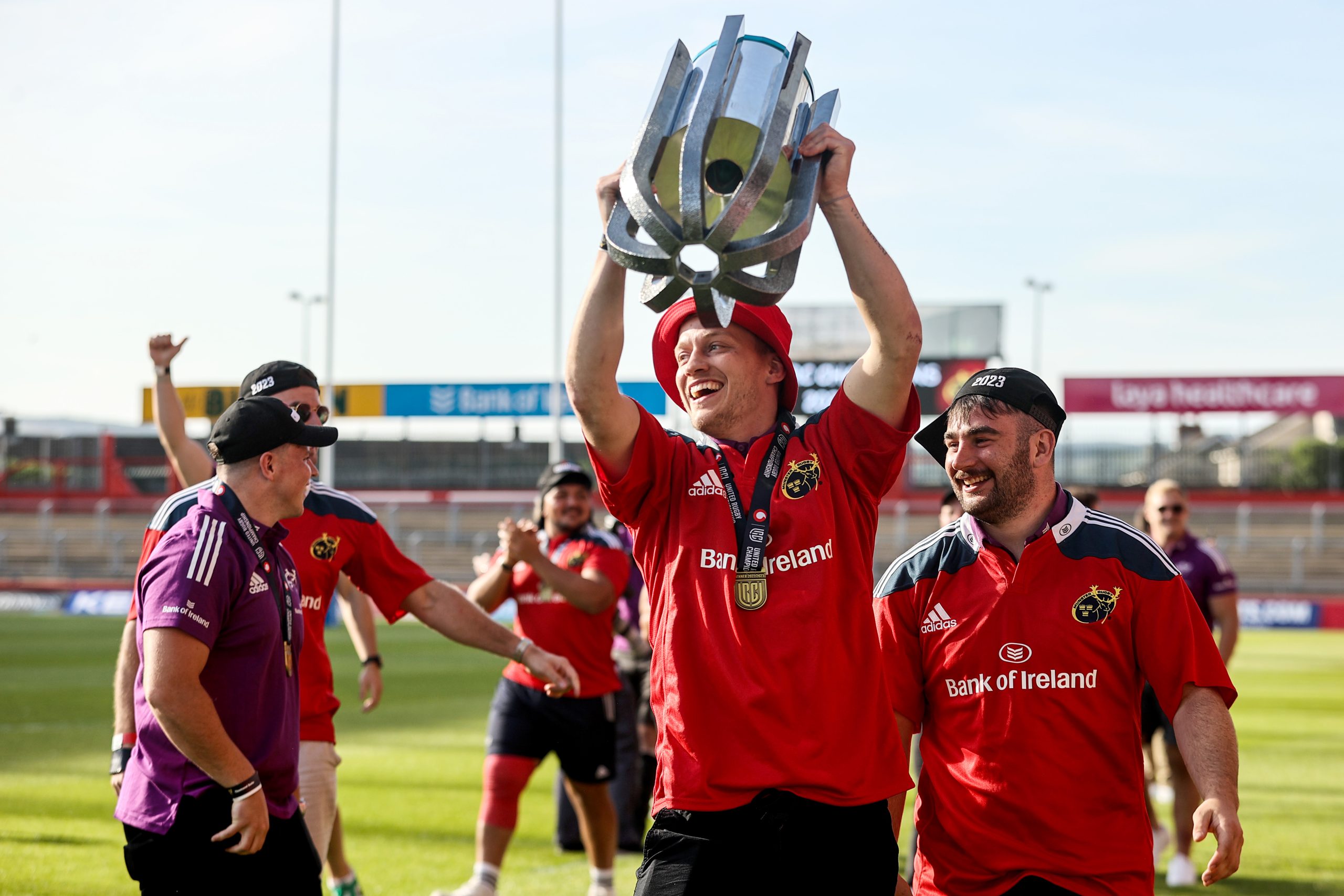
My girlfriend watches rugby with me every now and then and I’ll be honest, it isn’t easy to watch rugby with me.
I’m either jotting notes and timestamps down or queuing up posts or turning around and babbling something to her about maul builds or 3-3-X shapes that probably make me look like this.
She’s a casual rugby watcher so she knows all the big names – Murray, O’Mahony, Sexton – but the others can slip by her. Robbie Henshaw, for example, is “that handsome guy”. And who am I to argue with an objective fact like that? Craig Casey is “the really good small fella”. Again, an objective fact. Over the last few weeks, another guy has entered the realm of the Names She Remembers. That player has gone from “that really good fullback” to “the really good blonde fullback” to… “Mike Haley”.
That’s a big step.
This is the scale of what Mike Haley has achieved in the last few months. It would be reductive to boil Mike Haley’s career at Munster down to the last few months just because this season ended with a trophy. In truth, Haley has been building his game here for years while being one of our most consistent performers.
With the arrival of Mike Prendergast and the change in style that Munster have brought in this year, we’ve seen one of the most satisfying things in the game; when a good, but not fully utilized, player finds a system that suits them down to the ground.

Last season, Mike Haley was good. This isn’t unusual. One of Mike Haley’s best traits is that he’s almost always good at the very least. He scored a try in that epic against Toulouse in the Aviva and was generally one of our better performers in a disappointing season.
This season, certainly since the South Africa A turning point, has been radically different in that Haley looks like a player that has levelled up from a really good player to a great player. How could this have happened?

For me, it comes down to usage. Last year, Haley was often used as an auxiliary handler behind Damian De Allende and Chris Farrell. He was the most obvious guy to use in that outside backline as we tried to get Farrell and De Allende into the game as gainline breakers and collision winners. This was a constant schematic problem for Van Graan & Larkham’s Munster – getting the best out of De Allende often meant contorting our backline into awkward shapes to make sure he was the player receiving a pass in space rather than giving the pass to someone else.
We’d often drop Carbery into fullback to up our passing radius in bigger games as we reached the last quarter, to mixed results.
Haley’s role last season seemed to be as a habitual auxiliary playmaker in line with Munster’s ever-morphing play style. Haley had the quality to make it work week to week where he’d be a deep-lying kick-magnet exit machine one week, a heavy transition runner the next and then a playmaker like Willie le Roux whenever Larkham figured the ground was going to firm up the week after that. He was Van Graan’s stylistic utility wrench.

For me, the Mike Haley we’ve seen this season has been the best version of him we’ve ever seen and I think the reason behind it is simple – he’s become our transition captain, so to speak and become more of a strike runner than an auxiliary playmaker. The base statistics highlight this change pretty starkly.
Last season, Haley made 109 passes in 19 games. This season, he made 67 passes in 18 games.
In 2021/22, Haley had seven games where he passed the ball more than five times. This season, he only made 5+ passes twice, with the highest being in the game against the Dragons in the second game of the season. The last time he passed more than five times (6) was against Ulster back in January.
It isn’t that Haley can’t pass – far from it. His killer pass against the Stormers is all the proof you’d ever need that Mike Haley can rip a pass with the best of them.

But that asks a question of its own.
Why, if Munster are passing the ball more than ever before, is Mike Haley passing the ball less often year-on-year?
What’s actually happened is that Antoine Frisch, Malakai Fekitoa and Shane Daly have hoovered up the majority of the excess pass volume our new style runs on with Haley transitioning into a very specific role in our backline. In Prendergast’s system, the #12 (when it’s not Jack Crowley) will be found out on the wing and edge spaces as often as they will running behind a screen – it’s why I think Alex Nankivell is going to primarily wear #12 for us next season – with Antoine Frisch acting as the primary edge and second screen playmaker.
Haley is most often seen now in two primary areas;
The first is as a tertiary playmaker (along with Daly) off #10 when Frisch has been engaged in the previous sequence of play. Haley’s really good in this spot as he’s got the size, dynamism and subtle touch to make things happen in that slot.

This spot allows him to move in tandem with Shane Daly and Calvin Nash as the back three rotate and loop infield as needed.
Haley’s balanced skillset makes him a multi-vector threat when he’s put into a position to make a play. He can win collisions (just ask Ruben Van Heerden) and he can challenge a blitz with a well-rounded kicking game. He can nuke it downfield, yes, but he can also play it more subtly.
 Watch how Crowley dips right into the backfield to take the exit from the Stormers – another key relationship with Haley is the coverage of the backfield with #10.
When it comes to our settled outside backs by minutes played, our pass volume breaks down like this;
- Antoine Frisch – 166 passes
- Malakai Fekitoa – 125 passes
- Shane Daly – 119 passes
- Mike Haley – 67 passes
- Calvin Nash – 44 passes
The majority of Haley’s involvements now can be found on transition, where he’s an incredibly valuable component in our high possession, on-ball game. There are very few players in the game as good as Haley under the high ball or tracking kicks into deep tram position in the backfield. Haley has the pace, agility and size to set the centre-field position that we’re always looking for to start punishing teams who kick long to us.

You very rarely see Haley get smashed in these positions because he’s so physically dominant when he’s moving at pace and he’s got the footwork to evade the first transition defenders with the size to buy time for the cleanout when he engages the defence. He sets the position that we use to go 10/11/12 phases deep and shows up, again and again, to keep the play going with whatever is required.
He’s passing less often because he’s in positions where he doesn’t just have to sling the ball on while he waits for Jack Crowley or whoever the primary playmaker is to get back into position. He keeps the play going with multiple involvements, as well as a fantastic offensive breakdown output which is another underrated part of his game.
Defensively, there are few fullbacks at his level when it comes to his positioning and his ability to smash guys.

When Mike Haley hits you, dear reader, you stay hit.
As I was writing this, I can easily say without fear of contradiction that Haley is the best, most complete fullback, Munster have ever had in the professional era. Go through the names and you’ll see it’s true.
Haley’s a better transition runner and a more balanced attacker than Shaun Payne while being every bit as solid under the high ball and positionally.
He’s a more complete handler, a stronger runner and a more durable option than Felix Jones while being every bit as brave defensively.
He’s stronger and more dominant defensively than Paul Warwick. Christian Cullen might have been a far more renowned player but he was a shadow of the great he was by the time he played his 44 games for Munster in four seasons.
Haley is a more complete defender and aerial threat than Simon Zebo, who was a better winger at his peak, for me while offering more in-system usage on transition in Prendergast’s system.
Haley is a better athlete, a more rounded kicker and far more dominant aerially than Denis Hurley and Dominic Crotty, who were two other chronically underrated players.
And now Mike Haley has the medal in his back pocket to be credibly included in that list of greats.
