


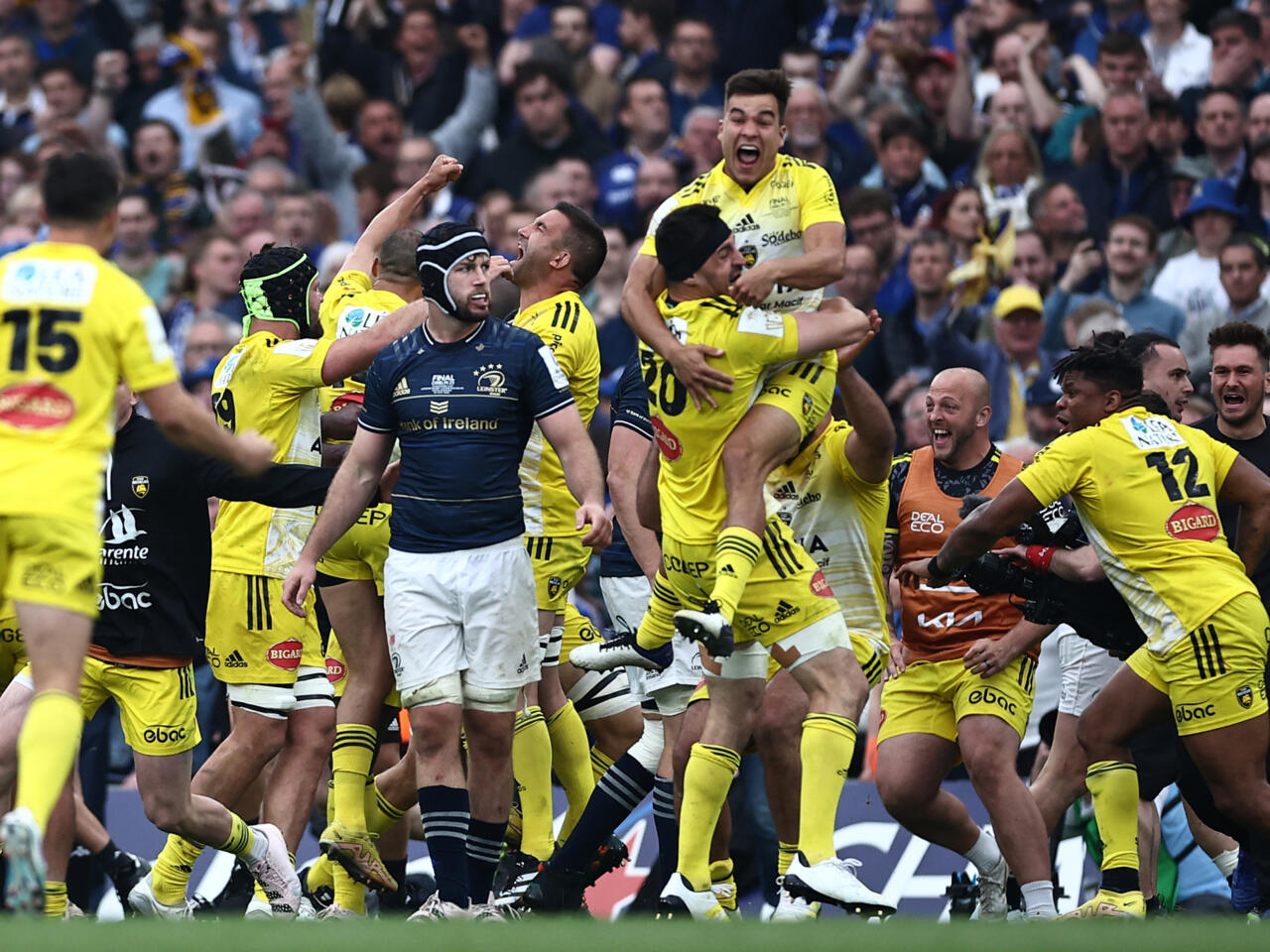
Losing a final as Leinster did this past weekend is incredibly difficult. It’s even more difficult to take when you consider that last year’s final played out broadly the same way. Leinster established a lead heading into halftime mainly based on the work of their lineout before La Rochelle dominated possession in the second half and slowly ate away at the lead until a late winner sealed Leinster’s fate.
A year later, with all the preseason adjustments Leinster would have planned and the long season of work, it all happened again. An early lead gobbled up over the span of 60-odd minutes like an anaconda slowly crushing and eating a cow.
In the aftermath of this game, I’ve seen a tonne of talk about how Leinster need more size to compete with teams like La Rochelle on those physical terms. This was considered an issue after last season’s defeat to La Rochelle also but it was also one that had been deemed to be fixed with the signing of Jason Jenkins. That signing has not turned out as planned and, while you could point at Tadhg Furlong slipping quite precipitously from his best in the last 12 months as a way that Leinster have gone “backwards” from where they were 12 months ago, I think the emergence of Dan Sheehan as one of the premier hookers in the game as well as James Ryan stepping up out of a four-year physical plateau goes some way to addressing “the size problem” that many seem to be obsessing about.
You could argue – convincingly – that neither Cian Healy nor Ronan Kelleher are the same players they were last season due in part to age catching up to them in the former’s case and a litany of injuries to the latter, but I fundamentally believe that “size” and the supposed lack of it is something of a red herring when it comes to Leinster’s game. Toulouse are every bit as big as La Rochelle in the front five – if not bigger, man for man – and that didn’t prevent Leinster from blowing them away. Now, did Leinster perceive La Rochelle as a bigger physical threat than they were due to previous scar tissue, to the point it altered their approach? It’s almost impossible to say but I suppose my point here is that Leinster were not drastically undersized for this contest by any means.
If anything this game, for me, was a perfect illustration of how different styles and tactical approaches produce unpredictable outcomes. It was a pure distillation of Leinster’s adjustments this season in the face of the immovable La Rochelle object so, as a result, it was fascinating. This is what Leinster have been building to for an entire year so their approach should, in theory, take in all the intelligence they picked up from the wreckage of the last three defeats to this very team.
Counter Transition
I’ve spent quite a bit of time writing about Leinster and Ireland’s counter-transition game over the last few years but, at its core, it’s about elongating the field, bumping the ball-in-play time in a way that stresses the opposition more than you and;
When you make your counter-transition play first and well, you play with initiative. The opposition is forced onto the back foot and finds themselves struggling against what feels like invisible momentum, almost, just to get back to an even keel.
Ultimately, the counter-transition game relies on the manipulation of territory through long, infield kicking combined with a high defensive press designed to force the opposition to directly or indirectly give you the ball back in such a way that you can double down on your positional advantage with deliberate on-ball action. When you take the initiative, the opposition has to kick incrementally better than you did to get out of the counter-transition trap. Any mistake when they attempt to do so is a killer – the very best sides will make you pay.
The mistake, in this instance, is giving Leinster lineout position in and around your 10m line, something La Rochelle did right from the kickoff.
The length Byrne gets on this restart has counter-transition at its root – he’s kicking for the lineout.

Byrne aims right for that pre-schemed spot in La Rochelle’s restart build for a very specific reason. He’s looking to find Dulin and use Keenan and Henshaw to pressure his exit off the left side. Byrne’s kick drifts to the right-hand side of the field which, in tandem with the chase pressure from his runners, squeezes a pressured exit out of Dulin.
Leinster would have been aware of this La Rochelle restart build and schemed specifically for it.
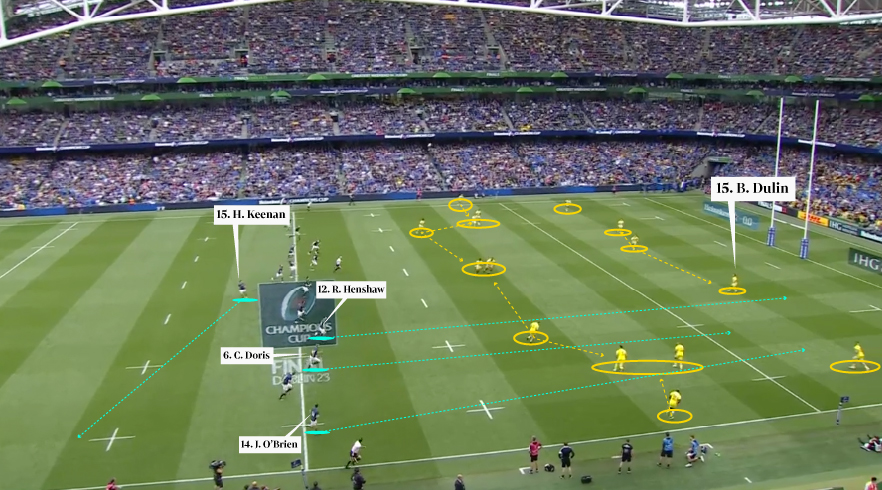
They scored directly from the resulting lineout which is about as clean a counter-transition sequence as you could ever see, right from the kick-off.
Leinster were distilling their counter-transition game down to such a purity that they hoped it would be toxic for La Rochelle. From the restart, Leinster manoeuvred Conan out of La Rochelle’s blitz right off the restart – something O’Gara spoke about targeting two seasons ago. La Rochelle found great success kicking to Conan at the back pin of Leinster’s restart structure and then hammering him with a chasing flanker up the touchline.
This time – Leinster adjusted. Look at the screen Ryan, Furlong and Van Der Flier build for Conan to swerve infield and keep Botia off him, who had been steaming up the touchline to catch him at pace.

Sure, there’s a bit of luck here with Wardi swinging into Sazy to let Conan out but this shows that Leinster knew what hurt them the last time and made plans accordingly.
From that really good exit, Leinster went right back to counter-transition and found Lowe with a booming left-footed drive downfield to Brice Dulin inside the right tramline.

This gives a really good example of what Leinster are trying to achieve with this tactic – it’s low risk, the ball is moved high up the pitch from where it started inside the Leinster 22 and the chase pressure yields an immediate reward.
A kick to the right side with a left-footed kicker, heavy chase pressure with a runner and the forward line shooting upfield to beat La Rochelle to the transition defence line.
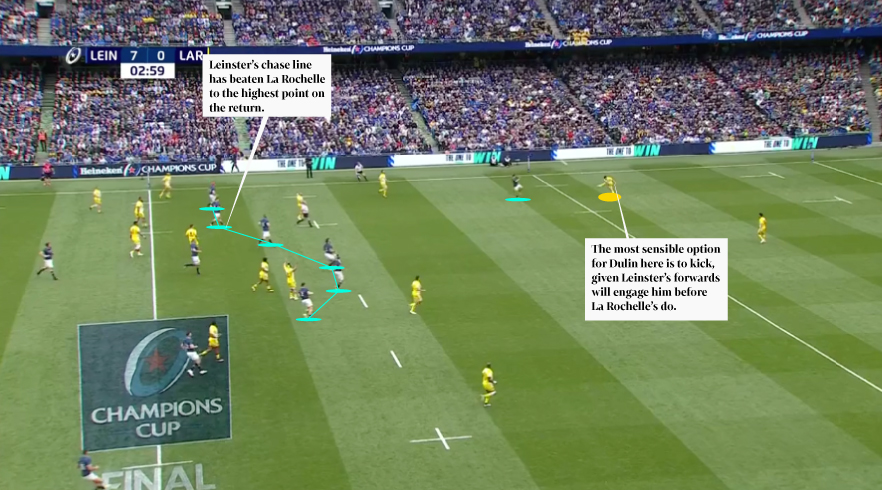
Dulin can only kick at this point and, from the resulting lineout, James Lowe landed a schemed 50/22 to bring Leinster to the 5m line, where they would eventually score from a scrum launch.
In two moments of counter-transition, two tries scored.
From the next restart, Leinster tried to screen Conan again with Ryan, Furlong and Van Der Flier – La Rochelle were still targeting him – but this time La Rochelle were able for it and Wardi stopped him dead inside the 22.

There isn’t as much room to manoeuvre for Leinster here but they use the same exit pattern. Secure the ruck, sling it back for Lowe and drive the ball upfield.
Look at the depth Lowe kicks it from compared to the previous exit;

O’Brien, the touchline chaser, has to step back in line with Lowe, who has to take extra depth to ensure he’s not scragged or charged down by La Rochelle.
As a result, there is less pressure on Dulin who can swerve O’Brien and set up La Rochelle for their primary style – on-ball, high possession, high phase rugby.
They would go through 12 phases of attack in this post-transition sequence without kicking. These sequences showcased all the things you’d expect from a high-possession side. Offloads, multiple screen shapes, and some scrappy moments on the edges as the attacking frame reloads.

You can see Leinster’s defence are really redlining to keep La Rochelle contained here. La Rochelle have all the attacking scramble you’d expect – good hand control when the ball juggles, willing offloaders and midfielders scoring high numbers at the breakdown.
At this stage, however, Leinster are still fresh and they make good stops at key times – this one on Aldritt by Ryan and Sheehan was particularly good and forced La Rochelle to readjust backwards, which relieved pressure on Leinster.

When La Rochelle readjusted, everything was a little hurried and they couldn’t scramble around Leinster’s edge blitz. Henshaw pressured Rhule, who’s hurried pass to Paul Boudehent was met man and ball by Jimmy O’Brien.

Van Der Flier won a key penalty and La Rochelle had Kerr-Barlow sent to the bin for a cynical tackle on Gibson-Park who tried to tap and go.
Leinster would score off the resulting lineout, but the position was earned by that multi-phase defence on the back of a long counter-transition starter.
Pyrrhic Victories
Looking at the game back, it began to dawn on me that Leinster’s commitment to counter-transition starter plays was total. They gave up almost every single possession they had to exert this up-field pressure on La Rochelle in pursuit of lineout position or turnovers, both played and penalty.
This is right off the restart from the try to take it 17-0 against 14 men. La Rochelle went away from Conan on the restart but Leinster looked for him anyway – once again he got stuffed inside the 22 by Wardi. As before, Lowe had to drop back with O’Brien keeping in line to exit long upfield.

Just like the previous example, O’Brien was too far back to pressure Dulin into kicking so the La Rochelle fullback was able to advance well into the Leinster half and, a phase later, Leinster had conceded a breakdown penalty as they over chased the ruck to spoil La Rochelle’s momentum.
It looked to me like they couldn’t withstand another 11/12 phase sequence.
La Rochelle would score from the position they kicked after this penalty but Leinster would not be deterred from this tactic and kept using counter-transition starter plays in an attempt to hem La Rochelle behind their own 10m line.
By the time it hit 40 minutes, Leinster were chasing with nowhere near the same intensity as Byrne, Lowe and Keenan kept being forced further and further back which meant the runner to bring the forwards onside had to travel further before they could move.
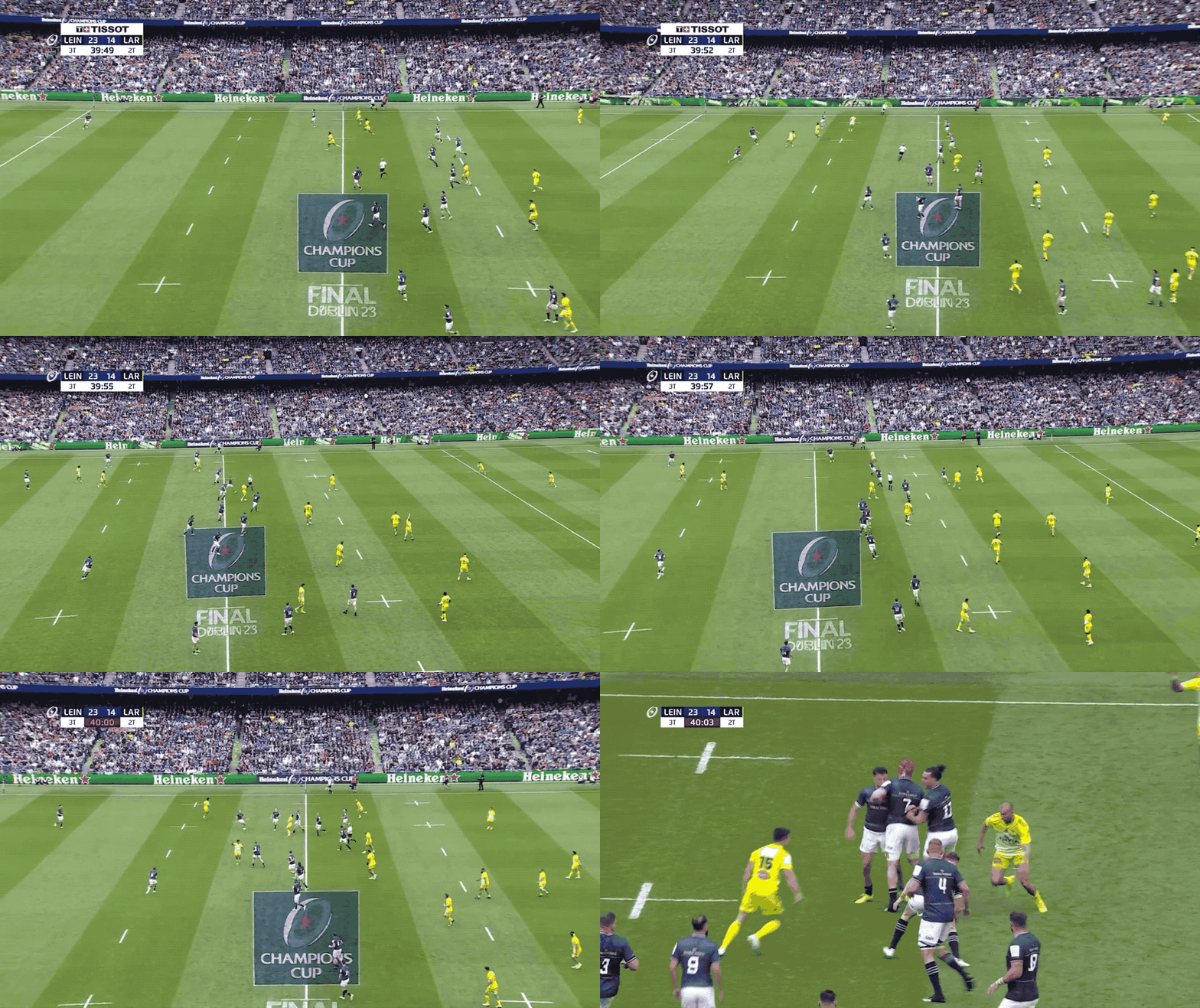
Leinster were trying to keep the heavy La Rochelle pack at arm’s length to defend the lead but with each passing minute, Leinster’s counter-transition game seemed to lose energy to the point where it was just kicking the ball away.
Not one of Leinster’s starting outside backs passed the ball in this game a single time. Why? Leinster were literally just boiling their game down to counter-transition starter plays and booting the ball downfield. In the second half, it was exactly the same as the first, but this time with far less energy than before.
This long transition starter by Gibson-Park had a slow, lethargic chase and it wasn’t long before La Rochelle had isolated Ross Byrne in open field for a big break that should have been a try, but ended in three points.
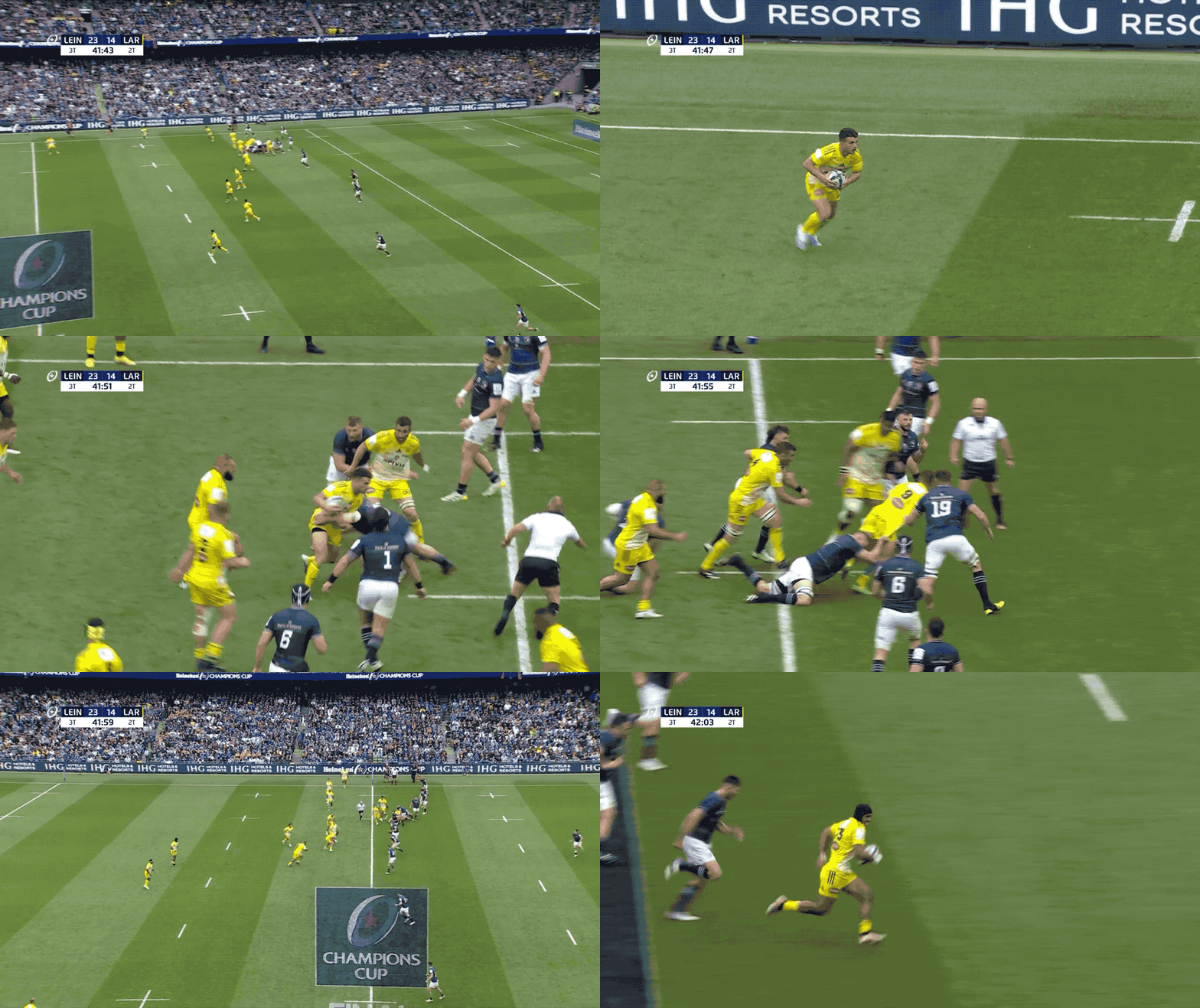
And it continued in that vein for most of the second half. Between the 40th and 74th minute of this game, not one Leinster possession went longer than three phases without a kick. Even decent lineout position was surrendered in an attempt to get the ball upfield.

If you’re thinking that this all looks a little laboured, you’d be right – at this stage, Leinster were getting burned on both ends. They had to defend waves of La Rochelle attack and then, when the siege would lift, they would boot the ball downfield again and start the entire process all over again because they couldn’t risk kicking off the field unless they had no other option.
La Rochelle’s winner was inevitable because La Rochelle wanted on-ball possession and Leinster kept giving it to them over and over and over again. You can only defend for so long before the maxim of “it’s more tiring to attack than defend” completely flips on its head and that’s what happened here.
Would Leinster’s approach have differed if they hadn’t a 17-0 lead? It’s hard to say but one thing is pretty clear, in my opinion, and that is that counter-transition when used like this is the exact opposite of a winning strategy against a team that dominates possession.
Adding more elite-level size to the Leinster team is pointless when you’re a counter-transition team because the team isn’t built to accommodate it. Their back five build has looked elite this year with Moloney, Ryan, Baird, Van Der Flier and Doris – all of whom are super mobile and rangy forwards who can cover that type of ground.
Their front row runs best when it’s got Porter – an absolute freak of nature athletically – and Sheehan – ditto – covering obscene levels of ground without a drop-off. Furlong looked well off the pace in this game in part, for me, because of the ground he had to cover before he was able to impact anything.
Unless Leinster can make a change to their pack and midfield build – as well as the inherent qualities of their halfbacks, #10 in particular – it’ll be difficult to see how they’ll wean themselves off this game plan which is good enough to beat 95% of the sides in Europe who either aren’t fit enough to live with it, aren’t built to play the type of on-ball rugby that kills counter-transition rugby or they don’t have the elite level heavy forwards you need to make it work at the super-elite level.
