


We have business to settle with this Glasgow team.
That’s been the story of the last few weeks really, though, hasn’t it? A few weeks ago, back-to-back stinkers against Glasgow and then the Sharks threatened to derail our season. We got a measure of revenge against the Sharks in the last game of the season to book this playoff run (along with Champions Cup rugby next season) and that brought us to Scotstoun for this quarter-final.
The good thing about Glasgow is that they hate us and we hate them right back. There’s a purity in that. No matey-matey, beers with the boys bullshit here. This is bone-on-bone, spite club murder ball stuff from the minute that game week comes up.
That’s the way rugby should be. The rise of #rugbyvalues just doesn’t stick with me. That isn’t the rugby I know. Give me generational grudges, spite and enmity any day of the week over clinked beer bottles, press officers lining up to take photos of lads in swapped jerseys for socials and swept-clean sheds.
Give us our hate.
I was in Thomond Park back in March for Glasgow’s big win doing live radio comms for Live 95. When you’re on the radio you kind of have to keep talking even if what you’re watching isn’t great or, in this case, distressing. The person driving in the car wanting to listen along to the game on the radio isn’t interested in me silently muttering “for fuck sake” every few minutes so I had to keep talking away so, as a result, I have a very detailed memory of that game. I couldn’t look away, I couldn’t shut up, I couldn’t leave. It was like aversion therapy where I got paid at the end.
To say that we were bad in that first half – truly abysmal – in that first half would be a chronic understatement. When the fourth Glasgow try went in right before half-time, people around me in the stands got up to leave and would not be back. That isn’t a reflection on them – it’s a reflection on how bad we were in that half. We shortchanged the people who made the effort to spend their money and come to the ground.
That cannot go unanswered.
And where better than Scotstoun to answer Glasgow back for beating us at Thomond Park?
That will be easier said than done. Glasgow are an outstanding side that are the form team in the URC over the last 10 games. Let me put it this way – if the URC started 10 games ago, Glasgow would be top of the table ahead of Leinster, ourselves and Ulster. They have been a formidable side ever since they got a sticky start to life under Franco Smith out of the way. Simply put, their performances domestically and in the Challenge Cup have been of the highest standard since around December. At home, they have a record comparable with Leinster and beating them this weekend will be up there with the South African tour when it comes to sheer difficulty.
The Hard Way?
The Hard Way.
Glasgow Warriors: 15. Ollie Smith, 14. Sebastian Cancilliere, 13. Sione Tuipulotu, 12. Stafford McDowall, 11. Kyle Steyn, 10. Tom Jordan, 9. George Horne; 1. Jamie Bhatti, 2. Johnny Matthews, 3. Zander Fagerson, 4. Scott Cummings, 5. Richie Gray, 6. Matt Fagerson, 7. Rory Darge, 8. Jack Dempsey
Replacements: 16. Fraser Brown, 17. Nathan McBeth, 18. Simon Berghan, 19. JP Du Preez, 20. Lewis Bean, 21. Sione Vailanu, 22. Ali Price, 23. Huw Jones
The obvious tweak that Munster with reference to the game in Thomond Park – GITP for short – is the breakdown work in the first half. As far as this season goes, it was as bad as anything we’ve produced in back-to-back quarters. Munster are an on-ball team so ruck efficiency and Offensive Ruck Work scoring is a great indicator of how we’re performing in any given quarter. A high Collective Offensive Ruck Work score doesn’t necessarily mean we’re scoring tries but it does show that we’re retaining possession well and putting ourselves into a position where we MIGHT score tries.
This graph is a breakdown of all our quarters over the last four games.
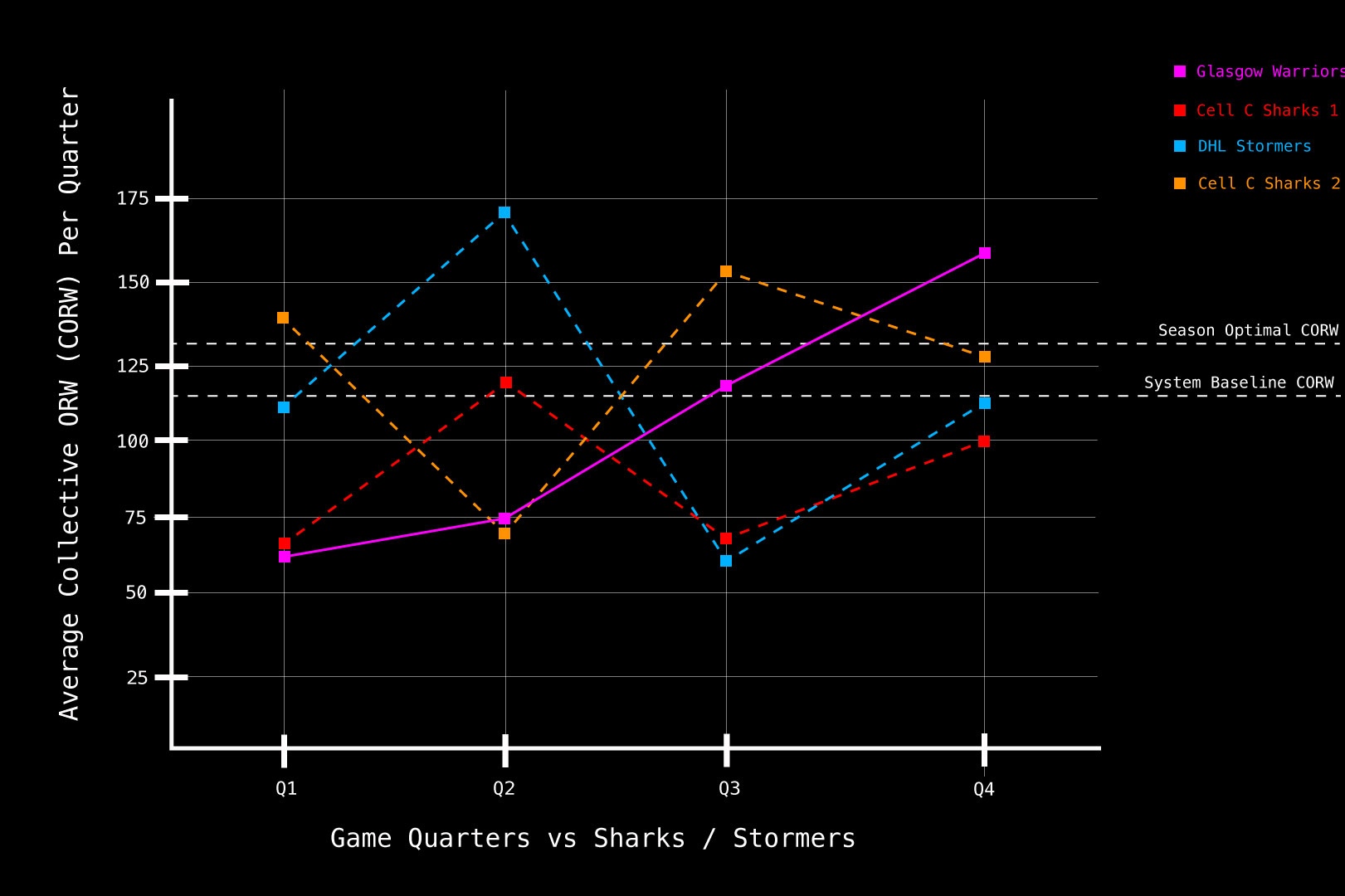
Now we overperformed (and underperformed) our scoring in some of these but they give you a guideline on how well we’re retaining the ball quarter to quarter. As far as the first half in the GITP, that’s about as bad a half as we’ve put down all season, purely from a ruck efficiency perspective. Any surprise then that we were blown out of it when we kept turning over possession and handing in-game momentum to Glasgow?
No.
We had so much of the ball in that first half that they essentially off-balled us through Zander and Matt Fagerson, JP Du Preez, Scott Cummings, Nathan McBeth and Sione Vailanu, in particular, who punished us in the tackle and at the breakdown relentlessly.
We looked too small, in a word, to hurt them in any meaningful way and even without that, we were suffering at 9 and 10 when it came to moving us around the field efficiently with what possession we did have.
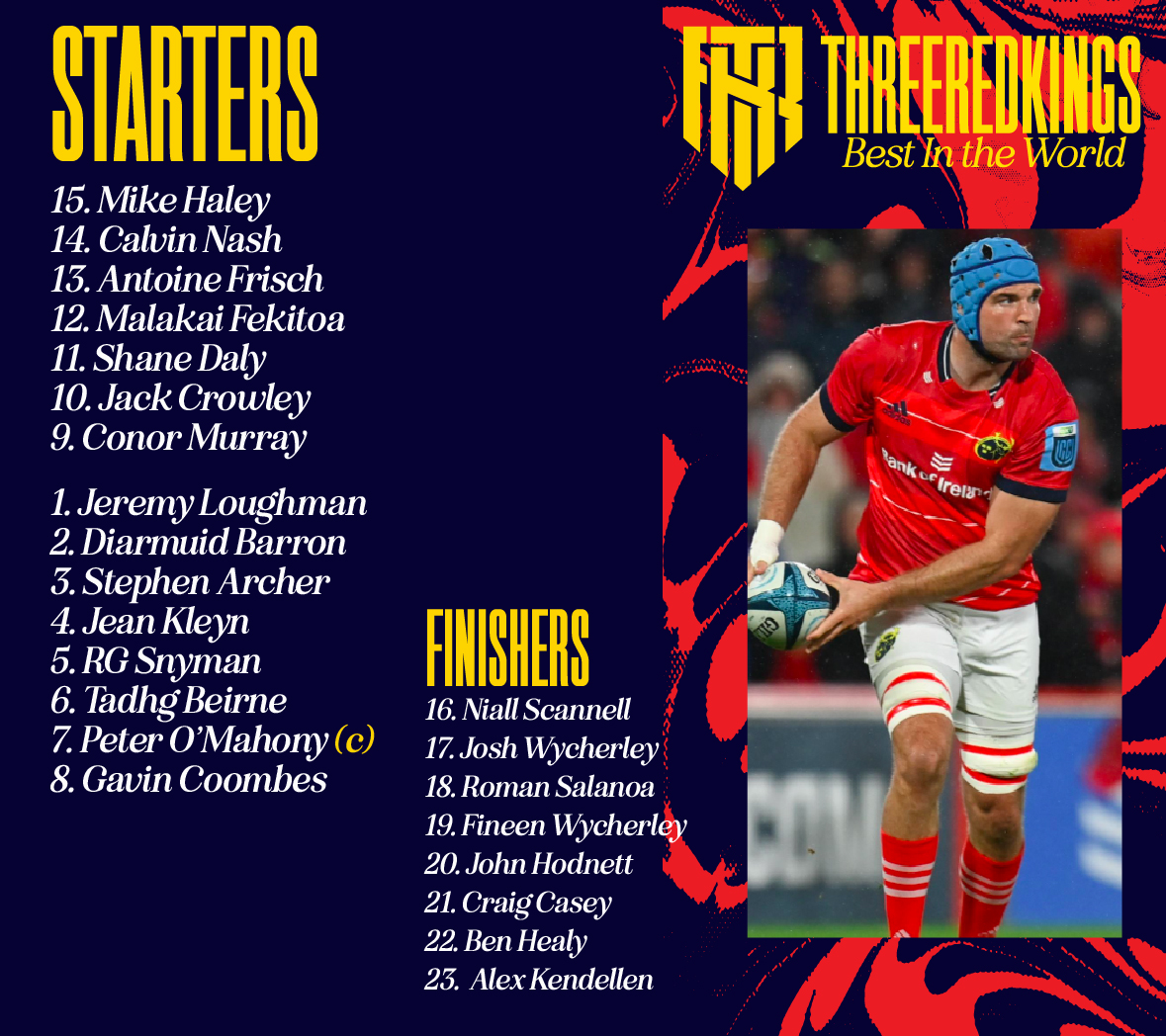
So we lost and that was despite having enough 22 entries to have gone in 28-0 up ourselves if we had been able to manage our field position and discipline better. A better breakdown performance is a must and, interestingly, we’ve selected the pack build that we used when we hit our optimal CORW score this season – against the Bulls with a three-lock pack.
With a build of Edogbo, Kleyn and Beirne in that game Munster were able to dominate a physically imposing Bulls side in possession and at the lineout on a night where handling conditions were really poor.
Will the same build work again here? It just might. With O’Mahony holding one edge and tracking infield with the tighter rucks and Beirne holding the other and tracking infield, we have a Big Six of Snyman, Kleyn, Coombes to win collisions with Barron, Archer and Loughman in top form at the offensive breakdown over the last few weeks.
That is a structure that can win this game if it plays out the same as the GITP.
From a system perspective, attacking Glasgow’s lineout is a key part of beating them home or away. We have first-hand experience of this when we were unable to affect them in the lineout and, as a result, we suffered in the maul.

This maul opened the scoring for Glasgow and you can see the strength of their maul build here, especially when they surge in behind a failed counter-launch. Glasgow’s maul is really dangerous this season and you can see why here – a middle lift with a swing “punch” from the front and the back of the lineout. Nice and low with a unified “punch” to win the first shove.
You can see it here – flanker lifts on the inside, the other lock lifts the back with the props swinging from the tail and the front to add the weight.

Vailanu, in particular, adds a particularly strong “rip” as the +1 receiver. So much of what Glasgow does really well comes from the lineout as a core starter platform.
The thing is, almost all of their best work happens with a variation of that structure – cut out, circle back for the punch, lift and drop in the middle.

Any lineout outside your 22 is worth challenging in the air at the front or in the middle because that’s where almost all of their starter plays go. Squeezing Johnny Matthews’ throwing range to make him find Gray under pressure from O’Mahony, Beirne and Snyman is a great play for Munster because if they want to go to a 5+1 build to give them backline options, we’ve got a 5 man lineout core that would spook any lineout in the game.
Beirne and O’Mahony are some of the best pace counter-jumpers anywhere in the game and Snyman has a wingspan like a pterodactyl. When you add in Kleyn as a power-lifter, there’s no reason why Glasgow should have an easy time on any of their own throws.

It’s almost worth your while to content any set up of theirs in the air when it’s outside your 10m line because if you give them an uncontested ball, they’ll hit strikes like this that stress your flank defence where we’ll be a little slow, at least to begin the game.

This is a good example of the system the Warriors play off their lineout possession – they are always looking to dazzle you with options until the punch comes. The thing is, the punch is rarely something you can’t live with but that is classic Glasgow in and of itself.
The Warriors don’t win a whole lot of collisions (they only make the gainline 50% of the time) but they don’t need to. They aren’t going for depth, they’re going for a quick ruck point that they can run shape off to force wide number overloads. That is especially true in the direct aftermath of a maul feint or a gimmick play off the front. Look at the first ruck here;

Lightning quick ball despite the lack of gainline. Connacht opted to no-compete here to keep players on the feet but Glasgow are so good at running blocking lines you’re nearly better off contesting these wide rucks when they are stacking numbers in their big openside framework. They aren’t after gainline – they want space. Deny them the quick recycle and you can slow down the Warriors, bring them back into settled phase play and you take them off-scheme.
