


The engine of the game is the breakdown. Listen to anyone talk about rugby long enough and you’ll hear a variation of that phrase because it really is that important, especially for a high possession, high Pass Per Carry side like Munster.
If you don’t have an efficient breakdown when you have a PPC ratio over 1.4, as Munster does consistently this season, then you will struggle to impact the game at best and lose badly at worst.
With that in mind, it’s unfortunate that Munster’s two worst offensive breakdown performances since the start of the season happened in the first half against Glasgow and then in the first and third quarters of last week’s European Champions Cup Round of 16 game against the Cell C Sharks.
I can actually see the ebb and flow of our breakdown work in big games by tracking our ORW scoring from quarter to quarter. To understand what we’re judging against, we need to understand what is elite globally and then what is elite for this Munster side as we are currently constructed.
The best ORW score I’ve seen since I’ve been doing this metric was Ireland’s performance against France in this year’s Six Nations. I can measure this metric by totalling the ORW score for each player and when I do that for Ireland’s game against France, I get a score of 638. That has to be put into context with the difference in the use of possession at test level and then in the next level down at the European/URC level. But then we also have to account for the difference in style between Ireland and Munster. Ireland, for example, kick far more frequently than Munster do at the moment so, as a result, they’ll have fewer rucks – most of the time – but that is usually opposition dependent. For Ireland, a combined ORW score of between 350 and 450 is generally a good window to be in against most opponents with anything over 380 ORW points usually being enough to warrant a win. Against elite opponents, like the All Blacks, France or South Africa, Ireland will play well when that Combined ORW score cranks up into the high 500s and above.
The best breakdown performance by Munster this season came against the Vodacom Bulls in Thomond Park where we racked up a combined ORW score of 523 on 1.4 PPC. To make our system work at full capacity I think we need to consistently hit the mid-450s. When we go below 430, we can look ropey, when we go below 400 into the 300s we always lose. The only outlier to this is the recent game to Glasgow, which we lost on a combined ORW score of 411 points but if we drill down into that game we see a halftime ORW score of 107, the lowest halftime score of the season. If that had continued in the second half, we’d have barely cracked 200 points and lost by 30 on the scoreboard if we were lucky. A big second half turned it around to 411.
Remember, we don’t kick the ball away at the same volume that Leinster/Ulster/Connacht do so if we have a low breakdown score, that possession gets handed back to the opposition or it becomes an ever-degrading sequence of phase play that ends in a sub-optimal result.
We have a high PPC ratio so we need a high ORW score to support that style.
How did we do against the Sharks?
MUNSTER’S OFFENSIVE RUCK WORK SCORE VS SHARKS
- A Dominant Clean is an action that decisively secures possession when the ball carrier takes contact. A Dominant Clean does not have to be the first arrival at the breakdown but it is rewarded in the context of effectiveness. We will assign this action 3 points.
- A Guard Action is where a player plays a role in helping to retain possession after we have “re-won” the ball on the floor. Sometimes this can happen on a carry/ruck point where there is no active contention by the opposition. Let’s assign this action 2 points.
- An Attendance can be anything from standing as a “kick shield” on a ruck to adding a bit of bulk to ward against a counter-ruck. I’m marking this down as being worth 1 point.
- An Ineffective Action is a blown cleanout, a lean, a breakdown penalty or an action that I couldn’t see any direct benefit for. This will be worth -1 point
| Dominant Clean | Guard Action | Attendance | Ineffective | Ruck Work Score | |
|---|---|---|---|---|---|
| Kilcoyne | 3 | 4 | 10 | ||
| Scannell | 3 | 10 | 2 | 4 | 23 |
| Salanoa | 3 | 1 | 4 | ||
| Kleyn | 2 | 10 | 2 | 3 | 22 |
| Snyman | 3 | 8 | 2 | 1 | 25 |
| O'Mahony | 1 | 10 | 3 | 26 | |
| Hodnett | 3 | 11 | 2 | 27 | |
| Coombes | 5 | 13 | 1 | 39 | |
| Casey | 1 | 3 | |||
| Crowley | 3 | 3 | 1 | 13 | |
| Daly | 1 | 3 | 2 | 5 | |
| Fekitoa | 2 | 5 | 3 | 10 | |
| Frisch | 2 | 9 | 1 | 1 | 23 |
| Nash | 5 | 1 | 8 | ||
| Haley | 4 | 2 | 1 | 14 | |
| Barron | 1 | 5 | 1 | 14 | |
| Wycherley | 1 | 3 | 9 | ||
| Archer | 7 | 7 | 3 | 2 | 34 |
| Wycherley | 5 | 4 | 14 | ||
| O'Donoghue | 4 | 8 | |||
| Murray | 1 | 3 | |||
| Carbery | 1 | 2 | |||
| Kendellen | 4 | 3 | 18 |
Top Five ORW Scores
- Gavin Coombes – 39 points
- Stephen Archer – 34 points
- John Hodnett – 27 points
- Peter O’Mahony – 26 points
- RG Snyman – 25 points
First of all, our top five scorers are way, way too low for a game against a team as big as the Sharks. That includes some players being scored twice for the same ruck because the intensity of the counter-ruck from the Sharks in some instances required a definitive second action by the player securing the ruck.
Ideally, a winning Munster performance here would have seen Kleyn, O’Mahony and Snyman all hitting high 40s at the very least.
But we can see the real flow of the game by looking at the Combined ORW score by quarter. If we can agree that Munster’s average elite performance level at the breakdown is 475, then we can break that down into an average ORW score per quarter of 118.
When we hit that metric, we play better. The opposition will struggle to regain the ball and we build phase pressure with multiple options. When we hit a combined ORW score of 125/130, that’s when we play our best. If we use the Bulls game as a benchmark, our elite quarterly score against a bigger opponent is 130 so that should be the aim against the Sharks and the Stormers on this upcoming tour.
When we break this game down into quarters, we can see the problems.
Quarter 1 – Munster’s Combined ORW Score: 67
Quarter 1 Scoring: 10-7 Sharks
Quarter 2 – Munster’s Combined ORW Score: +122
Quarter 2 Scoring: 7-7 (Munster had two opportunities in the 22 that were blown and the majority of this scoring happened after Etzebeth’s try in the 24th minute)
Quarter 3 – Munster’s Combined ORW Score: 68 (-54)
Quarter 3 Scoring – 26-0
Munster outscored the Sharks in the last quarter 21-0 and buffed the ORW scoring but there was too much “garbage time” about that final 20 minutes for me to score it credibly. When we map this out quarter by quarter with what we know has been Munster’s best breakdown performances this season, we can see the problem laid out pretty clearly.
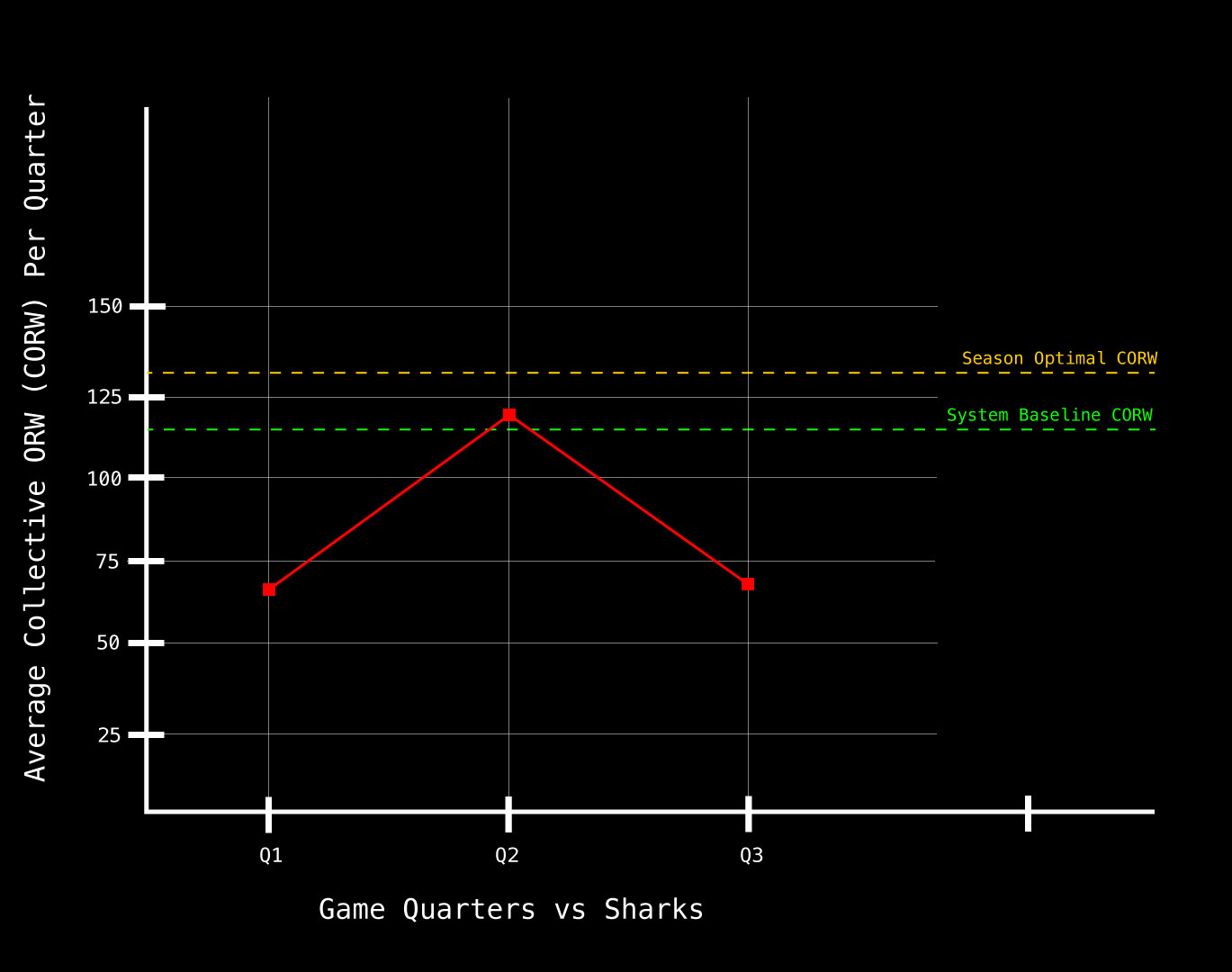
Those two poor quarters cost us the game. Munster don’t play counter-transition rugby so – and this will sound obvious, but it’s true – we voluntarily surrender the ball less which means inefficient breakdown work absolutely kills us. And it’s not just ruck entries either, it’s the play decisions.
Here’s one example. Casey sees Snyman in his eye line running on his outside shoulder, so he assumes that he’s stayed there to act as a ruck support player for Kilcoyne.
But he hasn’t – he’s gone inside to form up a three pod off #9 but he’s on his own too.
 The first ruck here sees Kleyn earn a Guard Acton (2pts) with Coombes scoring a Dominant Clean (3pts).
That means Kilcoyne is isolated by default. Haley has to come from ages back to clean out Mbonambi, and he can’t manage it. Hodnett holding his width because he’s looking for the short tip on passes he’s schemed to receive in these zones. We went off scheme here and got punished for it, something Rowntree referenced in this week’s presser.
“We can’t hide away from our own mistakes. We are the masters of our own downfall when we lose a game and that’s no disrespect to the opposition but a lot of it has always been down to us. What else can you do? You’ve got to get better, you take it on the chin, work hard and that’s what we’ve been doing.
… Discipline and breakdown. We speak about giving the opposition access to our try line through the maul and that comes through our making mistakes at the breakdown. That comes down to our discipline, not sticking to the system, and then you find yourself chasing the game.”
When you play a high-possession game and go off-scheme, you are vulnerable to clean turnovers or conceding a penalty. When you have issues with our maul defence – all throughout the season – that becomes a massive, game-breaking issue because one mistake leads into an area of weakness that puts you behind on the scoreboard.
All in all, our ORW total was 354. That’s the exact same ORW score as our away defeat to Cardiff at the start of the season, and just ten points more than our defeat to the Dragons a week later.
You can see the seeds of this early on by looking at Munster’s (and Ireland’s) canary in the breakdown coal mine Peter O’Mahony. When you’re playing a high-possession game and you don’t have Peter O’Mahony racking up at least 16 ORW points per quarter – given he now plays 60 minutes max in big games – you’re not playing optimally.
What were O’Mahony’s three in-game quarters like here?
- Q1 – 4 ORW points.
- Q2 – +11 ORW points.
- Q3 – +11 ORW points.
We seemed to shift his positioning midway through the second quarter but it didn’t get the required results and you know that because it was his lowest # of Dominant Cleans in months.
When you combine that with the worst breakdown performance of the season for Kleyn, as well as a slightly unbalanced carrying rotation (Kilcoyne carried the most out of the pack and passed the least) and you can see how things stopped flowing and played right into the Sharks’ hands… or flippers.
A big improvement is needed this weekend.
