


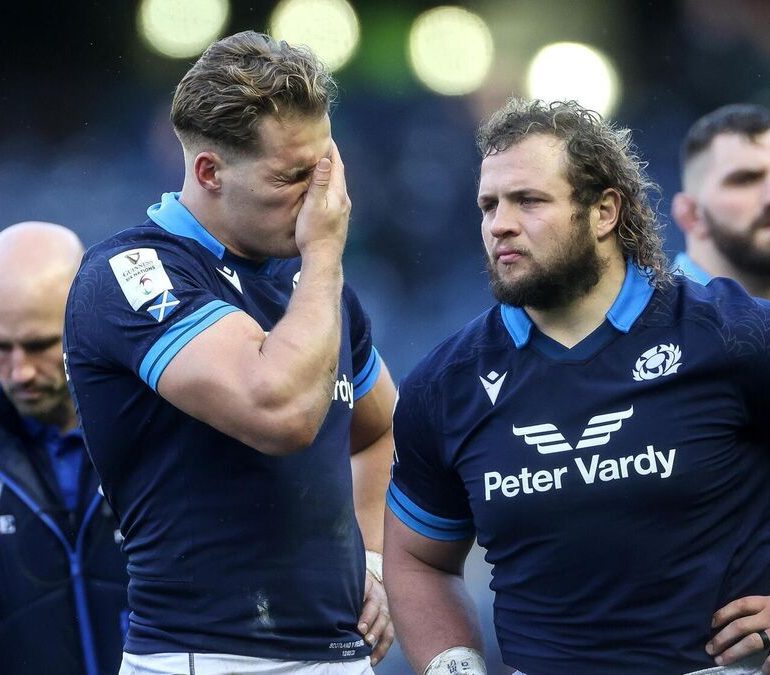
I have a soft spot for Power Wingers, especially Duhan Van Der Merwe who looks like Captain America had a son with Wonder Woman. Duhan looks like he was genetically engineered to make you tear your quad on the leg press machine whenever he walks past you in the gym. He is your power winger’s favourite Power Winger and offensively speaking, I think Van Der Merwe is outstanding when used correctly. As with all power wingers, you accept a bit of a drop-off in defence as part of the cost of doing business but some of the criticism he’s shipped since Sunday has been over the top, as it was with James Lowe. As with James Lowe, sometimes when you concede tries in the wide 5m channel, the winger is usually the guy floundering out on the edge like a turtle that’s rolled onto its back.
Edge defence, for me, is the hardest part of the modern game to manage because the winger often has to cover more than just the runner, they have to also cover the space behind them and, if they’re in the backfield, in front of them in a way that the outside centre, for example, doesn’t really have to do anymore.
This has been exaggerated in the 50/22 era with large, enhanced demands on the physical, aerobic and mental capacity of the winger to cover multiple square metres of space with more dire consequences for errors than at any point in the last 10 years on both sides of the ball. When you consider the large volume of quick ball, high PPC games and counter-transition rugby that wingers also have to deal with in the game as it stands in 2023 that, for me, makes the defensive side of the game (including both sides of the defensive transition) fiendishly difficult for wingers but double so for the rare enough role set of power wingers.
For bigger, heavier players the need to make early reads and early movements is crucial to keep control of dynamic situations. As with everything in rugby, however, the wider system plays a disproportionate role in most players’ performances. That isn’t to say that any player couldn’t have done slightly better when it comes to a linebreak or a try being conceded but it isn’t always the winger’s fault.
I went over the structure for Mack Hansen’s try in the first part of the Wally Ratings. Still, when I went looking again, I saw similar issues when Duhan Van Der Merwe was involved in the concession of what would be the killer try by Jack Conan a few minutes into the last quarter.
We join the play right as Ireland are beginning to press into the Scottish 22.

At this point, Van Der Merwe is exactly where he’d need to be to guard this progression of the ball. Jones is on Sexton and can swim to Conan, Van Der Merwe can step in to assist on Conan if he hits Jones or bundle Hansen into touch if the ball goes across.

Hogg’s positioning is quite central here again – in line with “inside” the pass movement that we looked at in the Wally Ratings – but you can see how it leaves him a lot of ground to cover.
Ireland chew through two 3.4-second rucks in quick succession to open up the killer phase. Hogg makes a critical mistake by assuming Ireland are going to over-focus on Sexton as the main mover of possession. He’s calling for numbers to stack to the openside.

You can also see Van Der Merwe, Jones and Conan resetting in the top corner of that graphic. When Ireland reset off O’Mahony’s carry – just look at the clean presentation for Gibson Park – Scotland are in big trouble.
Ringrose slots in to hold Tuipulotu (who is also tied to Gibson Park as the pillar defender) and when Gibson Park finds Hansen directly, Van Der Merwe is in No Man’s Land.
At the key point of this play, Van Der Merwe is defending three possible options.

He has to guard against the Keenan pump fake and carry, a narrow pass to Keenan and then hope to cover across on Conan.
Sure, he looks uncertain in his movements but my question is this; where’s his fullback? Watch the whole clip through.

Why is Hogg arriving after Conan is across the tryline? Why is he not assisting Van Der Merwe with the tackle right here?

It’s that central pendulum position again. It cost Scotland two tries in this game and arguably lost them the game as much as anything else. Hogg is two strides away from actually covering across and helping Van Der Merwe finish the job on this play. If you’re going to keep your edge defender narrow to make teams play around you why is your pendulum defender schemed to be further away from the edge?
It’s as much a question for the Scottish defence coach as it is for Stuart Hogg but the main thing for me is this; the heat Van Der Merwe is taking is a little too much. Sure, his work in the air was poor in this game but the criticism of his positioning should, in my opinion, be diverted to Hogg as much as anyone else.
