

I’m a Championship Manager veteran. It’s called Football Manager now but that Golden Age from 1997 when I first started playing as a 15-year-old goofball to around 03/04 were genuinely some of the best fun I’ve ever had clicking a mouse. I’ve played Football Manager since that era of nostalgia – you’ll notice the role descriptions I use are inspired by cool, mysterious words like Raumdeuter that you’d find in that game – but I’ll never forget the celebrating silently at 2 AM in my parent’s front room joy of that period between the end of secondary school and the first few years of college but that’s not true at all because I had forgotten that until just now when I was writing the sentence before this one. The truth is that I all too often remember the crippling, fist-gnawing, pissed-off-for-the-night frustration of the phenomenon of Championship Manager Bullshit.
Here’s the example I have; I was managing Real Madrid and had made it to the Champions League semi-final against Ajax. I was managing Real Madrid during their first Galáctico period around 2002/2003 because I was and am a cheesing Eggman. Ajax had been decimated that year by losing their two best players – Christian Chivu and Zlatan Ibrahimovic – and I know that because it was me that signed them to go alongside the original Ronaldo, Figo, Zidane, Roberto Carlos and all too many others. Tommasso Savaggio, the young Italian manager, was going to win a La Liga and Champions League double in his first season and that was that.
I beat them 4-0 in the first leg of the semi-final in Amsterdam and started looking forward to a Champions League final. In the second leg, they got a red card inside the first three minutes of the game… and then went on to win 5-0 in the Bernabéu with the last two goals happening in the last five minutes to knock Real out in a game for the ages. This is a good illustration of my reaction at the time if I’d had access to emojis or even knew what emojis were.

I CTRL+ALT+DELETED my way out of it at the final whistle, like a fighter pilot bailing out of a strike jet, and never came back to that save again, such was my disgust with the egregious, industrial levels of Championship Manager Bullshit I’d just experienced.
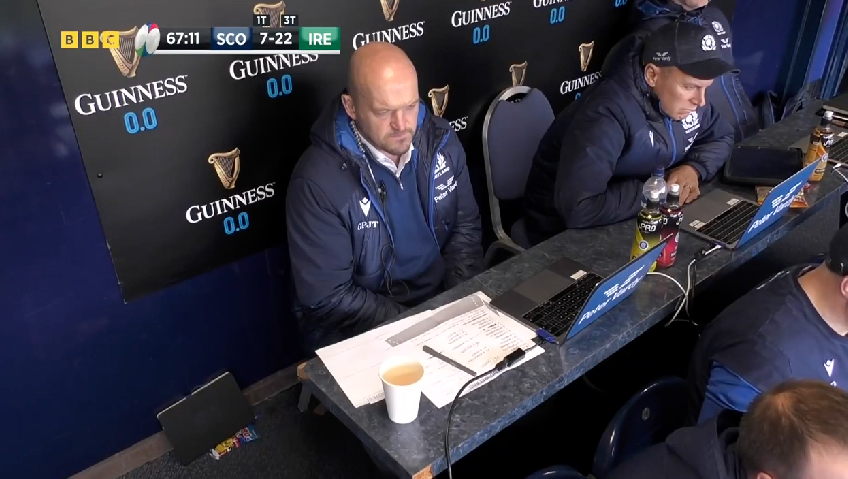
On Sunday afternoon with around 13 minutes left in the biggest game of Scotland’s season, the tv coverage panned up to Gregor Townsend in the Scottish coaches box and I thought of that game against Ajax on Championship Manager back in 2002.
I bet he’s clicking CTRL+ALT+DELETE in his head right now, I thought to myself, because Scotland somehow losing this is peak Championship Manager Bullshit.
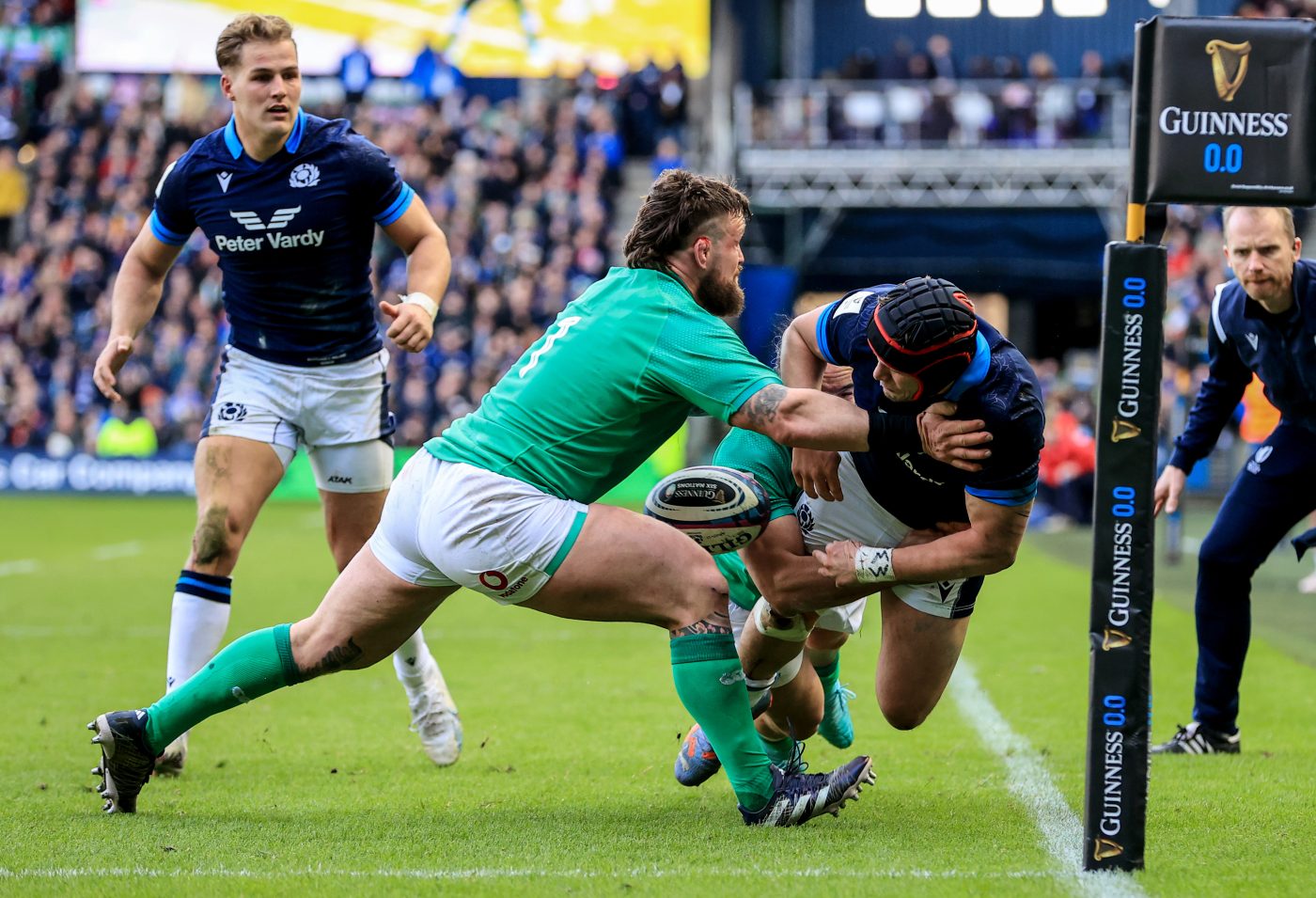
Over the course of this game, Scotland coughed up at least two gilt-edged try-scoring opportunities in the first half but, more importantly, Ireland lost Iain Henderson, Caelan Doris, Dan Sheehan and Ronan Kelleher inside the first 50 minutes with that last injury forcing Ireland into a scenario where Josh Van Der Flier (!) was throwing into the lineout and Cian Healy was scrummaging at hooker to prevent Ireland going down to 14 men for the rest of the contest.
And somehow Ireland still won and you could argue they won relatively comfortably, winning the second half 14-0 with a lineout that could only function at the front.
It was genuinely remarkable how (a) Ireland managed to win this game and (b) how Scotland managed to lose it. They’ll be studying this for years.
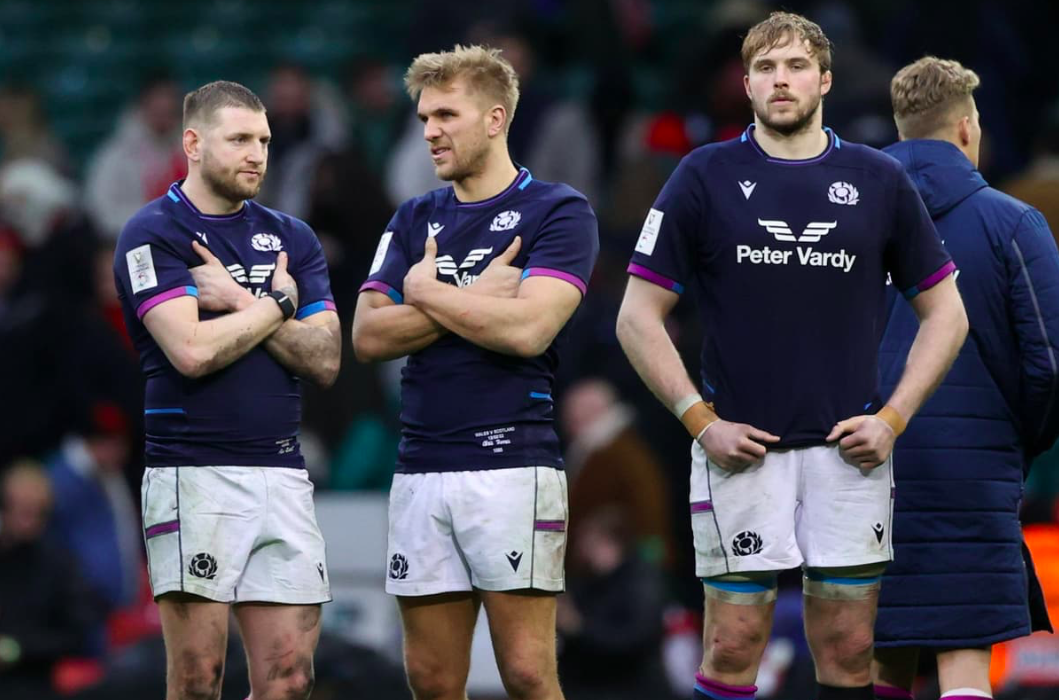
In another universe, Scotland go in at halftime in this game 17-8 up – at least – with Ireland forced to play without a fully functioning lineout for the rest of the game but somehow they found themselves 8-7 down after coughing up two close-range opportunities that I’ll bet they’re still raging about.
Up to that point, I thought Scotland had managed to resist Ireland’s counter-transition game relatively well and they had a good read of our Q2 and Q3 phase schemes for the most part.
One of the main adjustments that Ireland have made this season is moving to a 3-2-1-1 phase shape when we’re pressing in the opposition’s Q2, between the halfway and 22. This sequence shows Ireland’s efficiency and willingness to kick on the edge of the play against teams who don’t pack their backfield.
When Scotland blew a lineout, this gave Ireland the platform we needed to get into shape. Keep an eye on Scotland’s backfield coverage.
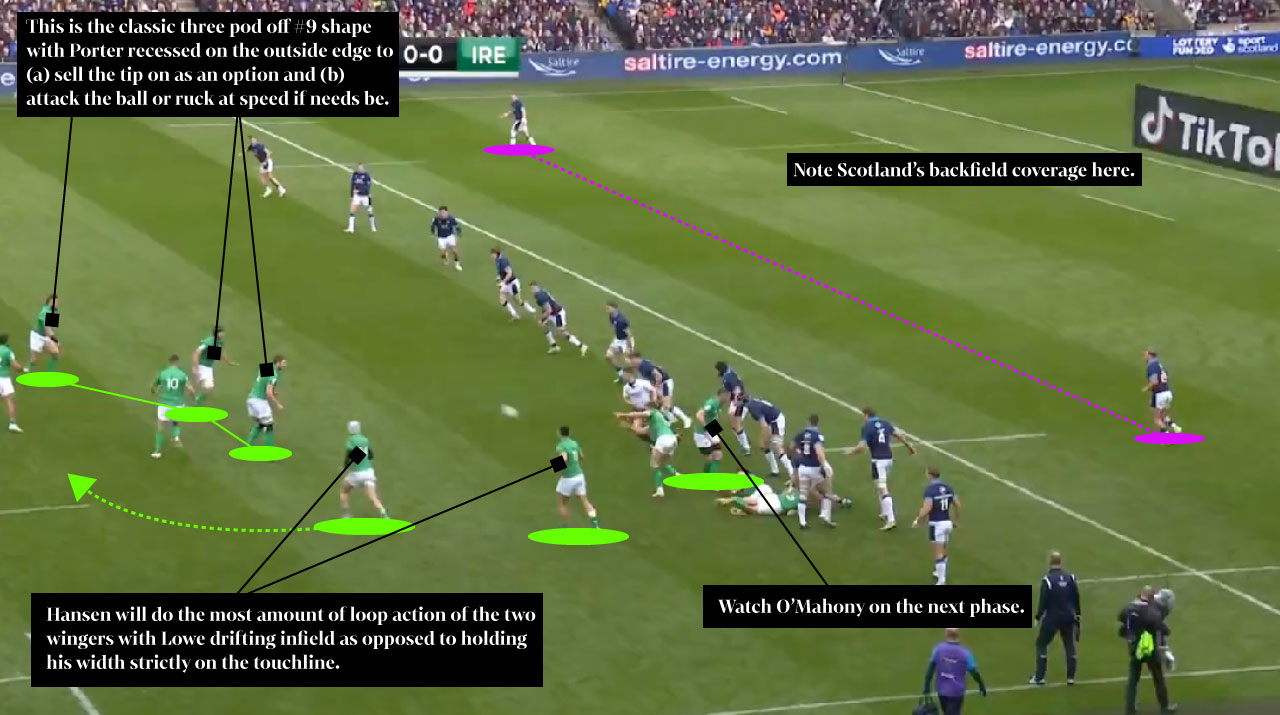
So far, so standard. Ireland play an awful lot off #9 and our use of that three pod is generally very effective at generating position, as you’d expect. It’s rare enough that a carry off #9 from this range would bust over the gainline dramatically but it compresses defenders and gives you something to work on for the next phase. This is where Ireland have started adding a few wrinkles.
This is verging on a 3-3-1 shape but… it’s not quite.

Ryan offers himself as more of a pinch line or crash ball option instead of being a genuine part of the pod with Furlong and Van Der Flier. He’s almost running a tip on/ruck support line like Porter is off #9 instead of being a genuine edge runner in the usual 3-2-2/3-2-X system.
Watch how Scotland’s backfield defence reacts – Steyn steps up into the primary line to guard against Sheehan while Hogg hovers in the middle of the backfield.
When the play develops, Ireland have multiple play options but, crucially, have exposed the edge of the Scottish defence.

Aki makes a good break but doesn’t advance that far into Scottish territory but what it reveals about Scotland’s defensive structure was probably valuable enough in its own right. You can see how connected everything Ireland does during phase play here is too – Ryan, Furlong and Van Der Flier turn from run options resourcing a sub-three-second ruck seamlessly while Hansen files out to the wing for the next phase.

Murray throws a dud pass on the next phase which slows down Ireland’s progression but it doesn’t actually matter – there are always players nearby to mop up any pass inaccuracy. The key here is position, though. Ireland were able to maintain a consistent position around the edge of the Scottish defensive line and observe a few things about how they were reacting live.
On the next phase, Sexton gets the alt-option that he’s always looking for – an edge kick.

Ireland have done this all throughout the Six Nations so far, especially early in the game – find the edge, kick to the back edge and pressure the exit, be it a kick or a lineout.

We almost scored directly from this edge kick when Scotland blew their lineout but they were saved by a somewhat obscure technical offence when they used a new ball instead of the one kicked off the field.
But space in the backfield was there consistently, as was Hogg’s unusually central positioning. Was he leaving himself too much to do? As in, was he over backing his ability to cover both the chip over the Scottish blitz and the back edges? No – because it wasn’t just Stuart Hogg who was covering that central space.
Look at Van Der Merwe’s positioning here when Hogg is forced to guard the edge space – same central space, same ground to cover.

Was this designed to increase the ability to spike into Ireland’s layers by packing numbers quite narrowly in the primary line? Maybe. They didn’t really compete too much on flow rucks to ensure they had those numbers and, if that was the concept, then you’d need your fullback – or your winger covering fullback in the pendulum – to stay relatively central to cover both possible outcomes of the blitz if the opposition looks to kick over it.
Ireland’s first try came directly from this concept. Look at how Hogg stays inside the passage of the ball on these stills.


And then look how that causes an issue on the edge for Mack Hansen’s try.

If the concept here was “give them that space and see if they can (a) make the long-range pass and (b) finish right at the edge under pressure” then Ireland answered that question. Maybe it was a low percentage look that Scotland knew was a possibility but against a side that kicks after two passes on the edge so regularly, it always had the possibility to be costly in what Scotland would have hoped would be a close game anyway.
The second half was a spectacle that will probably remain unique for a long time to come. With Sheehan and Kelleher both injured, Ireland used Josh Van Der Flier to throw into the lineout. Van Der Flier is an incredibly skilled human being – who happens to play rugby – so he gussied up and was given this job by the rest of the pack; hit the front or the front of the middle, keep it straight and we’ll get the ball for you.
That it worked is a testament to how good Van Der Flier and Ireland’s jumpers and lifters are but, as a consequence, how badly Scotland managed the last 35 minutes of this game.
Ireland had 14 lineouts in total and only lost 4 – the same number as Scotland. They should have had ten more to deal with.
Time and again, Scotland gave up clear opportunities to kick low and into touch in places that would really pressure Van Der Flier and Ireland but they coughed them up over and over again to keep the ball in hand.
Here are just a few samples;

You can see Russell think about the kick for a few footsteps here before deciding to pass when he sees Hansen shooting up. It’s almost like he decided that because Ireland were expecting deeper kicks he could pass around the edge that bit easier with the backfield stacked.
As for the below GIF – are you telling me that Finn Russell can’t find that gap in behind Hansen here with Keenan and Lowe out of position? 

The above GIF looks like Russell just didn’t even consider the idea of kicking deep from this position and testing the sideline, even with Hansen pushed up. It’s like they thought that Ireland were already down to 14 and they had endless time to find space.
Now, to be fair to Scotland I think sometimes they wanted to try to kick to touch but Ireland guarded the vulnerable space really well. That said, how Tuipulotu or Hogg didn’t think to dab a low-angled kick into touch here I’ll never know. Well, I do know; elite-level awareness and pressure from Hugo Keenan.
Watch him shut down the kick from Russell first, then Hogg.

Super elite stuff there.
But even when Scotland had Ireland where they wanted them – namely Van Der Flier throwing the ball into the lineout in the Irish 22 – their counter-jumping was just really dopey. There’s no other word for it.
Why are Scott Cummings and his lifters trying to read the footwork of the Irish pods here? Why is Jonny Gray trying to read the middle!?

There’s a flanker throwing into the lineout! Ignore the pods! Van Der Flier will only be throwing the two or the front of the middle and he’s only got one speed of throw! Cummings should be planted down at the front with Schoeman and Fagerson locked and loaded beneath him. JUMP WHEN YOU SEE VAN DER FLIER MOVE, NOT THE POD ACTION. At the very least, you spook Van Der Flier into a crooked throw but no – Scotland allowed themselves to get feinted out when the hooker can’t throw anything other than a flat, wobbling spiral beyond the front of the middle.
Why is Jonny Gray splitting the gap here when he should be planted on Cummings lifting pads? Where does he think Van Der Flier could possibly be throwing to?

Ireland scored from this lineout possession and increased the pressure on Scotland even further. This is just bad, non-adaptive lineout defence whatever way you slice it and it allowed Ireland to almost function as normal. When you combine this with Scotland’s backs overthinking Ireland’s backfield defence, any advantage Ireland’s injuries might have had blew away like steam in the breeze.
That isn’t to say that Ireland’s resilience here wasn’t inspiring, frankly, or a sign of how good a side they are but watching this game back I can’t believe Scotland’s second-half performance. It’s genuinely baffling game management and it’s that I believe will stick in their collective craw for some time to come.
As for Ireland, I genuinely believe that even with Scotland’s tactical implosion in the second half, most teams lose this game nine out of ten times. It can only be won with a squad imbued with the kind of cohesion Ireland bring to games like this. They just know what to do because they do it every week with Leinster and then, when they’re with Ireland, they’ve done it with Peter O’Mahony, Iain Henderson, Tadhg Beirne and the other lads who get dotted in from the other provinces, not just in this game but over the last 24 months.
The challenge now will be bringing in players from outside that group if Doris, Henderson, Sheehan, Kelleher and Ringrose are all hurt. That’s when Ireland’s cohesion amongst that group of 25/26 regulars gets tested, that’s when the latency goes up and that’s when mistakes can happen.
That’s for another day, however. This Irish side has every claim on the best Ireland side there ever has been or will be and all they need to do is win every game for the rest of 2023 to prove it. A win next week against England and they’ll have a Grand Slam – only the fourth in our history. That alone is a great achievement and one I wanted them to achieve to back up the hype of the last year.
But the World Cup is in sight and who could say that this Irish side can’t win it? Not me. History waits. This year, 2023, could be the year of rugby that guys like Hayes, O’Connell, Stringer, O’Gara, Bowe, O’Brien, O’Driscoll, Wallace, Hickie, Geoghan, Wood and others ploughed the road for in the dog days of the late 90s and early 2000s. Nothing is in isolation. We are where we are today because of them and now’s the time to seize everything they dreamed of and couldn’t dream of in their wildest.
It’s all there for the taking.
We just have to… take it.
| Names | Rating |
|---|---|
| Andrew Porter | ★★★★★ |
| Dan Sheehan | ★★★ |
| Tadhg Furlong | ★★★★ |
| Iain Henderson | N/A |
| James Ryan | ★★★★ |
| Peter O'Mahony | ★★★★★ |
| Josh Van Der Flier | ★★★★★ |
| Caelan Doris | N/A |
| Conor Murray | ★★★ |
| Johnny Sexton | ★★★ |
| James Lowe | ★★★★★ |
| Bundee Aki | ★★★★ |
| Garry Ringrose | ★★★★ |
| Mack Hansen | ★★★★★ |
| Hugo Keenan | ★★★★★ |
| Ronan Kelleher | N/A |
| Cian Healy | ★★★★ |
| Tom O'Toole | ★★★★ |
| Ryan Baird | ★★★★ |
| Jack Conan | ★★★★ |
| Jamison Gibson Park | ★★★ |
| Ross Byrne | N/A |
| Robbie Henshaw | ★★★ |
