


Ireland vs Scotland has turned into a bit of a weird one over the last few years, certainly from an Irish perspective. Over the last week or so I’ve been doing a lot of driving and, in that time, I’ve heard more than a few insinuations from a few different pundits on a few different radio shows that Scotland are, essentially, blowhards. The evidence for this? A few quotes from a player or coach responding to a question from a journo or TV presenter about how good their camp has gone, or how their fitness is, or what their hopes for the tournament are – pretty standard stuff, really.
That, for some reason, is taken as arrogance by some quarters on this side of the Irish sea because Scotland have only beaten Ireland twice in the last 9 years with this upcoming fixture representing the tenth anniversary of a 12-8 Scottish victory in Murrayfield in 2013. It’s almost like some in the media over here feel that Scotland players, coaches and media aren’t deferential enough when it comes to what they talk about in the build-up to playing Ireland… which is the kind of hubris that they accuse Scotland of.
But the Irish media bubble is not the Irish team, nor is the Scottish media bubble representative of the Scottish team. It’s just two dogs barking at each other from opposite sides of a gate but it does highlight the needle that exists between these two rugby entities that goes far beyond what you might expect given the flow of recent results in Ireland’s favour.
This Scottish side reminds me a lot of Ireland in the mid-2000s. A few generational talents dotted alongside a few internationally underrated players that are as good as anyone on their day with a good few solid stalwarts. They’ve cracked one particular glass ceiling – beating England and France regularly in the last few years – just like Eddie O’Sullivan’s Ireland did with the England of Clive Woodward, Andy Robinson and Brian Ashton to power his Ireland side of the time to multiple Triple Crowns.
But the French were always in our way when it counted.
In this particular metaphor, Ireland are to Scotland in 2023 what France were to Ireland in the mid-2000s. You know how France used to just beat us back then no matter what we did? By 15 points, by 20 points, by two points and by the skin of their teeth – they found a way.
Can Scotland break the last glass ceiling and turn the Six Nations on its head before Super Saturday? We’ll know soon enough. Or will Ireland continue their stranglehold over this fixture for another season and set up a Slam decider in Dublin next weekend?
Scotland: 15. Stuart Hogg; 14. Kyle Steyn, 13. Huw Jones, 12. Sione Tuipulotu, 11. Duhan van der Merwe; 10. Finn Russell, 9, Ben White; 1. Pierre Schoeman, 2. George Turner, 3. Zander Fagerson; 4. Richie Gray, 5. Jonny Gray; 6. Matt Fagerson, 7. Jamie Ritchie (capt), 8. Jack Dempsey
Replacements: 16. Fraser Brown, 17. Jamie Bhatti, 18. Simon Berghan, 19. Scott Cummings, 20. Hamish Watson, 21. Ali Price, 22. Blair Kinghorn, 23. Chris Harris
Gregor Townsend has selected an on-ball back row and midfield to have a proper crack off Ireland in this game.
Whether it’s successful or not remains to be seen but when I see Jones, Tuipulotu, Fagerson, Richie and Dempsey all in the same general unit, I see a team that wants to take Ireland on physically but none of it will matter if they can’t get Finn Russell on ball and in the game early.
Russell is everything good about this Scottish team. 22.7% of all Scotland’s try involvements this season have come from Finn Russell. No one has more direct try assists. He has the highest amount of carries of ANY player in the Six Nations, forward or back, with the most amount of offloads. No one has kicked the ball more than him or longer than him in the Six Nations to date. He’s in the top three for passes that have led to line breaks and Russell has the most on-ball involvements by hand (passing or carrying) of any non-scrumhalf in the tournament to date.
The only downside? He’s not the most accurate passer with an 89% accuracy rating despite having a high on-ball rate and he concedes more turnovers and handling errors than any other #10 in the competition.
The whole Good Finn/Bad Finn thing is real! It is! But he can also win this game for Scotland two or three times over with the right possession.
Townsend would move on from Russell if he felt he could – and he’s tried, believe me – but when he’s on, Russell breaks games open for his team in a way that few players can.
The first thing you’d usually expect from any opposition team would be to exert a lot of line speed and physical pressure on Russell early in games but he’s actually really good at drawing that out and using it against you. He’s brave, he’s committed and he will wait until the very last second to make the pass on the run.
And if he lands that pass, he’s putting his array of strike runners into space without question. Scotland’s build is basically a question of how many impact strike runners they can give Russell on any one phase.
Look at the role set of the back row and outside backs;
6. Fagerson – Heavy Wing Forward
7. Ritchie – Heavy Wing Forward
8. Dempsey – Heavy Wing Forward
11. Van Der Merwe – Power Winger
12. Tuipulotou – Slashing Strike Runner
13. Jones – Slashing Strike Runner
14. Steyn – Slashing Strike Runner
15. Hogg – Strike Playmaker
All of those weapons arrayed across the field are perfect for a player with as much on-ball variety as Russell and, with Ben White (a Winger #9) Scotland have the offensive capacity to cut any side open. The downside of this is that so much of it relies on accuracy from Russell that when he’s off, Scotland look like half the team.
From a general style perspective, Scotland would be a counter-transition side and their kicking volume and kicking distance coupled with their low possessions handled (where they either pass or carry) show a team that isn’t interested in playing too many dead phases of possession in their own half of the field. Inside their 10m line on phase play, they will usually kick within two or three phases and these kicks will almost always be infield with some variety on targeting. White will usually kick long off the box kick, Russell can do everything from chips over the blitz (which he will target over Aki and Sexton off the lineout at least once) and their long counter-transition kicks will often be taken by Hogg, who has a massive spiral kick in his arsenal that regularly makes 50+ metres. They aren’t afraid to give you lineouts either, and Hogg is great at punishing loose kicks into the 22 with booming returns downfield.
Their counter-transition game is so pronounced that they have a ridiculously low number 22 Entries but their ability to finish linebreaks is such that they have the highest efficiency when it comes to points per 22 Entry. If Scotland get into your 22, they tend to score but you’ve got a good chance of keeping them hemmed outside that zone based on this Six Nations so far.
One huge battle zone in this game will be the lineout. Scotland have scored most of their tries within a few phases of the lineout and, as you might expect, they have the highest lineout completion rate in the tournament. Scotland are most likely to hit the middle of the lineout to the Gray brothers and they will play off that with White usually separating himself from the set piece to allow Russell to move wider and deeper.
Defensively, Scotland are above average in the lineout and they are great at forcing ineffective lineout possession and have a really good steal rate. Ireland’s Dan Sheehan has the best throwing return in the Six Nations so far but Scotland will be going after Henderson in the middle, which is Ireland’s preferred lineout call with a 5+1 structure. Ireland tend to go to the front of the middle a little bit more often this season, which explains in part why we’ve scored so few scores directly from the lineout this season compared to last season.
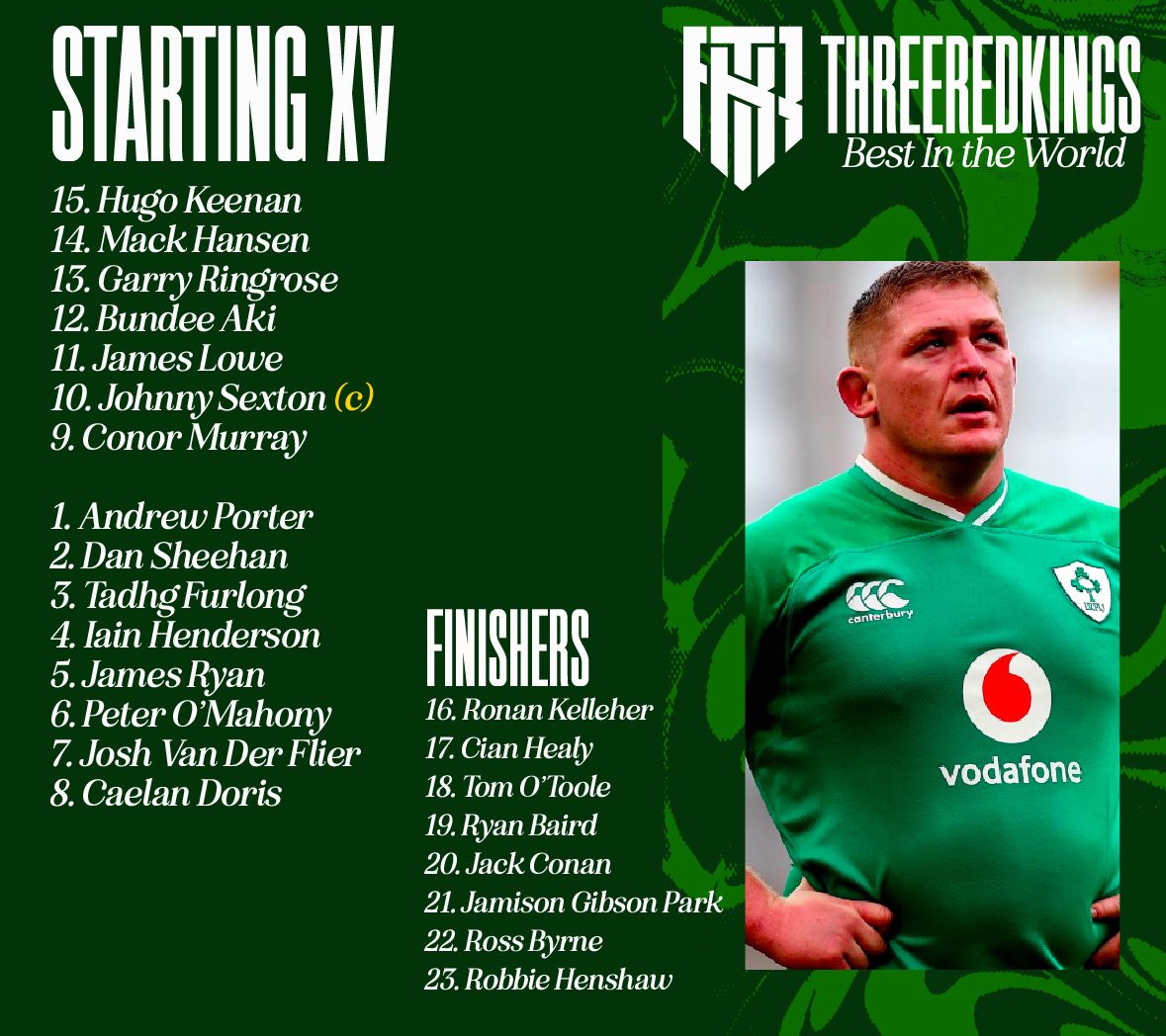
The big frontier in this game will be the counter-transition kicking battle. It’ll be, essentially, Hogg and Russell against Lowe, Sexton, Keenan, Hansen and Ringrose. Scotland’s kicking is concentrated into Hogg and Russell while Ireland spread the kicking across the backline. The first ruck on the counter-transition sets will be massive. Scotland have selected an incredibly mobile and physical strike wing forward-based back row which is perfect for tracking up and down the field protecting Scottish transition rucks and harassing Irish transition rucks. It’s not about the volume of rucks they hit, it’s about protecting and hurting the important ones. That will be a key battleground, as will the quality of Ireland’s counter-transition play – which is normally of the highest standard.
Expect a lot of kicking and a lot of shaping for position here as neither side like to play too much rugby on anything other than their own terms. Scotland just don’t play a lot of phase play at all so will Ireland move to a more on-ball style to get hands on Scotland early? Bullying Scotland is the usual Irish play here but will we go on-ball to do it? Scotland want to harry us on counter-transition so actually settling this game down into close-range, sledgehammer fight in a box room stuff might be a good play early on. Truck it off #9, see if they want to poach and then hurt them over the ball. Personally, I see Scotland going hands-off at the breakdown to avoid just that and use their speed and mobility to (a) harry Murray and Sexton and (b) force Ringrose and Keenan to make plays off the second screen. If they get their way, you’ll see Ringrose, in particular, getting heavy attention from Jones and Van Der Merwe on the blitz but if we’re accurate there are tries out there for us. Scotland concede the most amount of 22 Entries of anyone bar Italy.
This one is going to be fascinating.
