


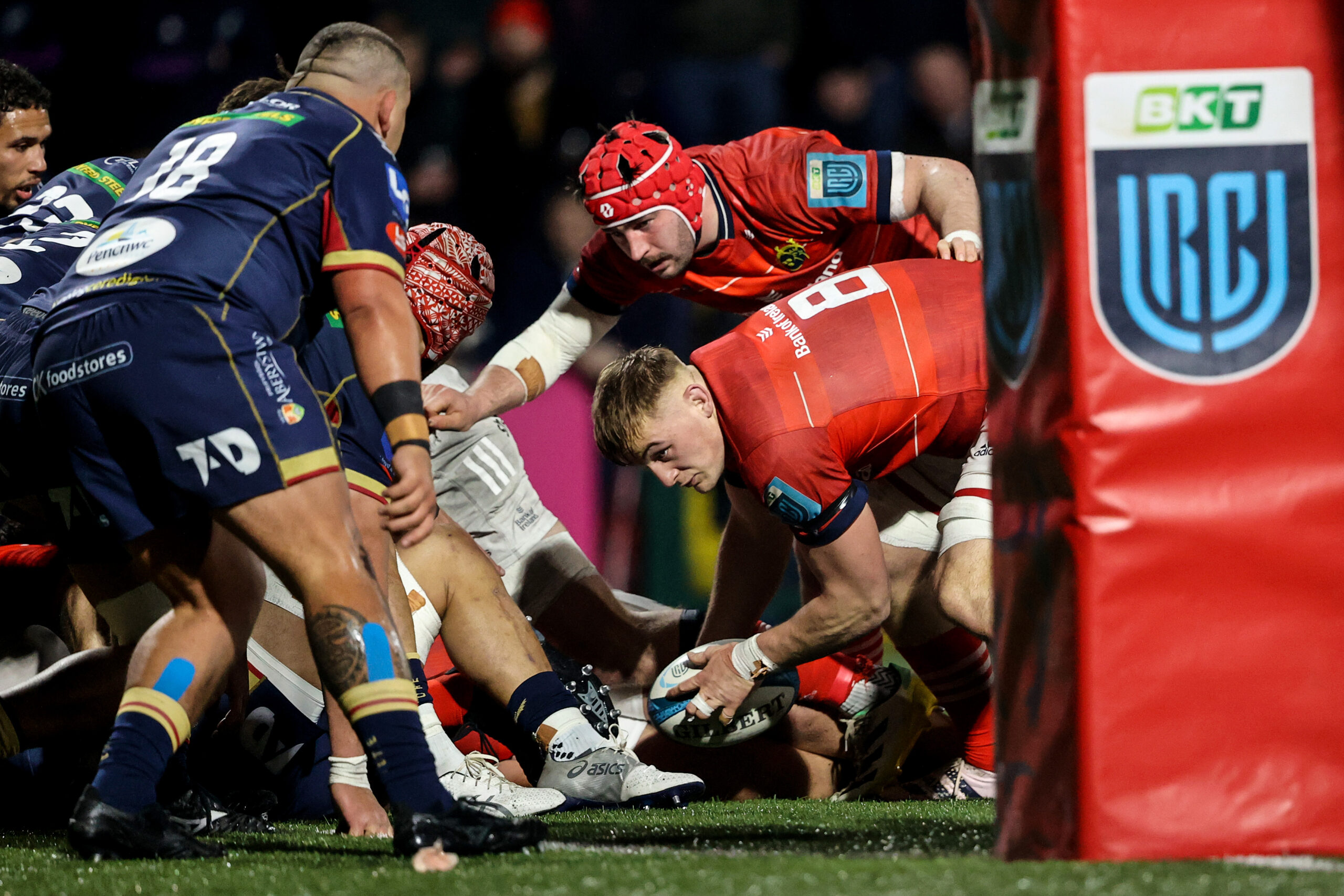
It was entertaining. It was thrilling at times. It made my heart do more belly flops than any game that was 28-0 at one point had any right to do so. It was a big, beautiful chaotic mess of a URC test window game that showcased all the good of this game in one sense while leaving a weird aftertaste that you want to ignore and regret later, like that time I started slugging Fernet Branca as a shot when eight glasses of wine deep drinking in and outside the Osteria Al Squero in Venice a few years ago.
Was the hangover worth it? No. But it never is. I think the review of Munster’s defensive work in the aftermath of this game will feel a little bit like a hangover though, and it’s worth considering for a second how close Munster came to drawing this one. It’s also worth pointing out that this team were at a funeral of a beloved underage coach and mentor the day before, who died suddenly a few days prior so if some things looked a little uncharacteristic from what we’ve seen over the last few months, maybe take that fact into your mind while also accepting that people are not robots.
In some ways, this game reminded me a little of the Axel game from 2016 where Munster built a big lead on the back of next-level, emotionally charged intensity but couldn’t keep that up for the full 80 minutes. When they dipped, Glasgow fought back to bring the game back to two scores but Munster were able to see out the win all the same.
There are similarities here. The first 40 minutes of this game featured some of the most devastating attacking, multi-phase rugby that I’ve ever seen from a Munster side. Ever.
The second half saw a real drop off in level. It was pockmarked by a tonne of individual errors, off-system action and some bad luck all forced by a Scarlets side that threw caution to the wind and, more importantly, played some of the best direct offloading rugby I’ve seen in a while. The two things fed into the other and Munster conceded 42 points at home for the first time ever in league action. In truth, we were lucky not to draw that game or, worse again, lose it.
All of the questions I got from people in the aftermath of this game were “what the hell happened with the second half??” so I wanted to spend a bit of time leaning into the hangover to explain how Munster managed to concede five tries after half time.
How did they manage that when we only conceded four penalties all game, the usual indicator of tries conceded?
Enjoy seven minutes of pain.
My big takeaway from it? It was a massive energy dump after the first half amplified by a Scarlets side getting an early try to give them something to chase. But that isn’t it alone. I also had some concerns about the depth the Scarlets were playing with and how it allowed them to tug at our Big Six defenders in the middle of the field post-set piece. It seemed like we struggled to get any kind of slowdown on the Scarlets’ breakdown – a common trend game-wide since January. That put real pressure on our ability to cover our heavy hitters, who in turn looked to be struggling to get on their inside shoulder cover routes when we blitzed on Costelow, who hung deep enough that we rarely got hands on him but left gaping holes inside and outside in the attempt.
Knox and Snyman looked a little sluggish on their defensive folds but you’d expect that from heavy front-five forwards returning from injury on a really fast surface. Donnelly, too, looks to have added real size and seemed to be carrying a knock relatively early into his time on the field and that hurt his mobility.
O’Sullivan had a tough time adapting to the coverage required in the #6 role defensively too, which wasn’t helped by some early disruption to our back three in the second half. I could say the same for Kendellen and Hodnett in the second half as they tried to cover a little bit too much space in the centre and then to the edges with Fekitoa and Frisch having particularly poor halves when it came to generating stops. Is it worth worrying over? Look, conceding five tries in one half is not good by any stretch of the imagination, especially when the Scarlets didn’t have to earn those tries with a tonne of 22 entries or forced penalties. That second half was dominated by the Scarlets’ big trio of Kalamafoni, Fifita and Lousi to the point that they didn’t have to start flinging a tonne of deep passes. They had a PPC ratio of 1.20 which shows that going direct and then sliding outside was a winning strategy. That manifested itself as forcing compressions as we struggled to get stops on that Big Three with issues coming in our alignment on the edges.
We’ll have to learn to drift and jockey on some phases, especially when we’re carrying bigger, heavier defenders.
The biggest issue, though, was giving the Scarlets some early hope inside the first five minutes of the half with three or four unforced handling errors. We’re an on-ball team and giving up those early possessions allowed a little hope to creep in for the Scarlets and they more than took advantage.
This compared to the first half, where we punished the Scarlets on multiphase possession repeatedly with the kind of accuracy and variety that I can only do justice in the GIF Room on Tuesday.
That opening half was dominated by Munster hitting the Scarlets on kick transition and then transitioning into multi-phase possession with real fluidity. As an example, watch how many times Campbell, Nash and Daly whip behind the pods here to offer depth and overload opportunities.
We used eight phases to score the opening try and thirteen for the fifth, without ever getting to a point where we were hammering at the tryline from inside five metres. That takes real creativity and strategic play to keep playing with the kind of variety off of #9, #10 and #12 that we saw in that first half. We used to be a team that was burned out and kicking inside four phases – not anymore.
And look, I focused on the defence here but that was only to pull the poison straight out the gate. There aren’t systemic issues in defence here that I would be concerned about. Sometimes you have one of those games and this seemed to be one of those when it came to uncharacteristic defensive errors and misreads. I still think our high-line speed game needs to be roadtested with heavier, slower power forwards that we hope will win us offensive collisions come playoff time. We’ve been playing “small” for long enough at this stage that we might need to compensate for having proper size and heft in our Big Six, especially when it comes to the coverage they’ll be expected to guard.
That’s for another day. I can’t complain about five match points and seven tries along with some of the best attacking rugby I’ve ever seen from Munster. The defence will come right, for sure and I’ll tell you now that I’d be far more concerned at this stage if we weren’t absolutely torching good teams with our offensive capabilities over the last three rounds of the URC. They balled out, they scored some lovely tries, and they honoured the memory of Tom Tierney with their creativity and guts to see this out.
All in all, a good night’s work to see off a tough week.
| Names | Rating |
|---|---|
| Josh Wycherley | ★★★ |
| Diarmuid Barron | ★★★★ |
| Roman Salanoa | ★★★★ |
| Jean Kleyn | ★★★★ |
| Fineen Wycherley | ★★★ |
| Jack O'Donoghue | ★★★ |
| John Hodnett | ★★★ |
| Gavin Coombes | ★★★ |
| Paddy Patterson | ★★★★ |
| Joey Carbery | ★★★★ |
| Shane Daly | ★★★★★ |
| Malakai Fekitoa | ★★★ |
| Antoine Frisch | ★★★★ |
| Calvin Nash | ★★★★★ |
| Pa Campbell | ★★★ |
| Niall Scannell | N/A |
| Mark Donnelly | ★★ |
| Keynan Knox | ★★★ |
| RG Snyman | ★★★ |
| Alex Kendellen | ★★★ |
| Ethan Coughlan | ★★ |
| Jack Crowley | ★★★ |
| Jack O'Sullivan | ★★★ |
