



It’s hard to know what frame of mind the Ospreys will be in ahead of this game. The whole point of professional rugby is the professional part. Getting paid. At the moment, everyone in Welsh rugby is in a state of uncertainty because, in quite simple terms, the Welsh Rugby Union is looking to drastically cut its contract spending across the board.
The PRB – made up of four reps from the Dragons, Ospreys, Cardiff and Scarlets – along with the acting WRU chief executive Nigel Walker, the WRU finance director Tim Moss and two independent observers, including chair of the process Malcolm Wall have been negotiating a new deal for some time to absolutely no success and a whole lot of rancour. There is a key impasse to overcome – the WRU wants to offer less money than the players, represented by the Welsh Rugby Players’ Association (WRPA), are willing to accept collectively.
Malcolm Wall said this week;
“The new agreement offers a complete funding package to the professional game in Wales, but it does come with financial limitations which will directly affect salary negotiations.
“The cold facts are that the WRU and clubs have been paying salaries that their businesses cannot afford, so the new agreement establishes a new framework for contract negotiations.
“The average salary of a Welsh professional rugby player under the new framework will be around £100k-per-year.”
Even then, that £100k per annum salary isn’t fully covering it because some of that money is held in a bonus system dependent on squad performance goals. You might think £100k per annum on a two-year deal is great going and, in a regular job, it would be but in pro-rugby you have to look at everything in one or two-year blocks and it can end at any time. One bad tackle, one bad ruck entry, one bad landing off a lineout and it can all be over. What then? Then you’re off looking for a new career with zero experience in your 20s or 30s with a mortgage, a family and a life to live.
In very real terms, there are players involved for the Ospreys this weekend who don’t know where their next contract is coming from this week because they either haven’t been offered one or what they have been offered won’t be enough to cover their lives as they stand this season.
As prep for a game goes, this is about as bad as it gets.
How hard do you go in a game when you haven’t even spoken about a new contract and it’s mid-February? On the other hand, a game is probably the best distraction from the financial nightmare of the last few months, the anxiety, the Whatsapp groups dooming it up with no outlet except for training.
For the Ospreys, it’s probably exactly what they need because they’ve actually been performing really well over the last few months while all of this was going on. They’re one win away from the URC mosh pit of 3rd to 10th and they’ve picked up some notable wins away from home in Europe, in particular.
Ospreys could well feel that they’ve absolutely nothing to lose here so why not forget their troubles, remind the club of their value or put themselves in the shop window?
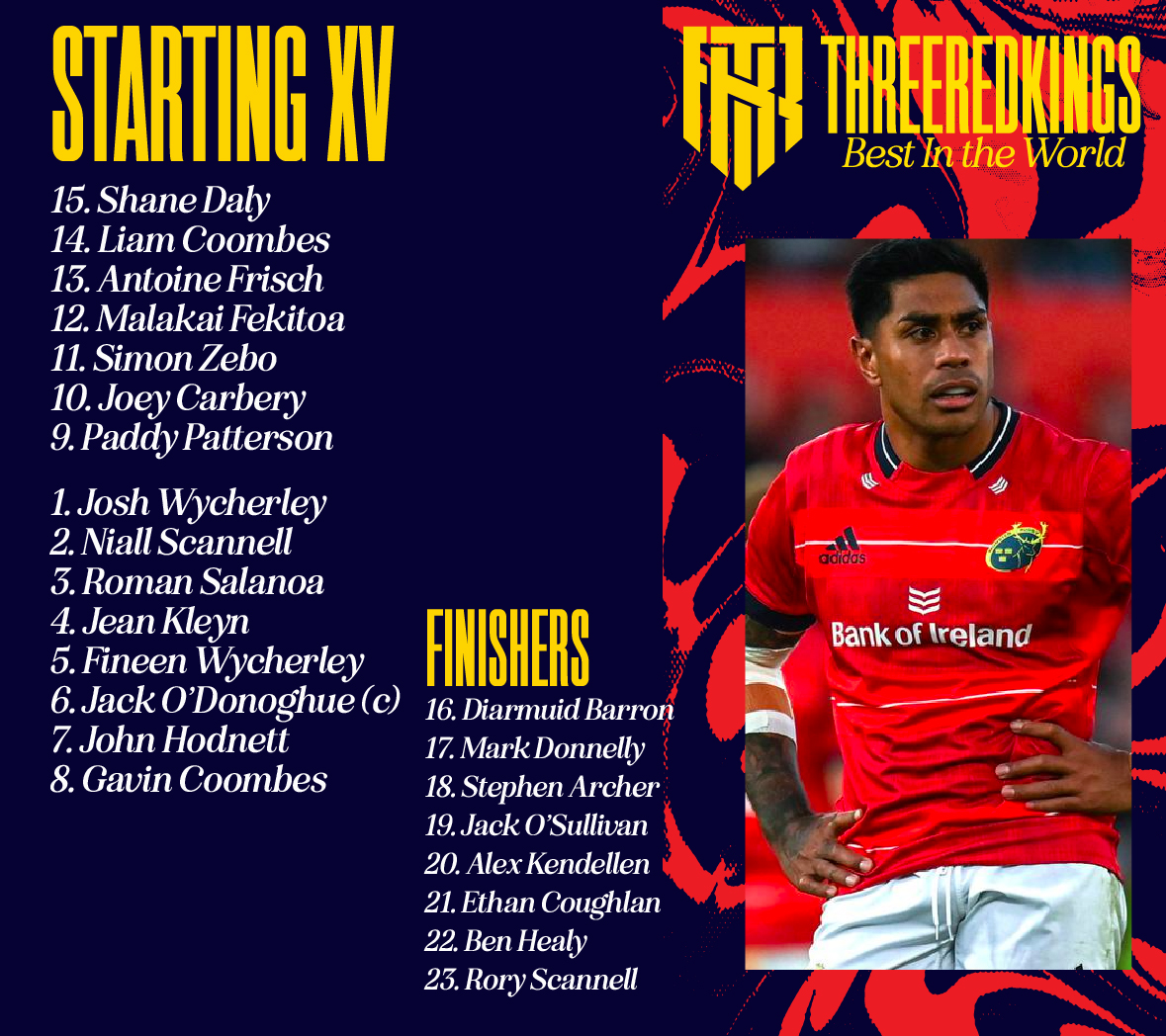
That’s the danger for Munster if we come into this one with even half an eye off the ball – that we gift Ospreys belief. The key for Munster is to make Thomond Park the hopeless place it usually is for travelling Welsh sides.
Ospreys: 15. Max Nagy; 14. Luke Morgan, 13. Michael Collins, 12. Ollie Watkin, 11. Keelan Giles; 10. Stephen Myler, 10. Rueben Morgan-Williams; 1. Nicky Smith (capt), 2. Elvis Taione, 3. Tom Botha; 4. Bradley Davies, 5. Huw Sutton; 6. Jack Regan, 7. Ethan Roots, 8. Morgan Morris.
Replacements: 16. Tom Cowan-Dickie, 17. Garyn Phillips, 18. Rhys Henry, 19. James Fender, 20. Harri Deaves, 21. Matthew Aubrey, 22. Jack Walsh, 23. Iestyn Hopkins
Ospreys’ relative success under Toby Booth in the last few seasons has been built on absolutely rock-solid basics. Booth did what all good coaches do when they inherit a complete mess – he tore everything down and started with the solid foundations of any decent side.
Good scrum? Ospreys have one.
Good lineout? They have that too.
Good discipline? They are the best in the league when it comes to how few penalties they’ve conceded.
Hard workers in phase and transition defence? They have that all through the squad.
What they don’t have is a sophisticated multiphase attacking game but, to compensate for that, they have a high-volume, high-distance kicking game off #9 and #10 – #9 primarily – and that means, regardless of anything else, they exit well, they don’t play a tonne of rugby in their half of the field and they mop up territory with scrum penalties forced off high contestables, especially on their feed. The Ospreys have the most scrums of any team in the league (23 more than the next highest team – Benetton) and that is a by-product of their high-volume contestable kicking game off #9.
To top it off, they have Keelan Giles as a one-man chase and transition strike runner which punishes any team that plays counter-transition rugby too loosely. By the same token, if you’re loose under the box kick, Giles will punish you in the air and then be under your posts by the time you’ve gotten back up off the floor.
So it’s kick pressure, essentially, and quite a pure distillation of it with Roots and Morris being their core breakdown threats in those phases directly after the kicks they don’t retain.
For Munster, this game necessitates our own basics to be spot on. High fielding, good escorting, and massive breakdown work rate on the first and second phase after. Last year, Munster were one of the poorest teams in the league on kick transition but that’s completely turned around this season. No team has scored more tries on kick returns than Munster in this season’s URC and Shane Daly, in particular, has been a huge part in generating that run-back offence. My key guys to watch here are Coombes and Daly on the actual receipt of the ball and how Zebo manages to interact with that phase afterwards.
Keep an eye out for an angled chip kick over the defensive line in the second phase post-transition – Ospreys blitz really, really hard on the second pass off a wide ruck position post-kick receipt. This is a key part of their kick-pressure game. Carbery’s pass accuracy will be under huge strain here but if he can be accurate, there will be key opportunities for O’Donoghue as a screen runner and Frisch as a layered pass option who can fix and then pass around Giles and Collins.
The scrumhalf snipe on the first phase after the kick receipt is a good option too, especially when Bradley Davies, Jack Regan, Tom Botha and Huw Sutton step in to cover the ruck fringes. Patterson and then Coughlan will have to keep them active because there will be space there to attack.
Transition is the key. If Munster are accurate, we will score tries and win this game.
