


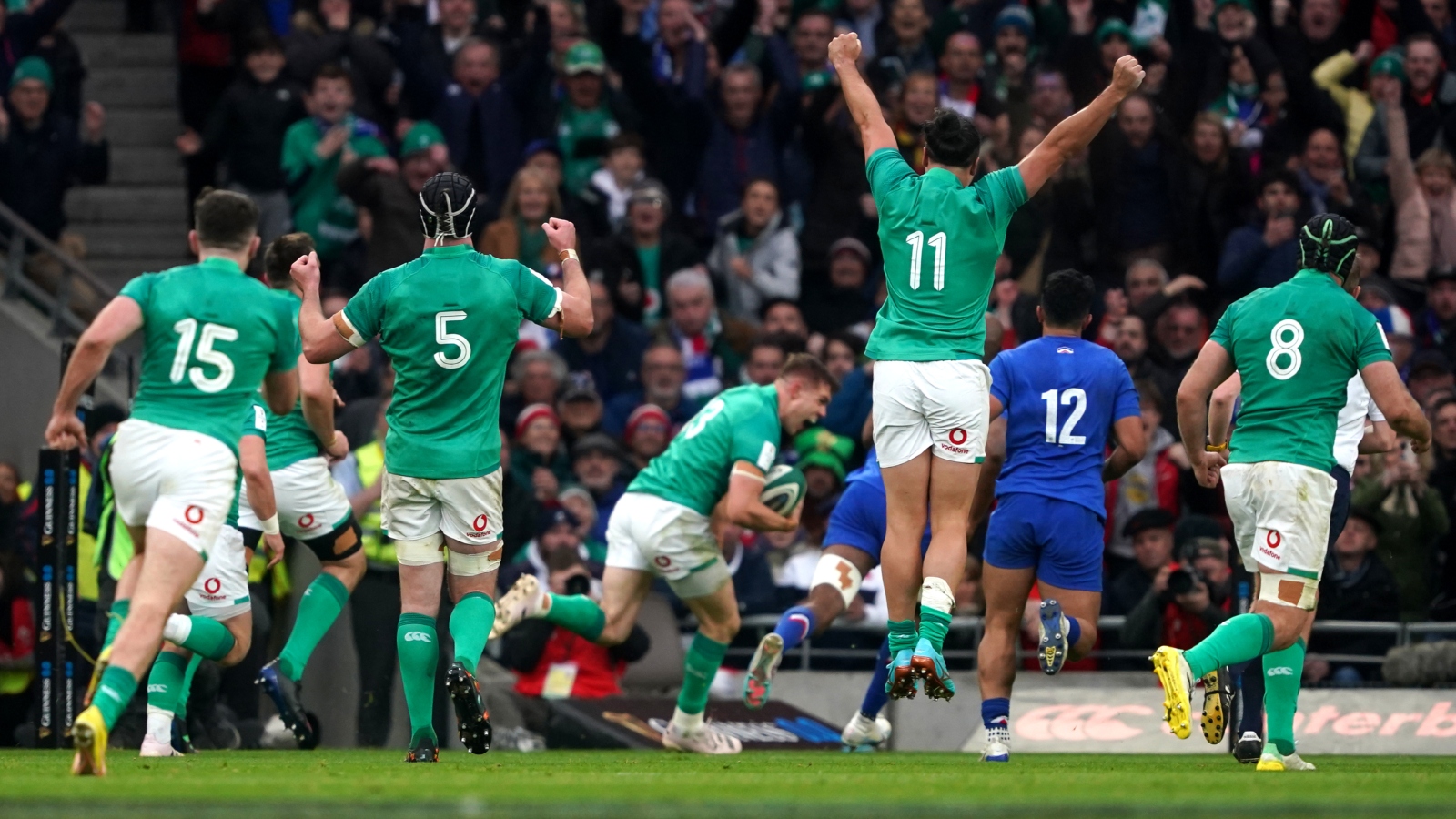
There can be no arguments now. Seven months out from the World Cup, Ireland is the best team in the game. Undisputedly. Unequivocally. Undeniable. This victory over France put clear separation, conceptually at least, between us and the rest of the game. This wasn’t a France side limping into the Aviva. They were not buckled with injuries. They didn’t even play poorly.
Ireland were just … better, and decisively so.
That is a massive step up on Ireland’s previous performances (and results, more importantly) against this generational French side. So how the hell did Ireland do it?
At regular points in this game, France looked out on their feet as a collective – forwards and backs – and that didn’t just happen all on its own. There were two factors at play.
- Ireland’s counter-transition kicking game consistently moved France backwards.
- France’s OWN tactical decision-making in the early part of this game to play a tonne of off-scheme – for them – rugby in their own half of the field.
France’s typical heavy kick-pressure game usually means less than 30% of their time in possession is spent in their own half. They typically use Dupont, Ntamack or Jaminet/Ramos to launch the ball downfield, chase, pressure and then play off the backfoot kick they will ideally get from the opposition. From there they will either reset and kick again, or play on the transition OR chew up ground through the middle of the field with narrow play action off Dupont and the heavy runners around him. When France go wide, they tend to do it off a heavy compression and they score a lot of their tries on transition using this general method. Even if they don’t score a try, this style of play exerts a big physical toll on the opposition and generates penalties as a by-product.
Using this method, France eat up territory and pressures the opposition constantly in areas of the field that they will typically kick from. To play this type of game, though, you have to make sacrifices and one of those is a fairly limited approach in your own half of the field – usually. There are exceptions, of course, like when an opportunity opens up on transition but, for the most part, you need your halfbacks, in particular, to be quite disciplined when it comes to stamping down on what might be considered their “natural” game. This is the unspoken toll of a heavy kick-pressure game – sometimes it can be quite boring and methodical to play. It has so many upsides and is such a winning strategy on the whole, that you’d live with those restrictions.
One of the main benefits of a good kick-pressure game is the control it usually gives you over the clock. Heavy kick pressure usually produces a lot of stoppages for scrums, lineouts and the phase play you produce afterwards If you control the clock consistently, you can supersize your pack and replacements because the usual constraints of packing your team with super heavy-weight players don’t apply.
If you control how the ball moves and can manipulate when it stops, you don’t have to worry about burning out a tonne of 120KG+ players because the routes are pretty simple. If you kick long with a tonne of volume, your wingers and midfield will do the majority of the chasing and “guiding” of the opposition with your pack moving 20/30m max up the field to await the runner if they kick back. France select a winger – Villiere/Dumortier – specifically keep their heavy, no small-forward build packs on-side during these kicking exchanges by chasing hard up on the outside. It’s a core park of the #11 role for France.
When France controls the tempo and speed of the game, they almost always win.
But when they lose control of HOW the game is played – and with that the tempo of the game – anything can happen.
Over their previous eight games including last week’s game against Italy, the 2022 Autumn Nations Series and the 2022 Six Nations*, you see a definite pattern in France’s games.
* I excluded France’s three games against Japan as I do not consider them elite level opposition at the moment.
On average, France play around 34 minutes of ball-in-play time with a massive differential between the time they spend in possession and the time the opponent spends in possession.
France will almost always have less possession than the opposition and, depending on their read of the strength of the opposition, the ball in play time will stay around 15/16 minutes max for a strong opponent and go as high as 19 minutes for an opponent they don’t really rate all that highly, like Italy. When you see this differential in use of ball-in-play time, you’re actually seeing France’s kick pressure at work.
Here’s the ball in play time from those eight eligible games.
- Italy 2023 – 36 minutes 16 seconds
- Australia 2022 – 35 minutes 18 seconds
- South Africa 2022 – 29 minutes 12 seconds
- England 2022 – 35 minutes 29 seconds
- Wales 2022 – 35 minutes 25 seconds
- Scotland 2022 – 32 minutes 40 seconds
- Ireland 2022 – 36 minutes 29 seconds
- Italy 2022 – 36 minutes 25 seconds
In this game against Ireland, there were 46 minutes and 15 seconds of ball-in-play time. That’s 10 minutes more than France have played in years. Why were they running on fumes? This French group aren’t built to play that much ball-in-play time.
As a comparison, when Munster played Toulouse in the Aviva last season with both sides looking wrecked after 100 game minutes the ball in play time was around 43 minutes. A week later they still hadn’t recovered and when Leinster despatched them a week later – with the same kind of emphatic scoreline as Ireland managed here, actually – the ball was in play for well more than 40 minutes again.
In the aftermath of that game, Toulouse’s head coach Ugo Mola spoke about the difference in ball-in-play time that his Toulouse side experienced between the TOP14 – where the average is 32 minutes of ball-in-play – and Europe;
“It doesn’t prepare us for what we experienced here. In the European Cup, it’s around 40 minutes of ball-in-play time.”
If France’s kick pressure is a built-in mechanism to preserve the size advantage they have over almost any other side other than South Africa (and even then, France can and regularly does go heavier) it cannot survive 40+ minutes of active rugby, be it in attack or defence.
But the crazy thing is – they did it to themselves! Last season, France had 17m 50 seconds of possession but they limited Ireland to only 49 seconds more possession. 53% of France’s possession in that game against Ireland in last season’s Six Nations happened in their own half. This season, France played three minutes more possession on their own ball but they were unable to limit Ireland’s possession – we had five clear minutes more ball in play than they did. 63% of France’s possession was inside their own half. That is almost unheard of with this French team under Fabien Galthié.
That made for an incredibly absorbing first half, in particular, but I think the early phase play pressure France exerted on themselves essentially holed them below the waterline for the rest of the 80 minutes.
France went into a high-intensity ball-dominant first 20 minutes that earned them six points after two really long phase play sequences but it felt like eight points left on the table given the energy they expended to get them.
The first burst of phase play energy earned France a 3-0 lead from a penalty but straight away you could see signs of a dropoff in the sequence that came after.
The same kicking concept that caught out Wales inside the first two minutes of the game last week did the same inside five minutes here.
The try that gave France the lead – an outstanding transition exchange – lasted a full two minutes of ball in play time with multiple swings of territory up and down the field. From that restart, Ramos coughed up another error – three inside the first 20 minutes – that let Ireland back into the game.
From there, Ireland were able to flatten out our attack and – quite easily actually – get outside the heavy French defence.
Sure, there’s more than a bit of luck involved in the last two moments of this try but the build-up was just outstanding adaptive rugby that used flat wide pods and smart blockers to open the space for players to make plays.
The early French expansivity burned out their forwards and the 15 points they conceded between the 15th minute and the 40th minute decided this game. In a game they lost by 13 points – that counts. I think France were looking to hijack Ireland’s counter-transition game in the same way that La Rochelle did to Leinster but they didn’t have the punch in the outside backs to make that post-transition phase play hurt Ireland in a meaningful way.
For Ireland to be capable of exploiting a team of that quality says a lot about OUR quality. Ireland can burn out bigger teams and bully anyone in our physical ballpark. Will France make the same on-ball mistakes if we play them again? I doubt it, but when they did here they basically walked jaw-first into all our punches.
What they learned from this game will be crucial but what we learned will stand to us also.
With the eyes of the world on us, we can do the business against our direct rivals.
That’s important. And now, the only thing that counts is getting the Slam.
If we land that, the world is next.
| Names | Rating |
|---|---|
| Andrew Porter | ★★★★ |
| Rob Herring | N/A |
| Finlay Bealham | ★★★★ |
| Tadhg Beirne | ★★★★ |
| James Ryan | ★★★★ |
| Peter O'Mahony | ★★★★ |
| Josh Van Der Flier | ★★★★ |
| Caelan Doris | ★★★★★ |
| Conor Murray | ★★★★ |
| Johnny Sexton | ★★★ |
| James Lowe | ★★★★ |
| Stuart McCloskey | ★★★★ |
| Garry Ringrose | ★★★★ |
| Mack Hansen | ★★★ |
| Hugo Keenan | ★★★★★ |
| Ronan Kelleher | ★★★★ |
| Dave Kilcoyne | ★★★★ |
| Tom O'Toole | ★★★★ |
| Iain Henderson | ★★★★ |
| Jack Conan | ★★★ |
| Craig Casey | ★★★★ |
| Ross Byrne | ★★★★ |
| Bundee Aki | ★★★ |
