


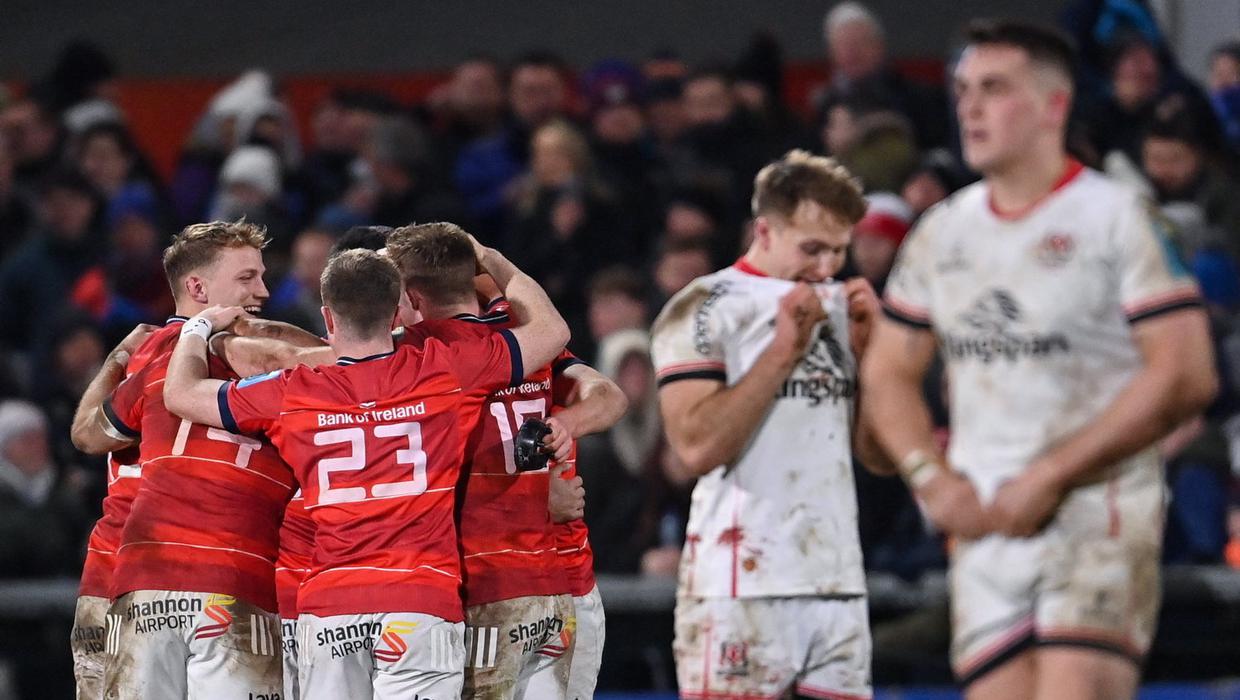
Did Munster play well here?
Not really.
I think if we extend the solid 15 minutes of good rugby we played here to even 60 minutes, we beat this Ulster side by 10 points plus. The problem, for me, was that when we weren’t playing to the level that we’ve shown that we’re capable of we looked a little blunt, a little flustered and prone to a few daft penalties in the exact places we knew Ulster would try to squeeze us.
But take that 15 minutes and break it up. I think you’ve got five at the start of the second half and the last 10 minutes. What do you have? You’ve got the thing that we love here in Munster. Character, spite, bottle and relentless desire to win a game that we looked like losing for 65 minutes.
I’m going to write something here now that sounds ridiculous on the face of it, but hear me out. Well, read me out.
Sometimes you can get a little bit too tied up in results.
I know, I know, it IS ridiculous but at the stage Munster are at right now – Year 1 of a three-year project, at least – losses are to be expected if you’re making radical changes in a short period of time. Go back to the first three games of the season and you’ll see Munster looking like a team that only met each other in the car park pre-game. Passes to nobody and nowhere. Blown rucks. Players not running lines that the play relied on to work. The whole show.
And results stank the place out as a result.
Loss to Cardiff. Loss to the Dragons. A loss away to Connacht. A loss to Leinster. A loss to Ulster. Five losses in seven games overall so what would a weak coaching team do? They’d pull back from the game they had laid out for Munster in June and July because September and October were washouts. That would be reading too much into results, bad as they were, and, as a result, stealing from the future because it’s getting a little hot in the now.
You have to stay on the path and see where it leads. That’s what coaching is.
It’s the inverse of that old “it’s a sign of champions that they can win without playing well” trope. We learned in the years after 2009 that sometimes it’s actually a sign of your own waning powers that will eventually translate into a terminal, status-altering decline, rather than it being a sign of a crafty team finding a way to win.
The key is performance. Are you producing in a way that is sustainable when we take raw results out of it? Are you losing due to a few bounces of a ball or is a unit speciality causing an issue? Are you pushing teams close that are better than you on paper while you’re missing key performers through injury or unavailability? Are you producing opportunities that aren’t capitalised on but that were produced?
These are signs that despite losing you could still be on the right path to a place where you’re doing all these things but winning at the same time, which is always the aim. You try to win every game but if you’re building something new, losses can be a side effect.
So what was our performance like here against a strong Ulster selection?
Encouraging mostly but with a metallic hangover taste of some of the old issues that need addressing in the medium term. That’s all going to be packed up and analysed as part of the ongoing job being done in Year 1 of a rebuild but for now, it’s more than satisfying that a young team minus a good few certain starters are able to pull off a win like this in a packed Kingspan Stadium right at the death.
That’s progress in the same way that losing to a full-strength Prime Toulouse by five points is, just with the scoreboard looking a little nicer at the end.
This is positive and, almost as importantly, it puts us in a position where we have all of our most challenging fixtures out of the way with seven games of the season left.
All of our fixtures between now and March are against sides in our immediate vicinity with key home games against the Lions, Glasgow, Ospreys and the Scarlets to come before we head to South Africa in April.
It’s all in our hands as of now, and that’s what we want. Ultimately, that’s what this big win produced for us.
***
I was quite surprised by Ulster’s kicking game in this one. Pre-game, I spoke about how Ulster’s kicking game was solidly middle of the road when it came to volume and distance. Across the season, they have tended not to kick long on counter-transition against most of their opponents and only kicked with higher volume against Leinster when they had a red card – or so I thought.
Ulster kicked with far more volume than normal in this game and after a few watch backs, I got why; I think they wanted to off-ball us in the way that Leinster and Toulouse did. I think – and this is just my read on it – that Ulster fancied that their front five and “stopper” focused back row combined with their midfield and big wingers would be enough to hem Munster in, beat us up in the middle of the field and force us to constantly reset through the boot.
In the first half, most of Ulster’s kicking was on scheme for them – mid-range kicking distance with Baloucoune doing most of the upfield chasing and contesting – and they did a really good job of controlling where Munster played. Without field position, Ulster could more freely attack our passing structures, pressure our handling and, right on scheme, force us to kick back ourselves from our own Q2 or just outside their 10m line.
Here’s a brief selection of the range I’m talking about.
Ulster controlled the territory like this for the first 30 minutes of the game – with one or two exceptions – and took a 9-0 lead off that back of that positional pressure.
In the second half, though, Ulster seemed to change tack which seemed dangerous to me because we’d already established in the first half that we could be dangerous when it came to executing in space.
Ulster began to kick more often in the second half almost to try and protect the lead that they’d earned. They were backing their defence but by kicking more often than they would normally, they exposed themselves to the kind of cardio drag that happens when you go off-scheme.
Ulster do not kick very often on average. When you change that tendency for a game, there can be unpredictable consequences. Look at how long it took Munster to adapt to a high-pace, high-possession game at the start of this season and how janky we looked last year when we decided we wanted to play a 1.3/4 Pass Per Carry game towards the end of the season when we’d fluctuated week to week all year long until April?
As Ulster began to dip in their vertical (chasing) and lateral coverage, Munster’s growing transition and counter-transition game began to come to the fore and, ultimately, won us this game.
The means that Ulster used to hold us out ended up being their undoing and we finally had the composure to take the opportunities that we’d worked hard to create.
That alone is something to be really excited about because we’re nowhere near what we’re going to be in that area of the game as of yet but we’re already putting together really nice multi-phase sequences on counter-transition that is hurting teams like Ulster.
A big win in a manner that suggests that the fundamentals of our game are growing every week. We’re not there yet, far from it, but this team is getting there.
| Names | Rating |
|---|---|
| Dave Kilcoyne | ★★★ |
| Niall Scannell | ★★★ |
| Roman Salanoa | ★★★★ |
| Jean Kleyn | ★★★★ |
| Kiran McDonald | ★★★★ |
| Jack O'Donoghue | ★★★★ |
| Alex Kendellen | ★★★★★ |
| Gavin Coombes | ★★★★★ |
| Paddy Patterson | ★★★ |
| Jack Crowley | ★★★★★ |
| Keith Earls | ★ |
| Malakai Fekitoa | ★★★ |
| Antoine Frisch | ★★★★★ |
| Shane Daly | ★★★★ |
| Mike Haley | ★★★★★ |
| Scott Buckley | ★★★★ |
| Josh Wycherley | ★★★★ |
| Stephen Archer | ★★★★ |
| Cian Hurley | DNP |
| Jack O'Sullivan | DNP |
| Conor Murray | ★★★★ |
| Ben Healy | ★★★★ |
| Pa Campbell | ★★★ |
