



Over the last few years, I’ve spent much time and digital space discussing the concept of Counter Transition rugby in the modern game.
Here is one of the better articles I’ve done on the subject back in 2022, even if the videos have been nerfed from their original hosting service. After some end-of-season catchup conversations with some people in coaching around the world in the weeks since the end of the season, one thing became clear; at the elite end of the game, defences have never been better coached, fitter, more physically impactful or adaptive.
Even the law tweaks designed to nerf the impact of defensive rugby haven’t been effective in making the core question of the game any easier. Essentially, how do you get from here to here?
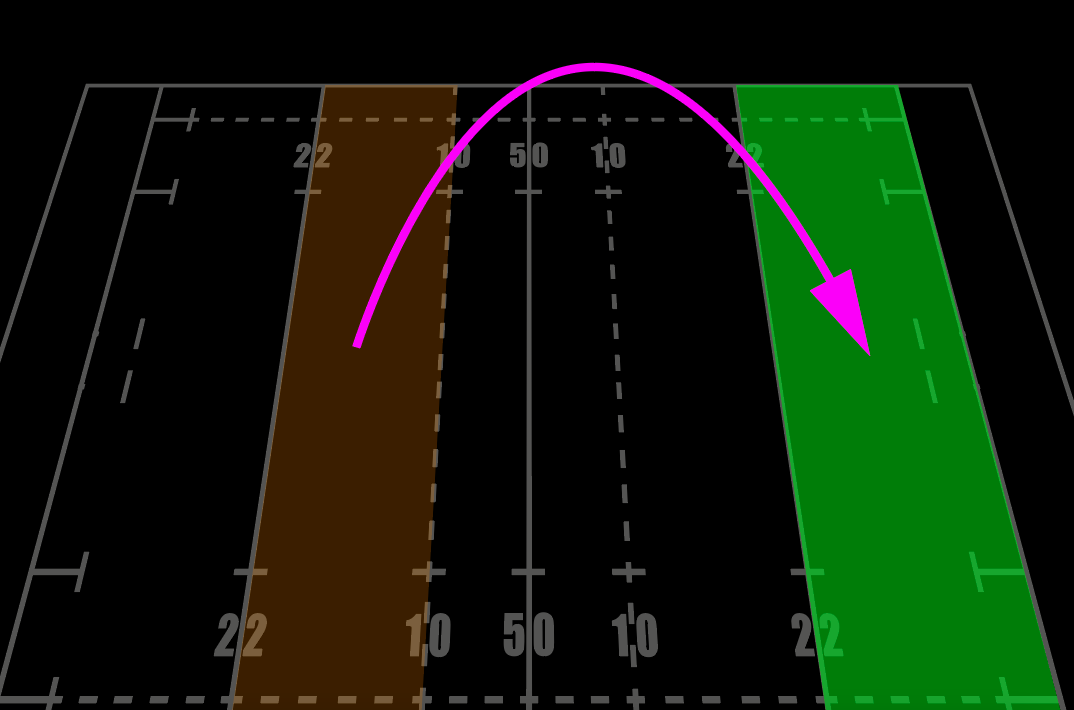
The orange zone is where you are most likely to receive the ball from the opposition and the green zone is where the vast majority of points are scored. Those 38 metres from your 10m line to the opposition’s 22 is, basically, the entire game of rugby union. The importance of 22 Entries and their correlation with winning rugby is obvious. Get in and around that 22m line and missed tackles are more likely to lead to tries, penalties conceded are more likely to lead to points and defensive errors become incredibly expensive. Getting there is the thing.
This is where game-states come in because they are your team’s chosen method of advancing from one zone to the other, with kicking relative to the amount of ball you choose to pass and carry as the primary method of identifying each state. We identify this with Pass to Kick (PTK) ratio and Pass Per Carry (PPC) ratio.
- On-ball rugby is defined by a very high PTK ratio – 1.7 or above – and carrying with a mid-range PPC ratio of between 1.4/1.6.
- Off-ball rugby is defined by a very low PTK ratio – 1.3 or below – with a conservative, tight PPC ratio from anything below 1.0 to 1.1 or 1.3.
- Counter-transition rugby exists on a sliding PTK scale between 1.4 to 1.6 with a PPC ratio consistently north of 1.5.
Last season, when it came to the elite level finals and semi-finals in club rugby, the team with the lower Pass to Kick ratio won every single time without exception. Put simply, when the elite sides play each other at the business end of club tournaments – high cohesion units vs high cohesion units – the team who kicks the ball more relative to the times they carry and pass it, wins by an average of a score or more in the first season post World Cup 2023.
To properly drill into this, we need to look at the political landscape of the game and how that impacts on-field style.
A Game In Flow
World Rugby are trying to please two opposing masters in 2024 and they are; player safety and maximising the value of the sport as an entertainment product.
If you were to fully lean into either of these values, it would fully come at the expense of the other. If you were to take player safety to the extreme, for example, you’d essentially end up with tag rugby played on soft mats, something nobody would watch. Swing too far into entertainment, with all the squalid, Let The Boys Play Boomfa stuff turned up to the max and you’d end up with an ugly hybrid of League, the XFL, Powerslap and NHL goon fights so brutal that even YouTube live chat sociopaths might turn their noses up at it.
A balance must be struck and that’s what World Rugby have tried to do in the last few years – especially post-pandemic. Tackle height has been addressed – imperfectly – and they’ve recently brought in amendments to outlaw the croc roll but for this article, I want to focus on their in-game law changes, which have been driven almost entirely to address criticisms of rugby as a spectator sport and TV product.

Those criticisms have ranged from the laws of the game being too complex and arcane for new fans to grasp to the game itself being too slow, too boring, too many slow caterpillar ruck box kicks and too many incidents of “kick tennis”.
The first major law change of the post-pandemic era was the introduction of 50/22 which, while not being revolutionary, has added new tactical wrinkles to the game that, in my opinion anyway, have been a net positive. The various goal line dropout amendments have also been pretty good, on the whole;
If the ball is held up in-goal, there is a knock-on from an attacking player in in-goal or an attacking kick is grounded by the defenders in their in-goal, then play restarts with a goal line drop-out anywhere along the goal line
I think the held-up in goal law is a little too punishing on the attacking team who’ve worked hard to earn that possession so close to the try line but, again, I think it’s a net positive on the game.
World Rugby, however, were far from finished. Several law tweaks were brought in post-World Cup 2019.
Then, on the first of July, they introduced three new definitive law amendments;
- Offside in front of a kicker
- Eliminating the crocodile roll
- Removing the scrum option when a Free Kick is awarded
These are all part of the initiative to create a game that “flows” more than it currently does. The changes were framed as “fan-focused” and designed to increase rugby’s “audience share” specifically.
More law trials are ongoing that might – and probably will – go further than these three tweaks, but World Rugby is telling us about the game they want directly; quicker, fewer slow set pieces (the scrum) and more transitions, counter-attacks and rapid switches of possession.
Anything that a casual fan – a potential long-term hardcore fan, remember – would find boring, contradictory or confusing is something World Rugby want to get rid of, where possible, and when it doesn’t endanger players any more than the base game already does.
So with that in mind, let’s look at what I think is, by far, the most interesting one of the July 2024 amendments; the fix for the so-called “Dupont Law”.
Teams and players have recognised that in a kicking battle with opponents, the kicking team – providing they are more than 10m away from the ball alighting – can be put onside by the actions of the catcher who runs 5m, passes or kicks.
This has created freedom for players to loiter in the middle and wait for a kicktennis battle to conclude.
The new wording makes clear that any player who is offside in open play needs to take action to put themselves onside and not just remain stationary. The clauses relating to the catcher running 5m and passing the ball to put an opponent onside, will be removed.
Releasing the Compression
Everything that World Rugby have been trying to do since the introduction of the 50/22 is to elongate the game. Pre-2020, the game had found itself compressed into 30m slices of the field with the only surefire tactical method to escape the crippling effect of league-style line speed on attacking rugby was the box kick. With the introduction of 50/22 and the grounding of attacking kicks in your in-goal area leading to a goal-line drop-out, a lot of extra space was created because of what could be achieved with accurate kicks from your own half of the field.
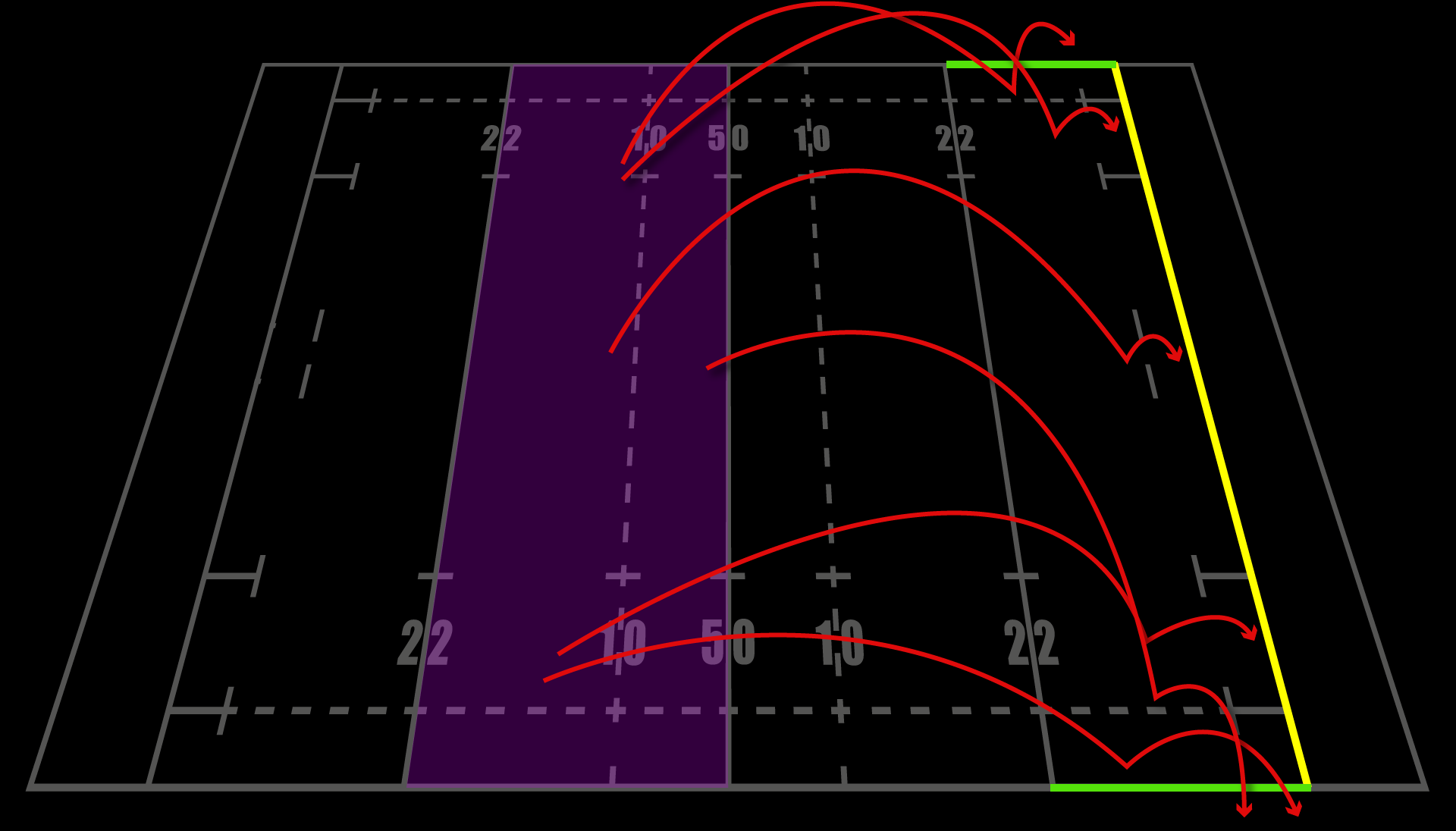
Even the tweak to the grounding of kicks in the in-goal area – which can be kicked from everywhere – succeeded in elongating the game by increasing the range that had to be defended. The results weren’t as dramatic as I hypothesised they might have been, but we are seeing more space on the edges of the field as wingers, fullbacks and 10s have pulled back to guard certain possessions around the halfway line. It’s a little more subtle than I expected, but it’s still there.
One thing I think it has done for sure is to increase the volume of tactical kicking done by 10s or other outside backs as compared to that done by scrumhalves. Scrumhalves still kick the ball but now there’s far more onus on a variety of kicking, a variety of kickers and, in general, longer kicking.
World Rugby wants longer kicks because it serves the two masters simultaneously – a rarity in the modern game. Longer kicking means the ball is in flow, there are fewer scrums and if the ball is fizzing up and down the field, players have to be lighter and fitter to make that game sustainable.
Well, that was the theory but it wasn’t fully working like that. Teams were kicking longer consistently but we weren’t seeing lighter forwards or more tired forwards. This was down to what became known as the Dupont Law.
Here is the new Law 10, with the old clauses removed and the new amendments inserted.
Law 10 – Offside and onside in open play
10.1: A player is offside in open play if that player is in front of a team-mate who is carrying the ball or who last played it. An offside player must not interfere with play. This includes:
a. Playing the ball.
b. Tackling the ball carrier.
c. Preventing the opposition from playing as they wish.
d. Loitering in an offside position
10.4: An offside player may be penalised if that player:
a. Does not make an effort to retreat and interfere with play; or
b. Moves forwards towards the ball; or
c. [unchanged]
10.7 Other than under Law 10.4c, an offside player can be put onside when:
a. An onside teammate of that player moves past the offside player and is within or has re-entered the playing area.
b. An opponent of that player:
i. Carries the ball five metres; or
ii. Passes the ball; or
i. Kicks the ball; or
ii. Intentionally touches the ball without gaining possession of it.
Those clauses of 10.7.b(i) and (ii) were the ones that allowed opposition players to stand still in the middle of the pitch while the kicking battle played out. As long as they didn’t advance, they were perfectly legal and 10.7.b(i) allowed them to become active defenders when the transition runner ran 5m, which was almost impossible to enforce.
With that clause removed, the forward must now actively retreat which means that standing still is no longer an option.
A player who remains in an offside position is loitering. A loiterer who prevents the opposing team from playing the ball as they wish is taking part in the game and is liable to sanction. A loiterer must not benefit from being put onside by the opposing team’s action.
If the kicking team wants the territory and tactical advantages that come with kicking longer – and they do – then the mass of forwards in the middle of the field have to move more and with that movement comes space and the elongated game World Rugby has been looking for.

As we sit on the cusp of the 2024/25 season, there is every reason to heavily lean into counter-transition rugby as a core attacking concept and very few reasons not to. Overtly on-ball rugby is (a) outside of the flow game that World Rugby wants and, (b) with the croc roll and anything like it banned, it will be far more difficult to sustain over long periods of phase play. That is beside the point that it’s also incredibly attritional rugby to play week to week.
These law changes benefit faster teams and punishes slower, heavier ones. This is the age of low KtP ratios and high PPC ratios with lightning-quick, super-agile and athletic transition runners being found by equally as quick, athletic and explosive playmakers.
This will be the game of the next four years and those who don’t realise that will fall by the wayside.
In this series, I will look into the scope of Counter-Transition rugby and how Munster are primed to take advantage in 2024/25. The next episode in this series will look at transition attack shapes and player roles.
