


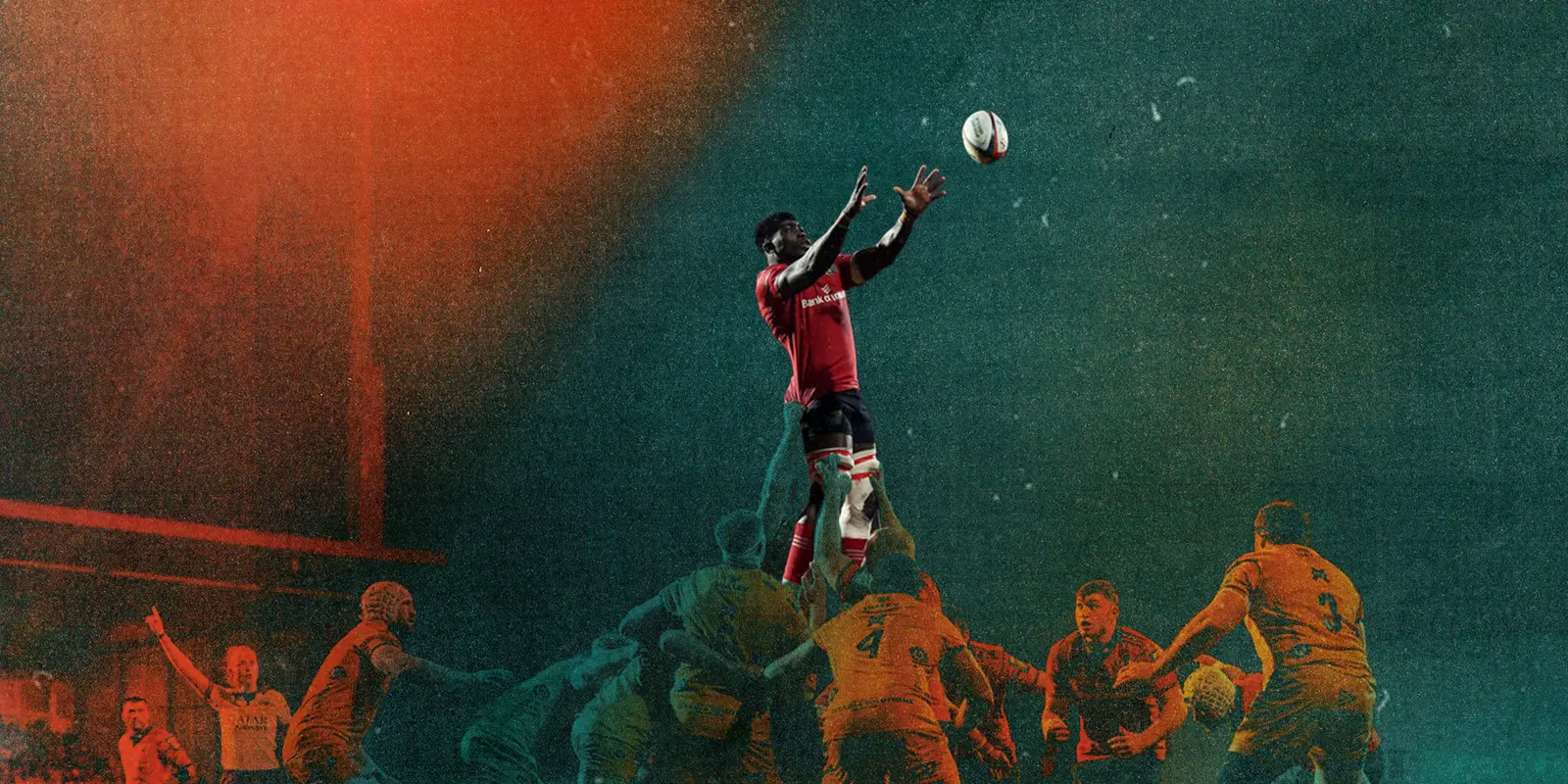
In weather like last Friday night, the easiest way to progress up the field reliably is through your lineout maul.
At a basic level, driving wind and rain will generally produce more lineout possession, and when playing off the top and into midfield becomes high-risk; the low-risk, high-reward play is using your maul to advance up the field directly, or through penalty ladders.
It isn’t overly expansive, it’s not going to make many highlight reels, but it’s reliable, and dovetails well with winning, pragmatic rugby in conditions that don’t suit tries from the ends of the earth.
This season, Munster’s maul has suffered due to a few different reasons.
The first one, which influences everything, is a lack of cohesion. We’ve had a lot of changes in the pack and pack replacements week to week. Just like the scrum, where “feel” and timing are hugely important, the maul relies a lot on in-game reps as a unit. We haven’t had that consistently, and it loosens the screws on what we’re trying to do. From a data perspective, it makes for some pretty grim reading.
Munster’s lineout + maul profile
| Metric | Munster | URC avg | Rank (of 16) | Read |
|---|---|---|---|---|
| Lineout – own win % | 89.0% | 86.7% | 6th | Solid, repeatable platform; not quite at the very top end. |
| Lineout – opposition won % (= your steals on their throw) | 10.4% | 13.3% | 12th | Below-average disruption; we aren’t regularly manufacturing extra possessions. |
| Maul – metres gained per maul | 1.8m | 2.24m | t-12th | Low yardage yield; maul isn’t consistently winning territory. |
| Maul – mauls per maul try (PER TRY — lower is better) | 47.0 | 19.7 | 15th | Very inefficient maul try conversion: we’re forming a lot of mauls for very few direct maul tries. |
Lineout (supply):
- Own lineout win %: 89.0% (6th in URC)
We’re a top-half retention side. Not Stormers/Leinster level, but stable enough to build a set-piece attack off. - Opposition lineout won % (steals): 10.4% (12th)
We’re not one of the league’s high-disruption units at opposition throw. That matters because steals are “free” attacking platforms — and we’re not generating many of them.
Maul (what we do with it):
- Metres gained per maul: 1.8m (joint-12th)
Low output. We’re not consistently getting territorial reward from maul volume. - Mauls per maul try: 47.0 (15th / 2nd-worst)
This is the killer number: we need 47 mauls to score 1 maul try. Only Ospreys (51.0) are worse. URC average here is ~19.7.
The intersection
Put the two together, and the story is pretty clear:
- We have enough lineout stability to be a maul team (89% on our own throw),
but… - our maul is not paying us back — neither in metres (1.8m) nor in tries (47 mauls per try).
- Because we’re not stealing many lineouts (10.4%), we’re also not creating extra maul-launch opportunities off opponent throws — so we’re leaning more on “earned” platforms.
How that compares to the league
- Best maul try efficiency: Cardiff & Glasgow (7.2 mauls/try), Connacht (8.0)
Those teams are converting mauls into tries 6–7x more efficiently than us. - Stormers: elite lineout (93.8%) + elite maul gain (3.6m) + strong maul try efficiency (12.6)
That’s what a fully functioning lineout/maul system looks like. - Leinster: brilliant lineout retention (92.1) and steals (17.6), good metres/maul (2.6), but 34.0 mauls/try
Even though they aren’t turning mauls into maul tries efficiently, we’re materially worse again at 47.0.
What we can and can’t conclude from this single table
What we can say: Munster’s maul, in aggregate, is currently a low-yield one — it doesn’t travel far, and it rarely ends in a maul try. Our best mauling performance this season was against the Ospreys, the only side in the URC worse than us in tries per maul.
What we can’t say based on the data alone: why.
If we treat this as a straight performance issue (not “we just maul a lot in midfield and that bloats our numbers”), then the set-piece picture is blunt enough: our lineout retention is good enough to build a maul game (89%), but the maul itself isn’t giving us gainline value (1.8m/maul) or finishing (47 mauls per maul try, second-worst in the league).
And because we’re also light on steals (10.4%), we aren’t compensating by nicking opponents’ throws and turning those into cheap pressure. We are not mauling well, and are constantly being mauled against.
The fix is equally blunt: improve the collision and shape of the maul (pre-bind timing, transfer point, latch discipline, staying square through the first stop), and layer in more five-metre variety so teams can’t just load the swim/sack and wait us out.
***
There is more than one way to maul, but the fundamentals of good mauling are almost always the same. Timing, unified hitting, dominating the initial shove — they translate regardless of the ultimate intent of the maul itself.
You don’t always have to run right over the top of the opposition. Sure, that’s the most direct route (and the most satisfying), but most sides are set up to defend that against all but the most physically imposing sides. Everyone’s getting better at the defensive fundamentals these days, and maximising every defensive advantage like the “scrum” counter-hit, timing it right before the drop — even with the penalties that sometimes come with it — and getting that first stop.
Against the Dragons, I think it’s fair to say that they’re a decent defensive maul side with big, heavy bodies and good coaching on the fundamentals.
Our first maul of the game wasn’t anything spectacular, but it did showcase some of the issues that we experienced throughout the game.
First, look at our build;
Kleyn and Loughman lifting Wycherley, Edogbo transiting from the back to the touchline pillar, Quinn as the rip, and Ala’alatoa taking the infield pillar from the back of the lineout, with Barron finishing the build at the back post throw. There’s no inter-pod movement, and it’s a straight lift and drive.
The problem here is that our timing is off on the hit. Dragons get their unified shove in first, and we don’t get the full six-man weight in place until after that first hit comes in.
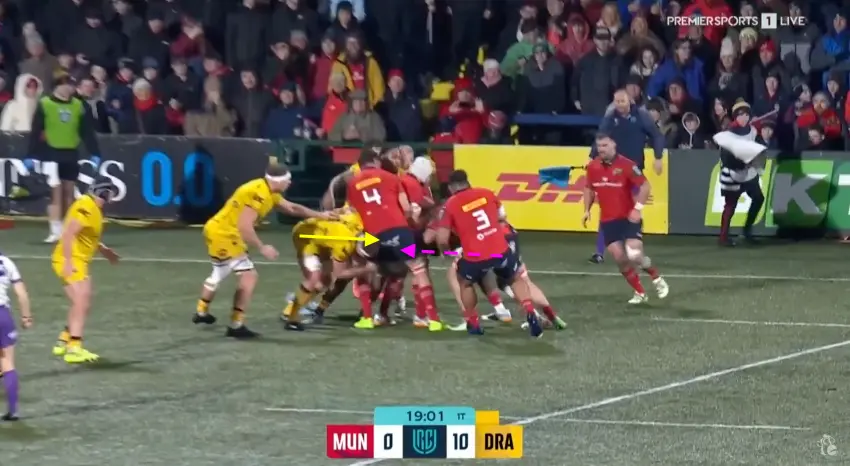
That’s not a killer necessarily — sometimes a late-arriving shove can help shift the maul around the initial countershove.
Put your two fists together. Have the left fist in earlier than the right. Then, shift the pressure of the right fist diagonally towards the pinky finger. The knuckle on the outside will shift towards the outside and can then shift around the pressure of the first fist.
Munster try to do this a lot, but if the pressure on the inside is too much, the initial momentum can be too hard to recover from. Increase the initial pressure on the index finger of the left fist. Now the diagonal doesn’t work. The pinky (touchline side) doesn’t shift.
That’s what you’re seeing here.
Ala’alatoa has too much ground to cover to hit almost simultaneously, so the pressure on the infield side of the maul is unequal.
Our next maul is a feint with the intent being to tie up Dragons in the shove, freeing up Quinn to take the ball immediately on the drop in the third layer to break into the infield flank.
It’s a reverse of the previous maul build, but this time at the front, rather than the back. Edogbo goes to the infield from the front space, with Loughman and Kleyn hitting the second layer, and Quinn taking the ball from the third, with Barron arcing around as ruck support.
Pretty good; but Ala’alatoa gets stood up a little too easily, albeit with the intent that he’s always going to break out for the phase play to come, so he’s not committing to a full-lean as the lifter. He’s there to invite pressure, which will, in turn, create a gap for Quinn to hit.
Our next maul was meant to be a drive, but we got a lot wrong in the immediate moments right after the drop.
Here’s the clip.
First of all, it’s not a tight jump/lift. Kleyn’s foot splays out, and that keeps Quinn from getting into the pocket immediately, as only a massive boot waving in your face belonging to a 6’8″ man can do.
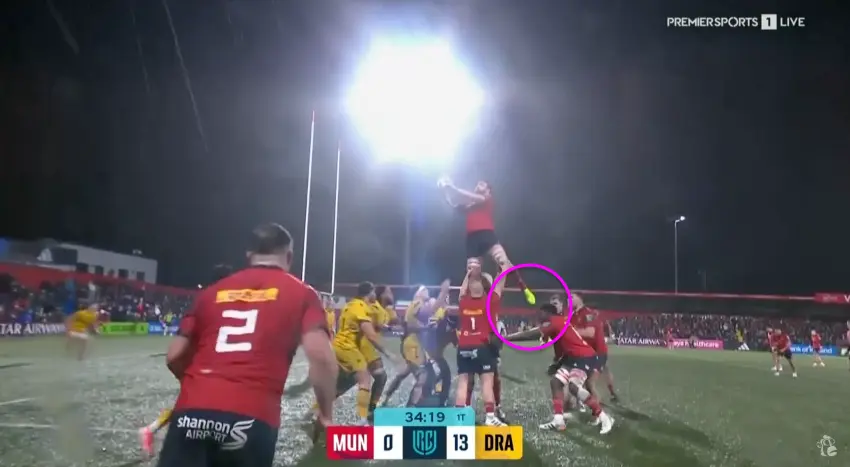
That means when Quinn enters as the rip, he’s a little higher and further back than he should be ideally. That’s not ideal.
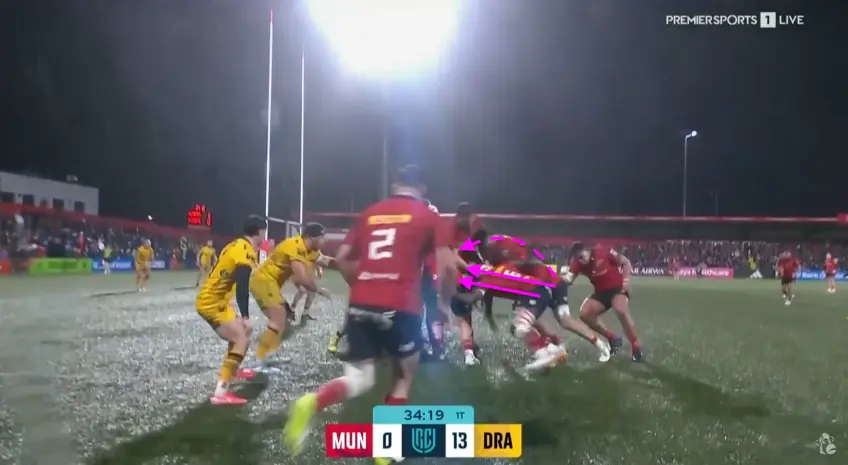
Again, if you’re not unified on the hit — in both entry timing and height — you give an advantage to the opposition, who don’t have the same problem on the counter-shove. Dragons went early on this shove — they were risking that all night — so we got the penalty advantage, but I think we were trying to run a touchline diagonal on this maul.
Ala’alatoa entered the maul last and went into the “lock” position at the tail of the maul, alongside Barron.
I think the intent here was for Edogbo and Loughman to create a diagonal “shear” to the maul that would then see Ala’alatoa as a heavy drive component for the second shove coming around the corner.
They couldn’t quite get the momentum they needed, most likely due to the early shove taking the space initially. As ever in mauling, the first shove usually wins, unless the reaction to it is overwhelmingly powerful.
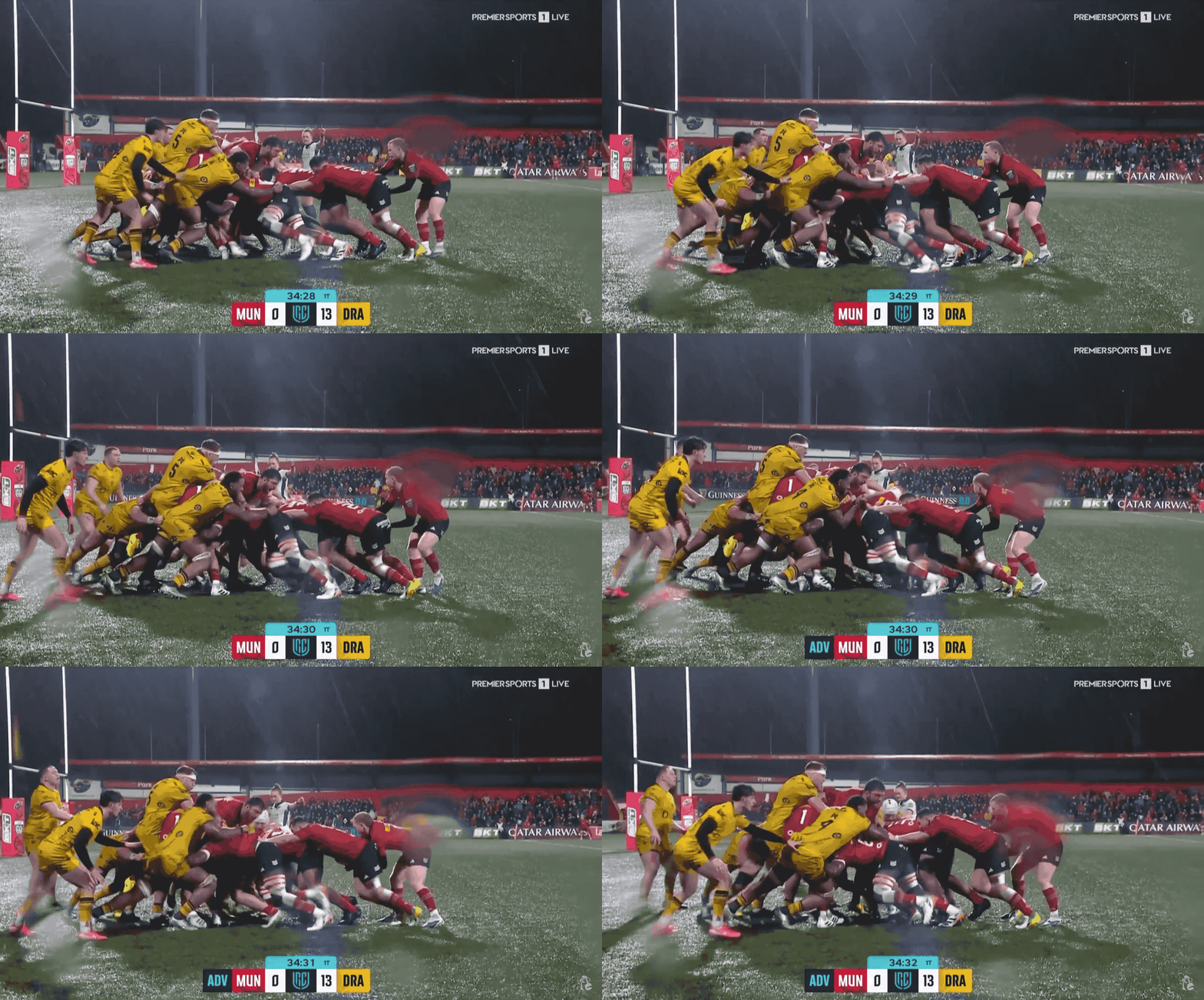
In a lot of mauls, you try to “feel” where the shear can work, and having a heavy driver in the third layer can work as a finishing touch once you get around the corner, but we didn’t get that momentum here, likely due to the early drive from the Dragons, and our own inaccuracies before the drive came in.
We had another maul a few minutes later, but it suffered from the same issue: a loose hit that saw core components hitting out of sync with each other, despite some good pre-binding. You can see the timing issue here.
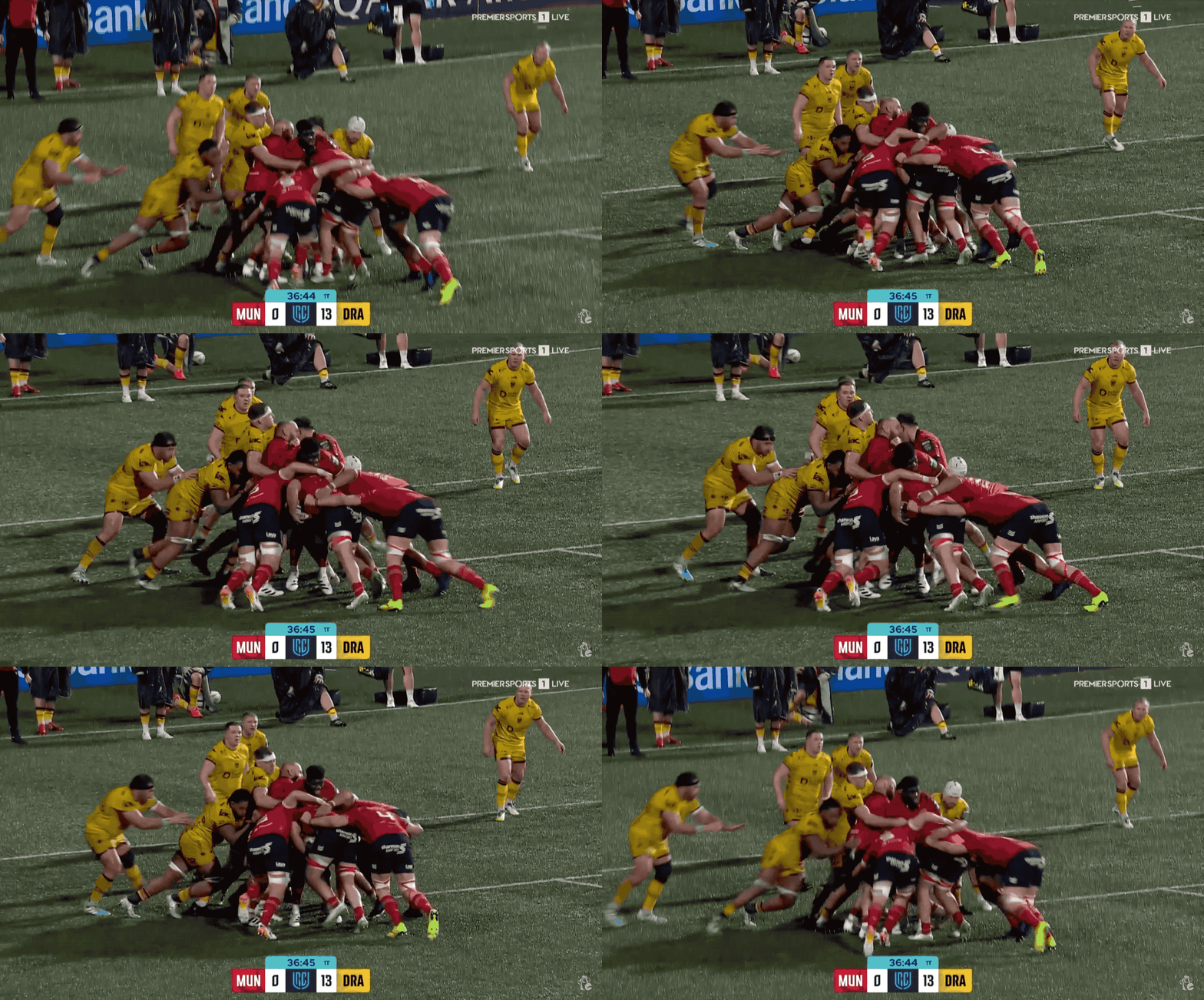
That comes from too much space between the starting position in the lineout and the maul target.
In the second half, we were back at it again, to not much reward, but there was forward movement at least. Look at Ala’alatoa’s position as the +1 in this lineout.
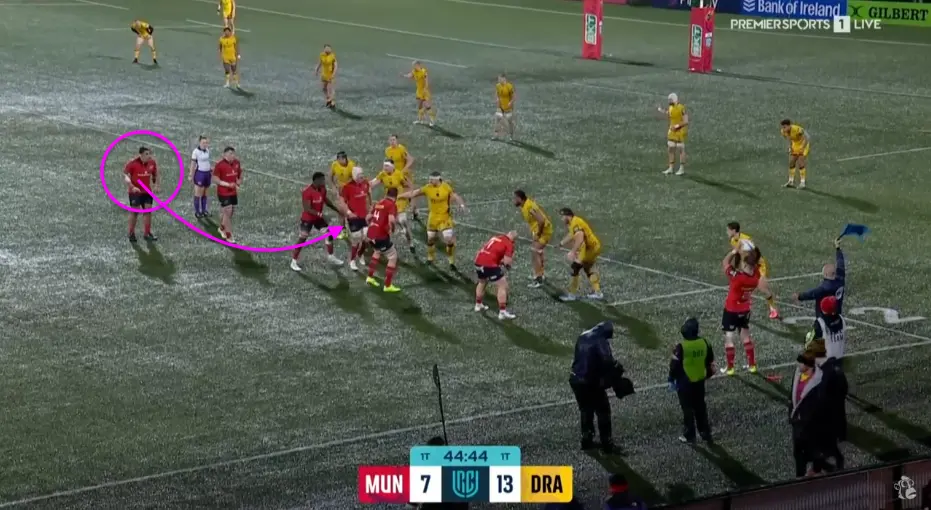
That’s the later-arriving shove again — not necessarily a bad thing — and Kleyn can get the forward movement on the infield side that allows that later shove to get momentum around the corner. Again, not much, but it’s there.
That’s the detail I spotted on my run of this game. Kleyn’s later appearance in that role is to add a late surge of heavy power as the maul shears around the corner.
A few minutes later, that pressure worked. Kleyn was the touchline lifter, and the Dragons overcompensated on that side. Look at Ala’alatoa in the third layer adding weight to the shove around the infield side and opening up a pocket of space for Barron.
That’s how it’s supposed to work, and we earn a penalty for a side entry after the shear.
Our next maul was really good — until a late bad decision.
Watch Kleyn in the third layer. Watching the next day, I felt this was a waste of his power, but he’s meant to be the driver on the shear, not trying to help push others over the top.
Look at the positioning at this time stamp. At this point, O’Donoghue has the ball in the rip — ahead of Kleyn and in between Ala’alatoa and Fineen Wycherley.
We get momentum on the touchline side, but the real pressure is on the infield side, where Ala’alatoa has the Dragons flanker at a good angle to work with.
Look at that strong line through Kleyn and Ala’alatoa!
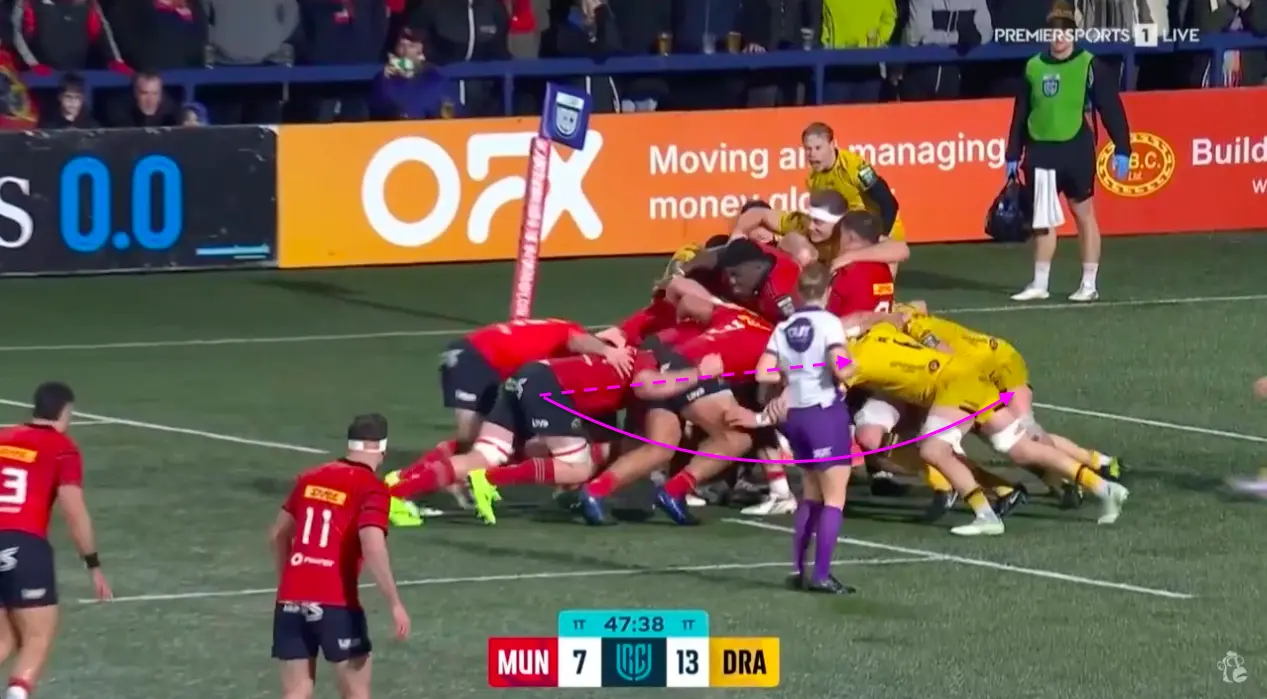
For me, the shear was to the infield side, not the touchline side. We have “fake momentum” there, and we lean into it, which unbalances Gleeson and Ala’alatoa. I’d have liked to have seen Ala’alatoa shift to his right here, and empower Kleyn around the corner into an unbalanced Dragons defence. We go the other way, the ball spills loose and almost concede a try up the other end. As ever, the backs coming in don’t really help.
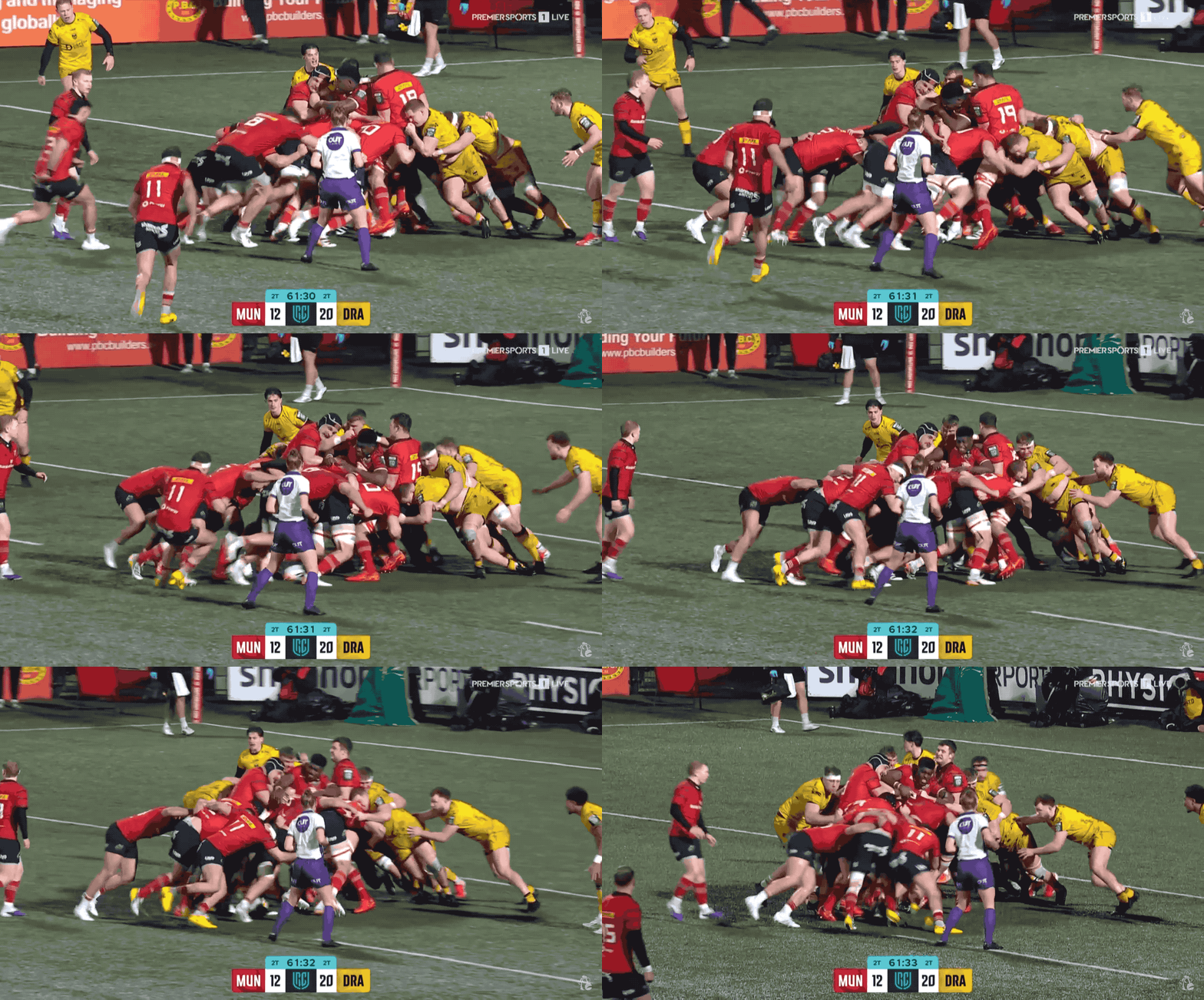
Finally, we had a great opportunity to drive right over in the 61st minute. One small detail stops this from shearing right under the posts.
We didn’t use a third-layer driver here, but we got great inward pressure on the touchline side through Jager as the lifter and strong direct lines through Edogbo in the middle with Coombes getting a great body position.
It’s Evan O’Connell. He does really well not to concede a blocking penalty early, but he never quite gets low enough as the infield lifter.
He’s never quite able to get low enough to crush down on the tiring Dragons defence.
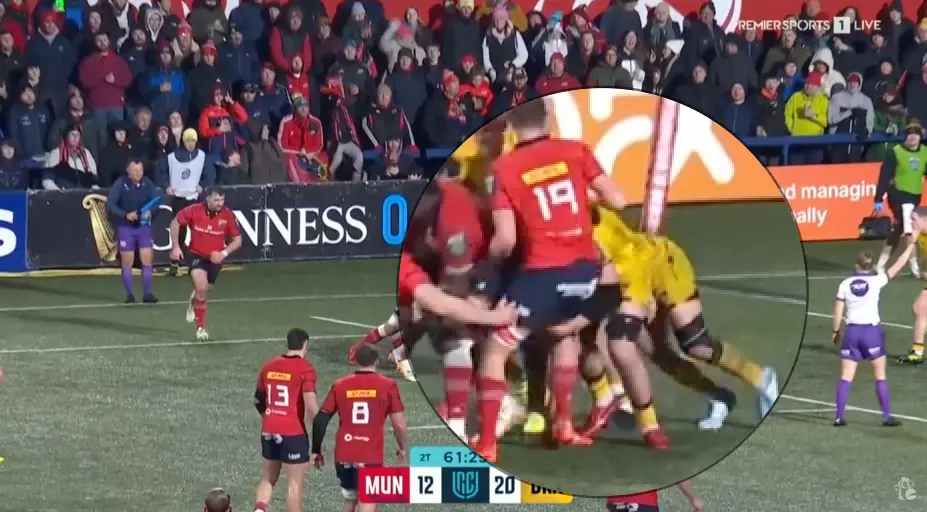
His feet never quite make consistent contact with the ground as the maul drives forward. The momentum, in a way, prevents him from ever recovering and the momentum stalls on that side right at the end. You can see it here.
As with a lot of things at Munster at the moment, we’re just a few small pieces away from pulling together the strands of a complete game.
In our maul, at least, it seems like the main details will come with more cohesion and time as a unit. No better place to start than this Friday, against one of the mauling sides in Europe.
