


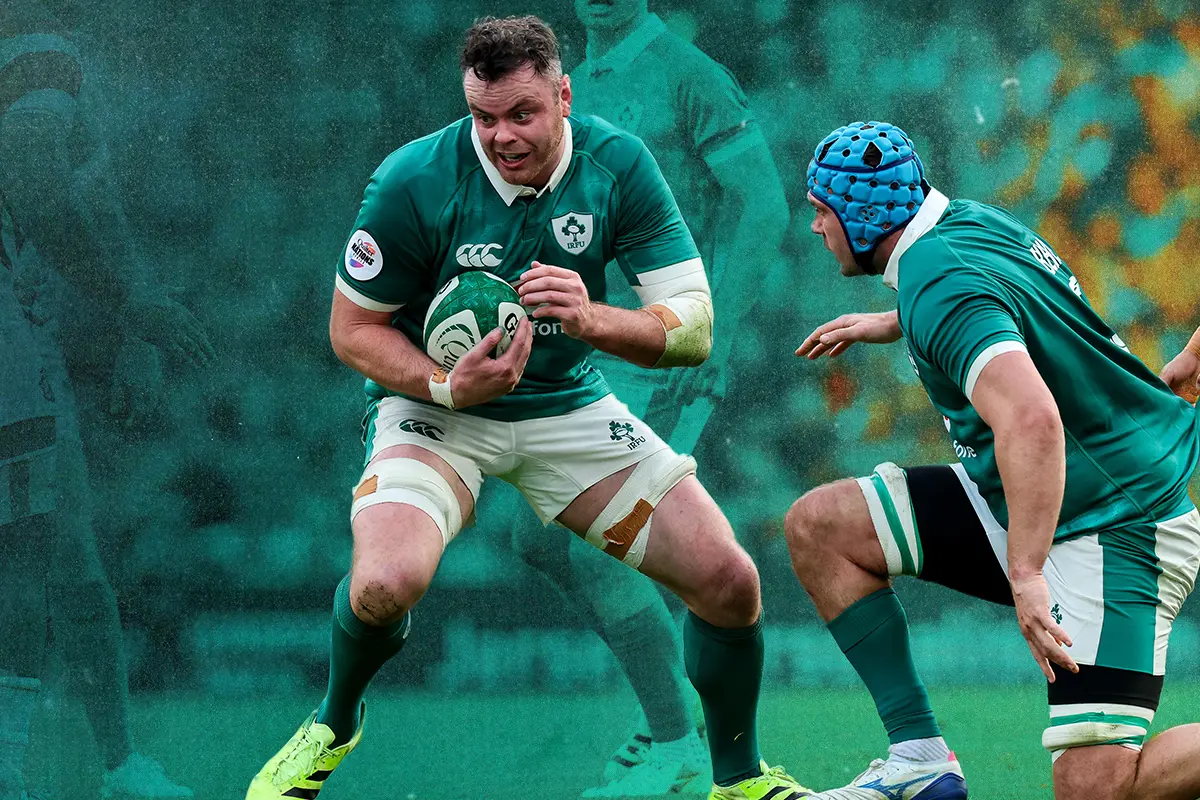
Ireland’s win over Japan wasn’t a classic breakdown dogfight.
Japan, like almost everyone else these days, decided that not competing at the breakdown — slow tackle recycle was the most they did — and two-man stops were the order of the day. You cede quick ruck ball to Ireland in that scenario, on most rucks, but you compensate by packing the pillars and using that half or quarter-blitz we’ve spoken about in the last few weeks to clog Ireland’s passing lanes and force deeper passes or bridge balls over the top.
It worked, for a while, but ultimately their conditioning let them down.
So how did it look at ruck for Ireland, and what does that data say about the overall performance?
Ireland’s OFFENSIVE RUCK WORK SCORE vs Japan
- A Dominant Clean is an action that decisively secures possession or that puts the defending player on the ground and keeps them there. It is worth 3 points.
- A Guard Action is where a player plays a role in helping to retain possession and either secures against a counter-ruck or ensures the players we’ve put on the ground stay there. Let’s assign this action 2 points.
- An Attendance can be anything from adding a bit of bulk to ward against a counter-ruck to extending your leg to make space for a box kick. I’m marking this down as being worth 1 point.
- An Ineffective Action is a blown cleanout, a lean, a breakdown penalty or an action that I couldn’t see any direct benefit for. This will be worth -2 points.
| Player | Dominant Cleans | Guard A | Att. | Inef. | TRA | ORW Score | Quality Index | Ineffective Rate % | ORW Share % |
|---|---|---|---|---|---|---|---|---|---|
| 1. Porter | 1.0 | 17.0 | 4.0 | 22.0 | 41.0 | 1.864 | 0.0 | 4.27 | |
| 7. Timoney | 17.0 | 4.0 | 1.0 | 22.0 | 36.0 | 1.727 | 4.5 | 3.75 | |
| 3. Clarkson | 13.0 | 6.0 | 19.0 | 32.0 | 1.684 | 0.0 | 3.33 | ||
| 5. Beirne | 2.0 | 12.0 | 7.0 | 3.0 | 24.0 | 31.0 | 1.542 | 12.5 | 3.23 |
| 12. Henshaw | 9.0 | 9.0 | 18.0 | 2.0 | 0.0 | 1.88 | |||
| 15. Osbourne | 9.0 | 9.0 | 18.0 | 2.0 | 0.0 | 1.88 | |||
| 13. Farrell | 11.0 | 2.0 | 13.0 | 18.0 | 1.692 | 15.4 | 1.88 | ||
| 8. Doris | 1.0 | 9.0 | 2.0 | 12.0 | 17.0 | 1.75 | 16.7 | 1.77 | |
| 2. Kelleher | 7.0 | 2.0 | 9.0 | 16.0 | 1.778 | 0.0 | 1.67 | ||
| 4. Ryan | 6.0 | 7.0 | 2.0 | 15.0 | 15.0 | 1.267 | 13.3 | 1.56 | |
| 6. Baird | 8.0 | 3.0 | 2.0 | 13.0 | 15.0 | 1.462 | 15.4 | 1.56 | |
| 14. T. O'Brien | 6.0 | 2.0 | 8.0 | 14.0 | 1.75 | 0.0 | 1.46 | ||
| 18. Bealham | 1.0 | 4.0 | 2.0 | 1.0 | 8.0 | 11.0 | 1.625 | 12.5 | 1.15 |
| 11. Stockdale | 6.0 | 1.0 | 7.0 | 10.0 | 1.714 | 14.3 | 1.04 | ||
| 20. Conan | 1.0 | 3.0 | 1.0 | 5.0 | 7.0 | 1.8 | 20.0 | 0.73 | |
| 16. G. McCarthy | 5.0 | 2.0 | 7.0 | 6.0 | 1.429 | 28.6 | 0.62 | ||
| 19. C. Prendergast | 2.0 | 2.0 | 2.0 | 6.0 | 6.0 | 1.667 | 33.3 | 0.62 | |
| 10. Crowley | 2.0 | 2.0 | 4.0 | 2.0 | 0.0 | 0.42 | |||
| 22. S. Prendergast | 1.0 | 1.0 | 2.0 | 2.0 | 0.0 | 0.21 | |||
| 23. J. O'Brien | 1.0 | 1.0 | 2.0 | 2.0 | 0.0 | 0.21 | |||
| 17. P. McCarthy | 1.0 | 1.0 | 1.0 | 1.0 | 0.0 | 0.1 | |||
| 9. Casey | 0.0 | 0.0 | 0.0 | 0.0 | 0.0 | ||||
| 21. Blade | 1.0 | 1.0 | -2.0 | 0.0 | 100.0 | -0.21 |
Headline
-
ORW total: 318
-
Total ruck actions: 214 → Positive rate: 90.7% (Ineffective 9.3%)
-
Action mix (of positives): Dominant 4.1% · Guard 76.3% · Attendance 19.6%
-
ORW per action: 1.486
Top Performers (ORW Scoring)
-
Porter — 41
-
Timoney — 36
-
Clarkson — 32
-
Beirne — 31
-
Henshaw — 18
Quality/Discipline
-
Quality Index (≥10 actions): Porter 1.864; Doris 1.750; Timoney 1.727; Farrell 1.692; Clarkson 1.684.
-
Highest Ineffective Rate (≥8 actions): Doris 16.7%; Farrell 15.4%; Baird 15.4%; Ryan 13.3%; Beirne 12.5%.
-
Zero-ineffective (≥8 actions): Porter, Clarkson, Henshaw, Osbourne, Kelleher, T. O’Brien.
Unit breakdown (share of player ORW)
-
Starting Front Row (1–3): 89 (28.0%) — strong guard load, 0% ineff.
-
Starting Back Row (6–8): 68 (21.4%) — 10.6% ineff; clean-up accuracy here — Baird in particular will need to be much more imposing against Australia.
-
Starting Second Row (4–5): 46 (14.5%) — 12.8% ineffective; mixed quality.
-
Starting Back Three: 42 (13.2%) — tidy (4.2% ineff).
-
Starting Centres: 36 (11.3%) — light volume.
-
Bench/Other: 33 (10.4%).
Output & Tempo
- LBR: 10 ÷ 93 = 0.1075 ⇒ 10.75 linebreaks per 100 rucks (one every 9.3 rucks). That’s a big return for the ruck volume and really blew up in the second half as Japan tired.
- Ruck-speed: Ireland played 64% of the ball at 0–3s (26% at 3–6s; 10% at 6s+). With Japan largely non-competing, that fast-ball share translated cleanly into the LBR above, especially as their blitz alignment fell away.
Actions Per Ruck
Actions per ruck (APR): 214 total Irish ruck actions ÷ 93 rucks ≈ 2.30 per ruck. That’s below our “overloaded” threshold of 3.0, so Ireland weren’t flooding cleanouts. It generally wasn’t needed.
Positive-action mix: Only 8 dominant cleans (≈ 0.09 per ruck). Positives were guard-heavy — 148 guards vs 38 attendances (of positive actions, ~76% guard, ~20% attendance, ~4% dominant).
Basically: This was a classic response to a low-contest defence — secure the ball with guards and recycle; no need to blast bodies off.
Accuracy: Ineffective actions 20/214 = 9.3% (≈ 0.22 per ruck). That’s pretty tidy for this volume/tempo, but won’t translate against Australia.
Pack Signals
Front row: zero ineffective across 50 actions; this was the biggest ORW chunk of the pack. They anchored clean recycling without errors and were generally all needed in the actions they provided.
Back row: ~10.6% ineffective; still productive, but the small error load sat mostly here.
Second row: ~12.8% ineffective; a touch loose relative to the rest — worth a look on long clean chains and body height, but especially usage. The question “Did you need to go off your feet here?” should be asked pretty regularly of James Ryan, in particular. Beirne was also well below his usual standards, especially over 80 minutes.
Player Snapshots
- Leaders by ORW: Porter (41), Timoney (36), Clarkson (32), Beirne (31).
- Zero-ineff (≥8 actions): Porter, Clarkson, Henshaw, Osbourne, Kelleher, T. O’Brien.
What it says about the game
Japan’s two-man tackle / no-jackal policy sped the breakdown and reduced the need for dominant cleans, letting Ireland keep numbers in the line. The 2.30 APR plus 64% fast ball explains the double-digit LBR/100.
The small pocket of inefficiency in the back/second rows is the only blemish; against a heavily contesting side that could become turnover or stall-speed, so that’s the tweak point and a key point for Farrell to consider, especially with an enforced change coming at fullback.
