


This was probably the best performance I’ve seen from a Munster team since the mid-2000s.
But don’t get carried away. It’s just an unprecedented — as in, we have never done this before — bonus point win against Leinster in Dublin during a regular season league game. We’ve beaten Leinster in Dublin during regular-season league play before, of course. Back in 2002/03, 2008/09 and 2014/15. That last one was our last regular-season league win before Saturday. In all of those wins, we failed to score a bonus point.
It’s our highest margin of victory over Leinster since we nilled them in the RDS back in 2008/09.
But don’t get carried away.
The euphoric nature of this game — the attitude, the performance, the result — is the kind of thing that could be transformative for this group of players, and for the club at large. If this group needed proof that what they have been working hard on under Clayton McMillan since the summer was working, this was it.
Belief.
No asterisks.
No dancing on the head of a pin about “Leinster B”.
They had 11 British & Irish Lions in their squad and 14 current Irish internationals, plus a few more who’ll probably get capped over November. They started a World Cup-winning Springbok. They were playing in a stadium where Munster have never won, in a city we haven’t won in since 2023 and just a few days after Andy Farrell determined that there wasn’t much of value going on outside the M50 for the Irish national team.
Are you not entertained?

The catharsis of this game could and should prove to everyone in the HPC that this is what we do. Not what we’re capable of on a good day, not a peak — what we should expect.
Before the game, I wrote this;
This game is a step along the road, nothing more, not much less. There are no Ireland spots “up for grabs”. That’s not how Ireland has worked for several years now. Play this game as it is, and I think it gets a lot easier to visualise as a concept. Once we realise that the animals needed to win this game, or leave a mark that counts as a win on our model with a losing bonus point, are the animals we need every week of the season, every day of the year, we’ll be on the right track.
It’s true. Beating Leinster is great, but we’re not just here to beat Leinster, in Dublin or Limerick or wherever. That is not a successful season for this club. This was a win, five points, a great day, and that’s it.
What we’ve seen now is that we have those animals needed. They walk around UL. They have shown that they are every bit as good as this Leinster team. We have now seen that when we go system for system, with the right game plan and the right mental approach, they are the same as any other team.
For the first time in a long time, we’re not the ones soul-searching once the flamethrowers get wheeled out, the posts come down, and the pigeons return to Croke Park.
We can realise a truth in that.
The animals we needed were here the entire time.
***
Munster successfully off-balled Leinster in this game, in the manner that Leinster have traditionally lost most of their big games in the last few years, regardless of the team they have out on the field.
I’ve seen a lot of people focusing on the fact that Leinster “weren’t at their best”, and that’s certainly true, but they weren’t at their best because Munster successfully created the conditions where Leinster almost always fall below their hypothetical best possible performance.
You don’t just rock up against Leinster and play the game they want to play.
I go back to two games in particular with this: Leinster’s big, dominant home wins over Toulouse and La Rochelle in European Cup semi-finals between 2023 and 2024. In both of those games, the French sides kicked significantly less than Leinster and, in key points of the game, tried to play on-ball rugby against Leinster, who forced 16 turnovers out of Toulouse and 12 out of La Rochelle, while overwhelming both sides with defensive volume.
In short, Leinster kicked freely to both La Rochelle and Toulouse in those games, and pieced them up defensively when they tried to play Leinster through multi-phase in the middle of the field. Leinster won more turnovers, more penalties, and used that platform to dominantly put away those sides. Did Toulouse look at their best there? Did La Rochelle?
No.
Why? They failed to understand who Leinster are in the modern era and what the best side of their game is, and got duly smashed for that mistake.
Leinster are not a team that cuts you to pieces with scintillating multi-phase rugby from everywhere. That is not who they’ve been for twenty years, and certainly not who they are in 2025.
If you try to play on-ball rugby with Leinster, you almost always lose. Defence is where they get their energy and platform; it’s what they and the IRFU signed Jacques Neinaber to double down on, and when you engage them there, regardless of how battle-tested they are, you almost always lose.
What the Leinster of 2025 don’t enjoy doing is attacking with the ball in midfield. They want set piece, they want to kick on turnover ball that they smash off you on your multiphase so you’re chasing a bouncing ball in the backfield under huge chase pressure, and they want to attack you on scripted launches or off a maul platform inside your 22.
What they don’t want to be doing is constantly resetting on midfield transition plays with an organised defence in front of them. They don’t have a pack that wants to be resetting 30/40m to meet transition rucks when their somewhat one-paced outside backline is being caught, maybe 4/5m back from where they ideally would get to. That pace issue — between their pack and outside backline — is only going to become more apparent without change.
So when Munster kicked infield constantly — denying Leinster easy set piece launches — it was a deliberate tactic designed to exploit a well-known Leinster weakness. Northampton understood it last season and beat them. We understood it here and did the same, even when we were scrambling under their kick pressure.
Dan Kelly’s work in defensive transition here is outstanding, but of Osbourne’s big strengths as an all-rounder back for Leinster and Ireland, killer pace isn’t one of them. He’s in position to be tackled, and he is, with Jack O’Donoghue winning the race to the breakdown.
Our box kick exits followed the same trope, especially with Beirne freed to be a nightmare for any dropping defender.
Watch the set-up here. We’re set up to swarm Osbourne on the receipt, with Nankivell leading the linespeed, Nankivell guarding the inside knock-down, and the best jackal the sport has ever seen lurking on the tramline.
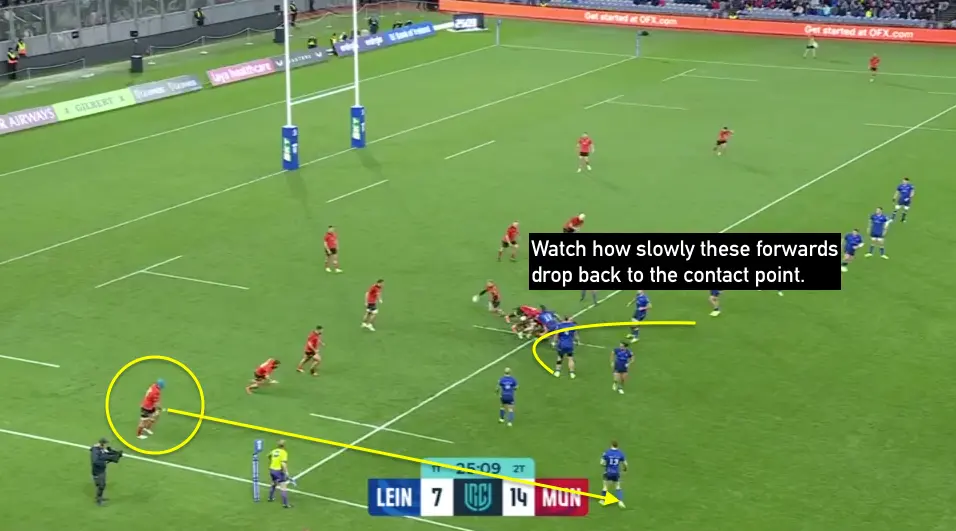
Look at how it plays out.
Pressure, winning races, winning physical battles and the best player in the world in 2025 doing what he could probably do in his sleep.
It was a constant pattern.
Kick to pressure, two per tackle, only go after a jackal if it’s really on or if you’re Tadhg Beirne.
Because when you’re Tadhg Beirne, it’s always on.
***
A lot of our defensive pressure was built on a deep understanding of how Leinster like to run phase play, when they are forced to do it outside of their 10m line.
Their biggest weapon in this regard is the passing speed and range of Jamison Gibson Park, along with the power and linking skillsets of Furlong and Snyman. We know all about it, after Gibson-Park destroyed us inside the first half an hour in Croke Park last season.
But even then, you’ve seen it constantly; long flat pass to Furlong and Snyman (or Lowe) outside of the defence’s “C” defender — teams tend to align in threes off a ruck to match up with an opposition pod, and Gibson-Park is very good at finding the outside man on that pod at speed. They win the collision, find an offload, and they’re away.
This is a good example. Leinster are showing a three-pod — or close to it — with Furlong attacking a gap around 10m away from Gibson-Park. He knows that JGP can find him in that spot, but it’s bait.
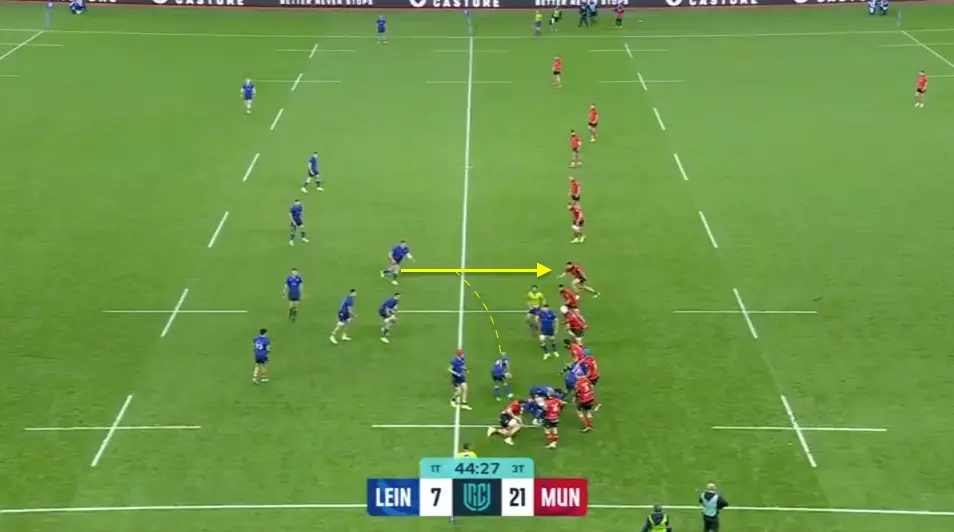
Munster are expecting it.
Barron and Coombes close the door with a choke tackle — off an excellent stop by Lee Barron — to hold up Furlong, knowing that he’s isolated by default.
Win the physical battle, fan out behind the choke tackle to stop the offload over the top, and maul them up.
We went after this tactic over and over again. This is another example, even though we just missed out on the turnover. We swarmed on the 10m pass, held up the runner and almost got the reward.
But when you know that 10m+ pass from the base is coming, you can also decide to attack the ball in the air between the ruck and the most usual target when you have time to see it coming.
If you time it right, who knows what might happen?
This is a perfect example of deep scouting, a defence coach identifying what’s important and then the head coach tailoring the game plan to suit.
The players were empowered with exactly what they needed to win and asked to deliver — and they delivered in spades.
***
The focus on Jack Crowley vs Sam Prendergast in the build-up was predictable. Without wanting to sound too churlish, so was the outcome.
For me, Jack Crowley was and is the more complete player of the two, and I think it will remain that way for some time. Had the scorelines been reversed, the same would be true. Jack Crowley seemed deeply aware of the narrative stakes, and it was clear that he wasn’t going to be overawed by the challenge. If it’s possible to alter Andy Farrell’s best laid plans, Jack Crowley did just that.
He became undeniable.
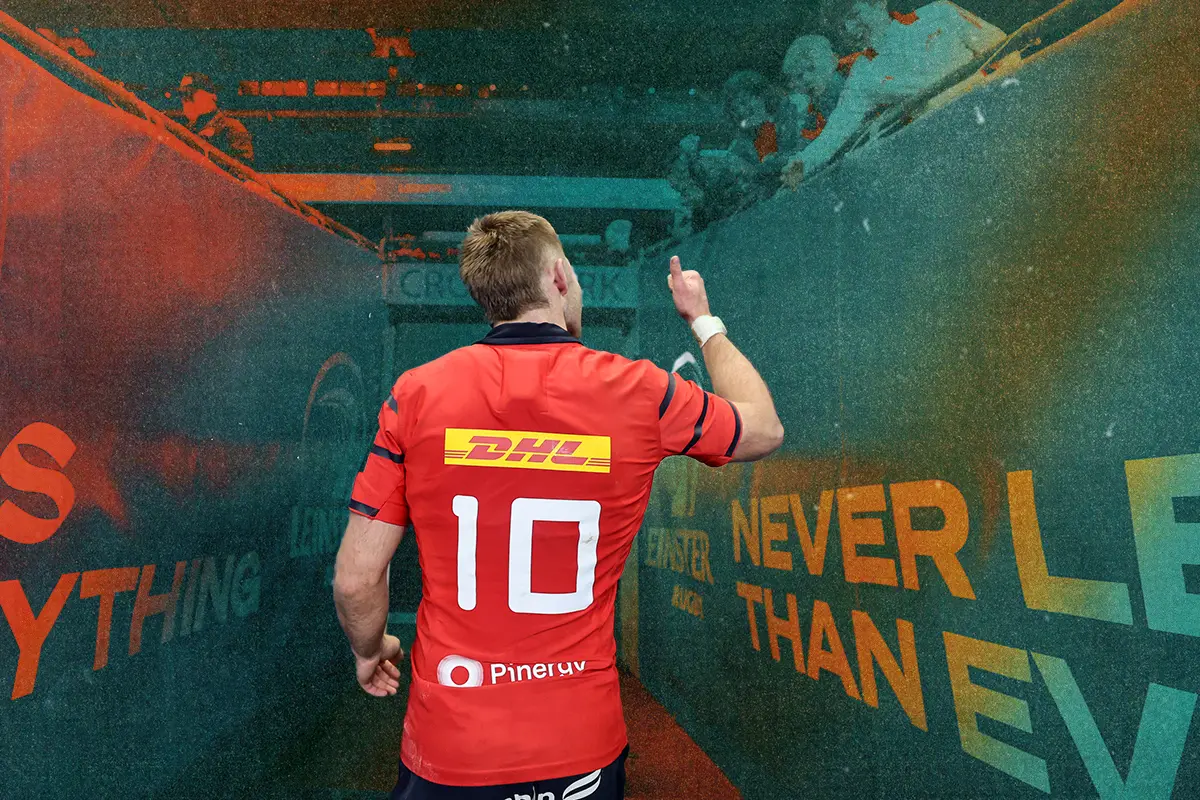
What was most pleasing to me was that, while he was aware of the stakes, he didn’t overplay. He picked his spots. He managed the game plan incredibly well.
Sure, you had the moment for Tom Farrell’s outstanding try; that kick has to be perfect, and it was. But that’s a scripted play — another good sign for Munster — and you’d back a guy with his talent to execute that.
What impressed me was Crowley showcasing how much he’s grown his game since last season.
When Crowley came back from the Ireland tour, he was determined that he was going to remodel aspects of his game. Mentally, tactically and physically. He looks leaner, he’s playing noticeably lighter, and that’s giving him real evasion in the backfield. If you were watching his Instagram in the off-season, you would have seen him working on just that.
You can see the results here;
I was watching this back and thinking wow, that’s great until I realised he exited there with his left. Isn’t Crowley a right-footed kicker?
He is!
I looked back at some of his crossfield kick attempts — one of many, another identified Leinster weakness — and he attempted those, along with the chip to Farrell with his right foot.
But then, as the game matured and we needed to hem Leinster into their own 22, I saw him consistently kicking off his left with real power and accuracy. The first one here I included because it was so well executed — and off his right — but the others were all with his left foot.
He’s always been really good at responding to video analysis, and this addition to his game makes him a more difficult player to stop.
Which side do you charge at in space for a block down?
It doesn’t matter. He can kick well with either now. The right foot is a little more accurate, as you’d expect, but that alone shows what a manic worker he is. Become two-footed, add more evasion to your game, more speed, and keep everything else.
As I said, undeniable.
***
Narrative was going to shape this game regardless of the result, so we can’t shy away from that. There’s a universe where we lose this game 31-14, and the general media reaction is, see? This is why Andy Farrell doesn’t select Munster players. That point is still there, lingering in the background, and hasn’t gone away. It’s just sitting in that awkward silence you always hear when people realise they can’t keep the same energy.
So if you’re wondering why this win felt so cathartic, it’s that. Munster fans — fuck it, Munster players — see and hear all the digs, big and small, that come their way around test windows and defeats to Leinster. So when you talk about disappointment with Andy Farrell’s selections and channelling that, you’d have to, firstly, be surprised at only four Munster players making his squad. Nobody was.
And that, in a way, was freeing.
Forget about Andy Farrell. Forget about Ireland. This is about you. As a player, as a man.
They don’t rate you? Fuck them. Leave a little extra on a tackle here, another one there.
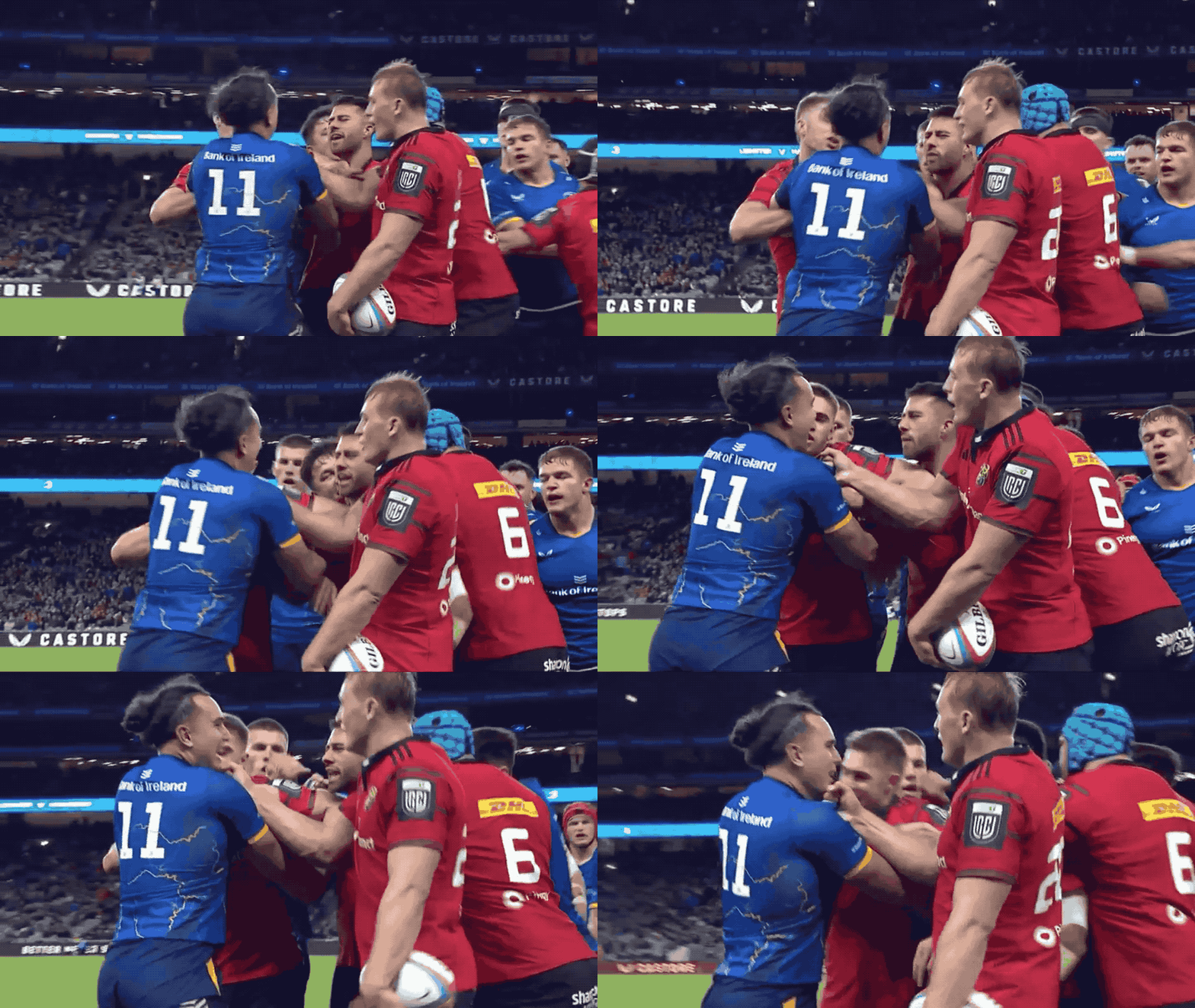
When I saw Brian Gleeson starting a scrap right after Leinster’s opening score, I knew that we’d be there or thereabouts. A bad start, sure, but we knew it.
That’s the kind of “fuck you” attitude and venom I wanted to see, regardless of the result. The only way you’ll win respect in this game is out there. The only way you’ll put respect into a team that fundamentally does not respect you is to beat them, yes, but to rattle them physically and mentally.
Anthony Foley passed away nine years ago last week, and when I saw Gavin Coombes running off the field after a yellow card that sealed a consolation try to end the game, I thought about what Foley used to say.
We’re better when we’re bitter.

| Players | Rating |
|---|---|
| 1. Mikey Milne | ★★★★ |
| 2. Diarmuid Barron | ★★★★ |
| 3. John Ryan | ★★★★ |
| 4. Edwin Edogbo | ★★★★ |
| 5. Fineen Wycherley | ★★★★★ |
| 6. Tadhg Beirne | ★★★★★ |
| 7. Jack O'Donoghue | ★★★★★ |
| 8. Brian Gleeson | ★★★★ |
| 9. Ethan Coughlan | ★★★★★ |
| 10. Jack Crowley | ★★★★★ |
| 11. Thaakir Abrahams | ★★★★ |
| 12. Dan Kelly | ★★★★★ |
| 13. Tom Farrell | ★★★★★ |
| 14. Andrew Smith | N/A |
| 15. Shane Daly | ★★★★ |
| 16. Lee Barron | ★★★★ |
| 17. Jeremy Loughman | ★★★★ |
| 18. Ronan Foxe | ★★★ |
| 19. Jean Kleyn | ★★★★★ |
| 20. Gavin Coombes | ★★★★★ |
| 21. Paddy Patterson | ★★★★ |
| 22. JJ Hanrahan | ★★★ |
| 23. Alex Nankivell | ★★★★★ |
There’s a very high bunch of ratings there, and I’ll focus on them in the Five Star Podcast, but I want to spend a little bit of time on Tadhg Beirne.
This was his first game after a long break, after a summer where he was named the Lions Player of the Series, off the back of another outstanding season for Munster and Ireland. One thing is clear: when you watch Tadhg Beirne in 2025, you are watching genuine greatness.
He is, arguably, one of the all-time Irish greats already. When it comes to what he’s capable of on a rugby pitch, how game-altering he is, his true peers are all retired. He is up there with O’Connell, Sexton, O’Gara, Wood, and O’Driscoll. That’s how good he is: a generational talent who was delivering pizzas in Dublin until he backed himself to go to Llanelli, and then become the best player on the planet.
Tell me who’s been better than him this year? There is nobody close. Is he a lock or a flanker? Who cares. Wherever he plays, he’s almost always the best player on the field.
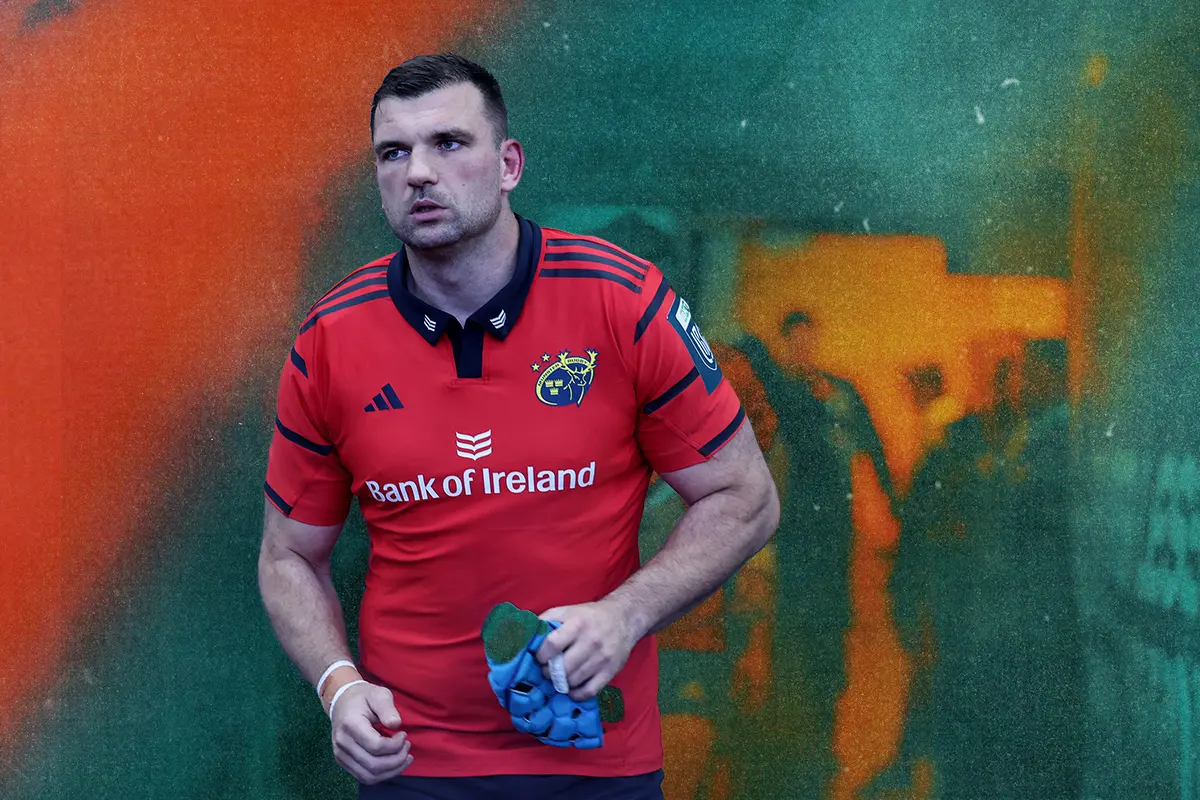
This performance from Beirne is up there with some of the best displays I’ve ever seen in the context of the game. There was a spell in the second half where he forced three turnovers in five minutes. Insanity. He turned Leinster back over and over again. He’s down for 14 tackles, almost purely because he missed 10 minutes for a HIA.
Recognise it, because true greatness doesn’t come along all that often and in this game, you saw the best player on the planet in 2025 turn a game on its head. Unplayable, elite, and already assured of being one of the best Irish athletes of all time.
★★★★★
Digestible Stats to Repeat to your Friends
Red-zone ruthlessness. Munster had 8 entries to Leinster’s 11 but posted 3.5 points per entry (vs 1.2). That’s ~28 points off entries alone and a 62.5% scoring rate (5 scores from 8), with tries on 50% of entries (4/8). Leinster managed ~18% (2/11).
Linebreak quality over volume. From far fewer phases, Munster produced 7 linebreaks to Leinster’s 4. Using our LBR rating on the €10 tier to assess it: Munster: 0.1207 LineBreaks per Ruck (12.07 per-100 rucks) on 58 rucks; Leinster: 0.0305 (3.05 per-100) on 131 rucks. Big edge in strike efficiency.
Defensive squeeze. Munster made 239 tackles at 93% (Leinster 95 at 86%). This is the off-ball stat to look for, along with the kicking. We slowed Leinster’s ball: only 44% of Leinster rucks were 0–3s, with 56% at 3s+—enough to blunt their phase attack and keep breaks to a minimum despite 178 carries.
Turnover game. Munster won 10 turnovers and conceded 10; Leinster won 5 and conceded 15. That’s a +5 steals edge and five fewer cough-ups—massive possession swings that fed those efficient entries.
Kick-led control. Munster kicked 28 times (KT:P 1:3.3) to Leinster’s 13 (KT:P 1:17.9). We traded possession for territory/pressure, forcing Leinster to build from deep and into slower rucks, then struck off transition/first-phase.
Set-piece survived, not won. Munster were 67% on our own scrum (8 taken) and leaked penalties on Leinster’s put-in constantly, but we ran at 100% lineout (9/9) and spotless on restarts received (6/6). Leinster’s 16/16 lineout didn’t translate — again pointing to our maul/goal-line defence and post-set containment.
Territory ≠ scoreboard. Leinster owned 63% territory and most of the ball (233 passes vs 93), but our combo of fast rucks when we attacked (51% at 0–3s), kicking volume, and red-zone accuracy flipped the outcome and bonus point.
***
