So it’s the week of the first test.
I think that for Andy Farrell, the last few weeks have been pretty painful. Having covered Farrell, his decisions and his methods in great detail for the last four years, I think he’s a coach who lives and dies by the ends justifying the means. He has taken a generally unpopular and divisive squad selection strategy (outside of Leinster) for the Ireland squad and justified it over the last few years with mostly good results.
Other Tier 1 test countries tend not to build around one club, because of the risks involved with turning their ecosystem into a toxic mess. The All Blacks, for example, could have benefited from making the Crusaders into their test side post 2017. They resisted that temptation because (a) the NZRU does a better job of moving talent around and (b), having spoken to journos and coaches working there, they understand that the All Blacks jersey, and, more importantly, the players wearing that jersey, have to represent all of New Zealand. There’s no better way to get everyone on board than by, well, trying to get everyone on board. When you don’t, it creates an internal pressure where everyone, internally and externally, is aware that the team doesn’t represent most of the environment it purports to, which can lead to viewing results as a means to keep the status quo, as opposed to winning for winning’s sake.
Andy Farrell has gone a different route, both with his Ireland squad post 2021 and with this Lions tour, with his self-perpetuating reliance on Leinster Rugby, something that has had such a knock-on effect on the financial ecosystem within the IRFU that radical change had to be brought in to counter-balance the funding imbalance than naturally followed from those selection policies.
Unhappiness with Farrell’s reliance on Leinster stretches well beyond social media in the Irish rugby system, deep into the halls of the IRFU, something Farrell and his team are well aware of, despite their claims to the contrary. When Ireland are successful, the noise stays at a level that can be lived with. When Ireland lose, however, Farrell feels the pressure instantly, which is why his usual strategy is to double down on a Leinster depth chart or academy player when basic common sense would tell him that it would be better to get a starter in from another province. He knows that, when it comes to it, system familiarity gets the job done, or usually has done. It’s all he knows.
For Farrell and the coaches around him, that Leinster player will fit better in training because he already knows most of the squad from a personal and game sense perspective, and so will better prepare the team to win on Saturday during the week of the game. Cohesion begets cohesion begets more cohesion. And it has been successful, for the most part, which is Farrell’s only remit, something he has been at pains to point out. Ireland win more important games than they lose, and that’s all that matters. The ends (Ireland winning) justify the means (having match day squads that have 16+ Leinster players in them).
This is a fundamentally logical strategy by Andy Farrell, and it has allowed Ireland to punch above our weight, relatively speaking, during his coaching tenure, even though it comes with serious risks and longer-term downsides. In all likelihood, those downsides will be for someone else to untangle.

The big challenge for Andy Farrell as Lions coach, however, was to build a system that doesn’t rely on a core group of 11/12 players who play and train with each other all year round. It’s been a struggle for him.
Farrell’s way of attacking with the ball in hand is incredibly complex, as we’ve been through on these pages extensively, so players that are used to playing this system for the last five years have a natural advantage in knowing what to do, when to do it and how to do it all at the kind of pace that you need to win test matches. Being 5% off is enough to look like a no-hoper in this system, and that comes with a cost when, in theory at least, the Lions are meant to be the best of the four nations on These Islands.
That cost is the knowledge of what you have to do to win, what you know works and is essentially the only way you know how to run a test side weighed up against the political damage internally and externally it will do if that leads to 10 or more Irish players playing in the test this weekend. In that context, Farrell has done it again in building internal pressure on both himself and his team.
Almost the entire coaching staff is from the Irish national side, and as of Tom Clarkson’s callup, there are now 18 Irish players in the squad, the second most players from one country in any Lions squad in recent history, one more than the 17 Welsh players who toured New Zealand with the Lions in 1971 but two less than the 20 English players Clive Woodward took to New Zealand in 2005.

Clarkson and Osbourne have been controversial call-ups, but they make sense if you know how Farrell operates. They will help the Lions train better this week, which will make Farrell feel more secure about Saturday’s first test. Those call-ups bring a lot of scrutiny with them, especially when viewed through the lens of how many Leinster players are already on tour and the recent call-up of Owen Farrell.
If the test side has more Irish players than the 13 English players who featured against the All Blacks in the first test of the 2005 tour, Farrell risks his means not being able to cover the ends.
Win and, like at home, the noise will stay at manageable levels where the end can justify the means.
Lose, and it would be framed as a uniquely Irish Lions loss in a way that would make World Cup quarter-final exits look like a fun run where everyone gets a medal.
***
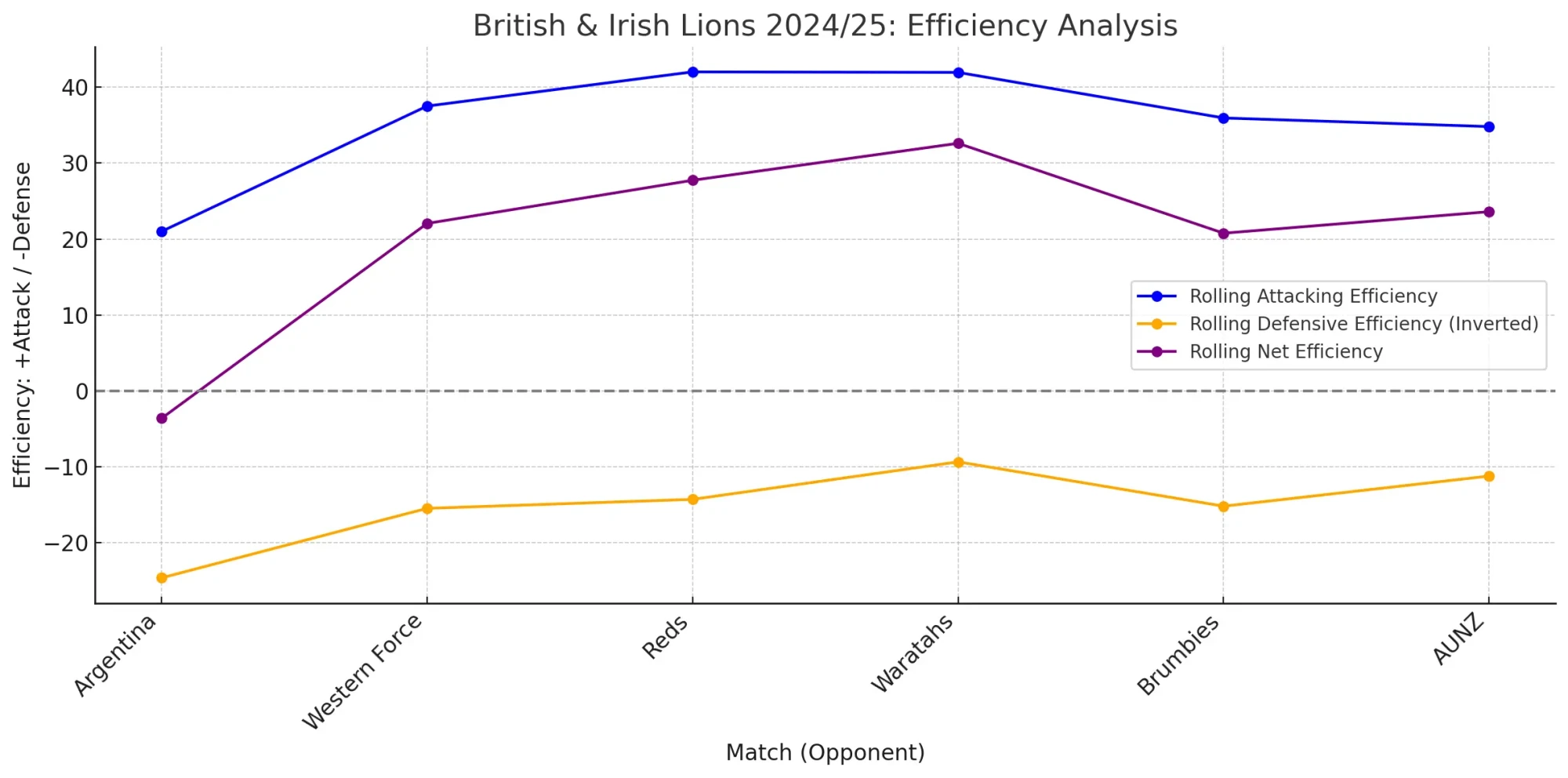
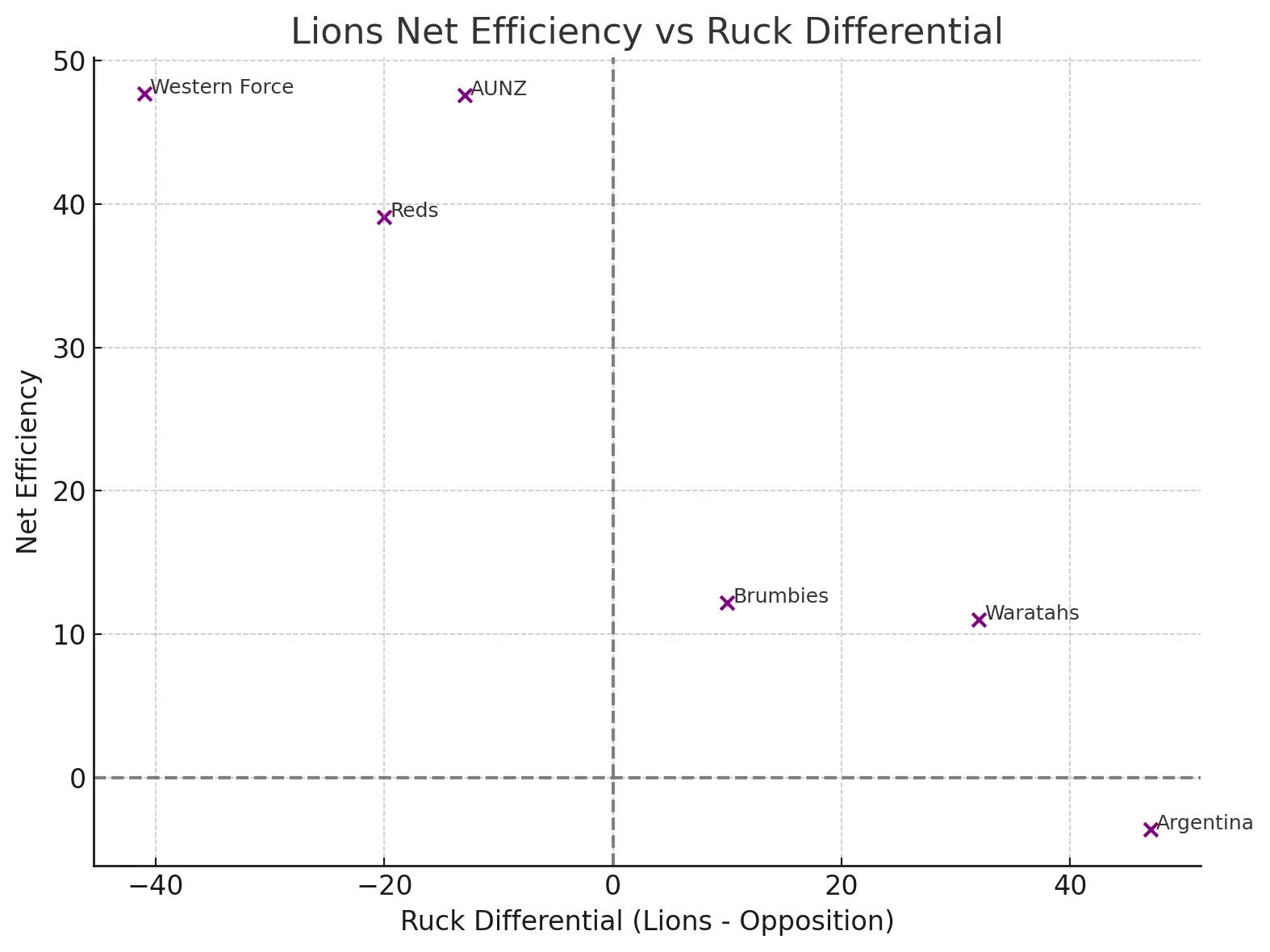
On the €10 tier in the last week, I’ve been trialling a new metric called Net Efficiency, where I plot a team’s rolling efficiency to visually track a team’s efficiency in the core parts of this game – getting into the opposition’s 22 and scoring, while preventing them from doing the same.
In a general sense, here’s what the different line colours represent.
Blue Line – Rolling Attacking Efficiency: This line shows how well a team turns attacking opportunities inside the opposition’s 22 into points over time.
A rising blue line means the team is finishing chances well — they’re clinical when it counts. A falling blue line suggests they’re getting into good positions but not converting pressure into scores.
Think of it as a measure of how sharp a team is with the ball in the red zone.
Orange Line (Inverted) – Rolling Defensive Efficiency: This line tracks how many points a team is conceding per opposition entry into their own 22 — but it’s flipped upside-down (inverted) on the graph.
When the orange line drops, it actually means the team is doing well defensively, giving up fewer points. When the orange line rises, they’re struggling; opponents are turning pressure into points too easily. This gives a visual sense of defensive resilience, but because it’s inverted, lower on the graph is better.
Purple Line – Rolling Net Efficiency: This is the key line, it combines attack and defence into a single figure:
Net Efficiency = Points scored per entry – Points conceded per opposition entry
A purple line above zero shows the team is out-performing opponents in the red zone, a good sign of control and effectiveness. A line below zero means they’re leaking more than they’re producing, which is a warning sign, even in close games where you might win.
It’s essentially a “balance sheet” for red zone rugby that goes beyond wins and losses.