



If you want to know the shorthand for this win, it’s this: Ireland navigated the weather conditions better than Georgia with an infinitely more accurate kick chase and were far more efficient in the 22 when it counted.
That’s the headline. It doesn’t get any more complicated than that. There’s an irritating tendency amongst the Irish Rugby bubble to sometimes paint teams like Georgia, who have a particular superstrength rooted in physicality – the scrum in this case – as being somehow less intelligent than we are. You’ll see a lot of headlines – what little there’ll be this week with the Lions and the GAA – essentially painting this as clever Ireland outsmarting the muscle of Georgia, but that isn’t really what happened.
Georgia knew what they had to do, it’s just their execution on both the kicking and backfield coverage side of the game was well off where it needed to be. Not a lack of smarts. It was a difference of 5/10m per kick when it counted, and that did the damage.
***
Here are the kicks that Ireland used to dominate territory and position when it counted. Perfectly executed mid-range contestable kicking in the “drop zone” behind the Georgian’s primary defensive line and around 10m in front of their backfield coverage, who had dropped deeper to take what they had expected to be longer, raking counter-transition starters.
Did Georgia assume Ireland would kick long to avoid an uptick in scrummaging? It was a fair assumption to make on the Georgian’s part, but Ireland found a lot of joy aerially through Stockdale, Tommy O’Brien and Osbourne (who played almost like a second fullback rather than a role-specific outside centre) when kicking to the mid-range.
This kick from Casey inside the first minute, for example, was right into that drop zone, and when Ireland retained possession, they were able to slice through the retreating Georgians.
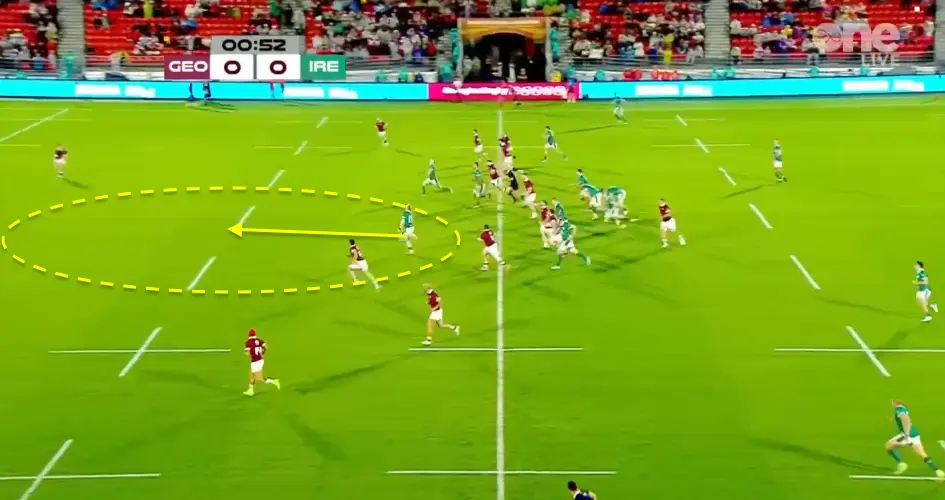
The position that led directly to the second try came from this kick over the top from Prendergast to, once again, the chasing O’Brien, who scragged the ball through and forced the Georgians to concede a 5m scrum.
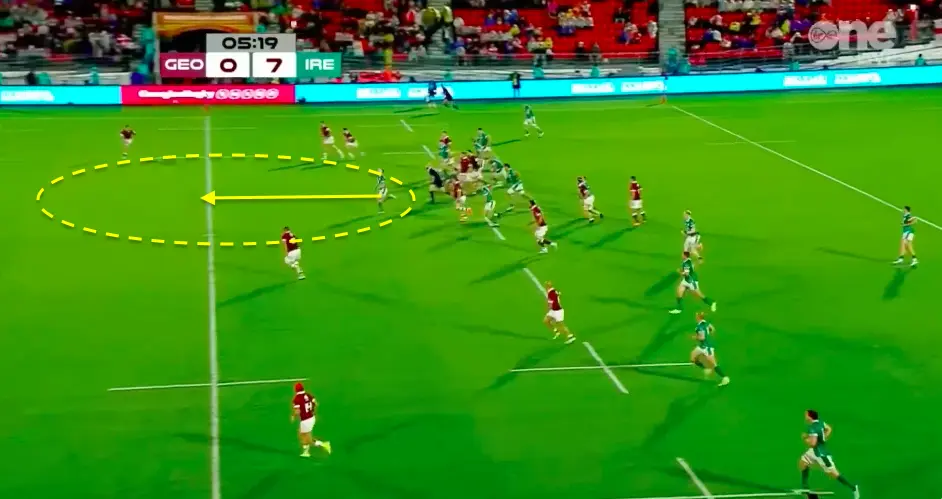
Ireland converted that entry into a try, and, all of a sudden, it was 14-0. The Georgians had a mountain to climb in weather that made position and territory the most valuable asset; the only problem was that the Georgian halfbacks couldn’t get the ball in the zone it needed to be in to force the kind of scrappy ball that might have given their team a way into the game.
Go back and look at those Irish kicks again – look at where they land. How difficult it is for the Georgians to get to the ball, and how “on the line” the Irish chasers are. The Irish chasers are running under the line of the ball and getting to the drop at the same time as the receivers, if not before in some cases.
Now look at these Georgian kicks;
What do you notice?
All of those kicks are too long by maybe 5/6 metres. Any kicks that aren’t directly retained and marked by the Irish backfield are in a position where they can’t realistically be competed for, either because of an isolated chaser or because the chaser isn’t a realistic aerial competitor.
This is a really good example of what I’m talking about, and it led to the killer third try for Ireland.
Watch the kick and ask yourself if (a) the kick is too far and (b) if your flanker is the right guy to be leading the contest?
From there, Ireland ran in a superb try on kick transition – one of the few we’ve managed all season – and the game was gone for the Lelos.
Georgia had a semblance of dominance in the scrum, as you might expect but most of their lineout possession was to the front given the weather conditions, so they couldn’t really do all that much with it, despite two nicely taken mauls that should have yielded more reward than the five points they ultimately earned.
Without regular access to Ireland’s 22 off the back of their inability to find position through the kicking game, the contest fizzled out. Georgia weren’t able to force penalties at the volume they needed to compensate, so we saw out a comfortable win.
Most of the things I was worried about pre-game were defanged by the weather. There wasn’t much scope to overplay in the way that the Lions have seen in their warm-up games, so Ireland played a 1:3.2 kick-to-pass ratio game with just 68 rucks. So while the Pass Per Carry ratio was high, it reflected Ireland’s transition work rather than overplaying ruck to ruck.
At the lineout, O’Connell seems to have used the last two weeks to find different ways to get Ryan Baird up as the primary jumping option to cut down on the complete lack of cohesion this pack had. If the only call is “lift Ryan Baird” then it’s very hard to go wrong, and so nothing did go wrong. Simple.
A game that could have been a proper landmine ended up being nicely routine and even a little dull. Exactly as the doctor ordered for a mid-Lions mid-summer tour game in torrential rain. The key here was making sure this game was forgettable, and Ireland delivered that perfectly.
Onto the next.
| Players | Rating |
|---|---|
| 1. Jack Boyle | ★★★ |
| 2. Gus McCarthy | ★★★ |
| 3. Tom Clarkson | ★★★ |
| 4. Cormac Izuchukwu | ★★★ |
| 5. Darragh Murray | ★★★ |
| 6. Ryan Baird | ★★★★ |
| 7. Nick Timoney | ★★★★ |
| 8. Gavin Coombes | ★★★★ |
| 9. Craig Casey | ★★★★★ |
| 10. Sam Prendergast | ★★★★ |
| 11. Jacob Stockdale | ★★★ |
| 12. Stuart McCloskey | ★★★ |
| 13. Jamie Osbourne | ★★★★ |
| 14. Tommy O'Brien | ★★★★ |
| 15. Jimmy O'Brien | ★★★★ |
| 16. Tom Stewart | ★★★ |
| 17. Michael Milne | ★★★ |
| 18. Jack Aungier | ★★★ |
| 19. Tom Ahern | ★★★ |
| 20. Max Deegan | ★★★ |
| 21. Ben Murphy | N/A |
| 22. Jack Crowley | N/A |
| 23. Calvin Nash | ★★★★ |
