


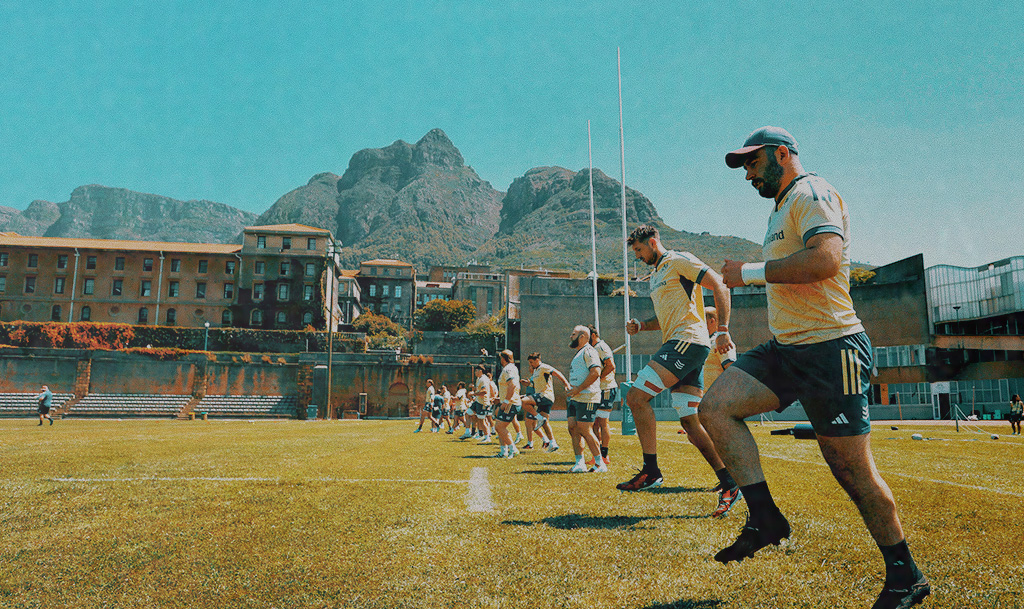
The squeeze has come a little early this year.
Travelling to South Africa for a league game is never easy. Your travel can be simple or complicated, comfortable or a total nightmare, but it doesn’t change the immutable fact that, at the end of the week, you will be playing in a hostile environment against massive, equally hostile human beings.
That was true when it came to playing the Southern Kings and Cheetahs back in the old PRO14 days, and it’s even more true now with the traditional Big Four.
After the week that was – Leinster, Croke Park, Bad Start, Inaccurate Finish – getting on a plane Monday was probably the best thing for the squad. Not ideal, certainly, but far from the worst thing given how the annual defeat to Leinster in the regular season can fester. That doesn’t change the fact that a response is needed after that loss, but it changes the location of where that response has to happen. Away from the noise. Away from the press hoopla. Away from the looks in Dunnes.
I sometimes feel that this team plays their best rugby on the road as long as that road is outside Ireland, so that kinda matches up with what I hope will be a good tour.

At this stage, putting expectations on points totals for this tour feels counterproductive. We have to see how the rubber hits the road. The Stormers have been poor this season so far – beyond poor by their standards – but this is their first home game of the season. With the Sharks loading up on Springboks the way I load up on sausages and hash browns at a breakfast buffet, next week is already looking like a tall order so maybe this week is the week to get the bulk of the points we want from this tour.
The squeeze is on, sure, but there’s still plenty of wiggle room. I think a 5/6 point South African tour with that travel out of the way before Christmas would be a great result. Let’s see how we handle the pressure.
Munster: 15. Mike Haley; 14. Calvin Nash, 13. Tom Farrell, 12. Alex Nankivell, 11. Shane Daly; 10. Jack Crowley, 9. Conor Murray; 1. Jeremy Loughman, 2. Niall Scannell, 3. John Ryan; 4. Jean Kleyn, 5. Tadhg Beirne (c); 6. Tom Ahern, 7. Alex Kendellen, 8. Jack O’Donoghue.
Replacements: 16. Eoghan Clarke, 17. Kieran Ryan, 18. Stephen Archer, 19. Fineen Wycherley, 20. Ruadhán Quinn, 21. Ethan Coughlan, 22. Billy Burns, 23. Seán O’Brien.
DHL Stormers: 15. Warrick Gelant; 14. Suleiman Hartzenberg, 13. Ruhan Nel, 12. Dan du Plessis (c), 11. Leolin Zas; 10. Damian Willemse, 9. Paul de Wet; 1. Sti Sithole, 2. Joseph Dweba, 3. Neethling Fouche; 4. Adre Smith, 5. JD Schickerling; 6. Marcel Theunissen, 7. Ben-Jason Dixon, 8. Keke Morabe
Replacements: 16. Andre-Hugo Venter, 17. Brok Harris, 18. Sazi Sandi, 19. Ruben van Heerden, 20. Dave Ewers, 21. Louw Nel, 22. Herschel Jantjies, 23. Jurie Matthee.
The Stormers seem to be in the middle of quite a considerable style change when compared to last season.
I would have been comfortable labelling the Stormers a high-kicking volume, medium-range PPC counter-transition team that verged on off-ball, at times. That is to say, when you watched the Stormers last season you would be most likely to see them kicking quite frequently and playing no wider than off #10.
Nobody played past the second receiver less often than the Stormers did in the URC last season, and that’s with 90% of their team movement going to the openside of any given ruck across the season. The reason for this is obvious; they have big, heavy runners when they’re at their best and they are very good at getting over the gainline. Only the Bulls had better success on the gainline than the Stormers last season.
But that did not translate to a successful season for them.
They finished outside the top four for the first time since the URC was founded and lost their away quarter-final to eventual champions Glasgow.
What has Dobson changed this season?
Well, on the evidence of the first three games of the season, the Stormers look like they’re becoming an on-ball side. They have all the hallmarks of it. Their kicking numbers – by volume and relatively – have plummeted. They have kicked less often than their opposition in every game so far this season. As a result, the number of tackles they’re making has also plummeted because, as logic would dictate, they are not kicking the ball to the opposition at the same frequency so they are defending less often.
We know this well from our first year under Prendergast’s attacking system.
So why have they been struggling? Without counter-transition kicking to fuel their attack, their Clean Breaks and Defenders Beaten numbers have cratered. What does this mean? That teams are kicking to them but then stopping them on offensive transition, forcing them into settled phase play and then forcing errors. They are still offloading at the same rate as previously, but it’s not proving effective so far because they have the most turnovers lost in the league so far.
We know what that’s like too.
Dobson’s reasons for making this change are sound. The Stormers had an excellent, penalty-generating scrum last season that would translate really well to an on-ball game that, usually, brings an extra load of scrums. More scrums = more penalties generated and when you consider that they also have a fantastic lineout – the best in the URC this season – you can start to see how that style would suit what they have on the field.
As well as that, do you want Mannie Libbock and Damian Willemse engaging in kick transition battles or playing on multi-phase looking for gaps and mismatches against a defence that has to deal with runners like Roos, Ben Jason Dixon and any other number of massive lads that you care to mention. They have the pace and creativity to be kicked to often – they want this – and the power up front in the loose and the set piece to make it work physically.
It’s a sensible change for Dobson but it will bring teething problems, as I think they’ve already seen so far this season.
For Munster, it makes complete sense for us to sit back and try to off-ball the Stormers. We know what that feels like as a team who typically like to play on-ball rugby.
Oh, you want to play multi-phase and not kick? Then have all the phases in the world!
I had hoped during the week that Munster would roll out the “off-ball” build for this game and it seems like they have. In that context, what we need to do is pretty straightforward; have a kick-to-pass ratio of around 1:3 and a pass-per-carry ratio of around 1.3/4. Play very conservatively in the scrum – no penalties – and get after their lineout with one or two pods early and often, led by Ahern.
From a kicking perspective, we shouldn’t be afraid of getting the ball off the field against this team. Their lineout has been fantastic but it’s also mostly been unchallenged. There are coins to be rifled out of it, I think.
The key is to kick in the mid-range – contestably – before going diagonally over the top onto Leolin Zas and Suleiman Hartzenberg while looking to stretch Warrick Gelant’s positioning at all times.
The Stormers’ defence coach, Norman Lake, has a similar defensive philosophy to Felix Jones and Jacques Neinaber – it’s why he was in contention for the English defence coach gig as of late – so the same offensive plays that worked against Leinster will also work here. But with a few key differences; the first one being that their edge coverage isn’t great.
They will press really hard and really narrow but the ability of their midfield to cover those big openside spaces leaves a bit to be desired, and their wings lack positional disciple.
You can see Zas and Willemse lose themselves on this relatively straightforward kick because they have so much space to cover outside the last primary defender.
They also lack clarity in their backfield management so you can often find spaces to easily kick into like this;
If Thompson got a better bounce on this, he would have put Gelant under massive strain. The positioning and awareness is awful but you’ll often find the Stormers leaving massive space in the backfield behind their wingers as they press, usually asking a lot of either Willemse or Gelant when it comes to coverage.
This kind of space will be there all day for Murray and Crowley to get after and both of the Stormers’ wings have a positional slip-up in their locker.
The Stormers are unusual in that they want to be an on-ball team – on the evidence of the first few games – but still defend like a high-kick volume counter-transition team. There are huge opportunities for us to strike when we choose to go. Edinburgh turned the ball over here but you can see the principle of Stormers’ press.
A little more accuracy and we can unlock them, especially if they’re engaging in long sequences of phase play, and especially later in the game. This kind of opportunity and structure – heavily overloaded wings in the layers – will work a charm against this Stormers’ defence, but we have to be more accurate than we were last week.
Do it right, and a win is more than achievable. We’ll need patience, a functioning offensive and defensive lineout and good decision-making around the breakdown. If we can do that, opportunities will present themselves. It’s up to us to take them.
